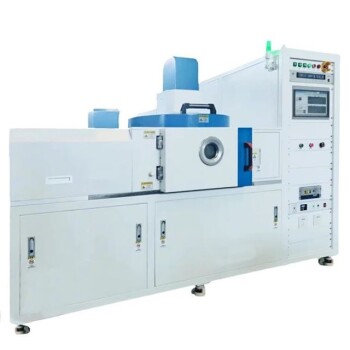
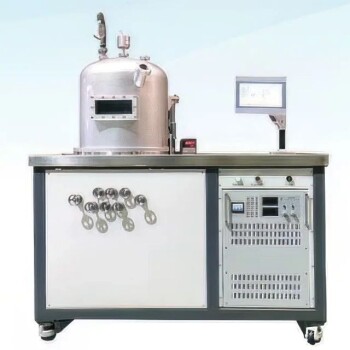
Chemical Vapor Deposition furnace systems are the core enabling technology behind high-performance ceramic matrix composites (CMCs) and advanced ceramic coatings. They provide the precisely regulated high-temperature, vacuum, and gas-flow environment required to transform volatile gaseous precursors directly into high-purity solid ceramics. Without this controlled thermal reactor, achieving uniform thin-film deposition, deep matrix infiltration, and preservation of delicate substrate structures would be impossible.
The central role of a CVD furnace is to create and maintain the exact physical and chemical conditions—temperature uniformity, gas composition, and low pressure—that govern every aspect of ceramic formation. From the infiltration depth in a fiber preform to the grain structure of a wear-resistant coating, the furnace’s precision directly determines the quality and performance of the final ceramic product.
The Chemical Vapor Deposition Process in a Furnace
A CVD furnace is not just a heat source; it’s an integrated process reactor. Understanding its role starts with how it orchestrates the entire deposition cycle.
The Integrated Function of a CVD Furnace
A modern CVD furnace system combines a vacuum-tight chamber, a multi-zone heating array, and a mass-flow-controlled gas delivery system into a single platform. The user first cleans the substrates (or weighs and tees up a porous preform) and places them inside the chamber. The system then purges the atmosphere and establishes a vacuum or a stable background pressure. A carefully metered mixture of precursor gases (for example, methyltrichlorosilane, CH₃SiCl₃, carried by hydrogen or argon) is introduced, and the temperature is ramped to the reaction window—often between 600 °C and 1000 °C for silicon carbide deposition.
From Gas to Solid: Localized Chemistry at the Surface
At temperature, the precursors thermally decompose or react near the hot substrate. The furnace’s job is to keep these reactions confined to the surface, not in the gas phase where they would form unwanted particles. The controlled low pressure and laminar gas flow suppress gas-phase nucleation and ensure the active species diffuse to the substrate. There, they chemisorb, react, and form a solid ceramic film one atomic layer at a time, while by-products are swept away by the exhaust system.
The Critical Role in Ceramic Matrix Composite Fabrication
When fabricating CMCs, the furnace’s role expands from coating a surface to densifying a porous body—a process known as Chemical Vapor Infiltration (CVI).
From CVD to CVI: Infiltrating the Fiber Preform
A CMC begins with a porous preform of ceramic fibers (e.g., SiC or carbon). The furnace must deliver precursor gases deep into this three-dimensional network and cause them to react on the fiber surfaces to build up the matrix. This is the essence of CVI. The furnace’s ability to maintain a steep concentration gradient and a uniform, precisely controlled temperature profile is what drives precursor vapors into the preform’s interior. If the temperature is too high or the pressure too great, the reaction will occur only on the outside, sealing the pores prematurely and leaving the core hollow.
Uniformity and Microstructural Control
Multi-zone heating in a CVI furnace ensures that every part of the preform—whether a thin-walled turbine blade shape or a thick plate—sees the same thermal history. This uniformity prevents density gradients and residual stress. The low-pressure environment (often a few kPa) increases the mean free path of precursor molecules, enhancing deep infiltration and ensuring that the deposited matrix (typically silicon carbide) has a consistent, fine-grained microstructure that is free of cracks and voids.
Delivering Advanced Ceramic Coatings
For coatings, the furnace’s role is to lay down a thin, dense, and highly adherent layer that transforms the surface properties of a component.
Protecting Against Wear, Heat, and Corrosion
Advanced ceramic coatings like SiC, diamond-like carbon (DLC), or silicon nitride are synthesized by the same CVD principle. Here, the furnace must guarantee exceptional film-thickness uniformity across complex shapes, such as cutting tools or turbine blades. The precise regulation of gas flows and thermal profiles allows the operator to tune the coating’s stoichiometry, crystal orientation, and stress state. For example, a carefully graded transition layer can be built by gradually changing the precursor ratio, something only possible with a programmable furnace.
Process Window and Repeatability
CVD furnaces operate in a narrow process window where temperature, pressure, and gas ratio work together. A minor drift could turn a hard, adherent coating into a powdery, non-adherent deposit. The furnace’s closed-loop control on temperature (via multi-zone PID) and pressure (via throttle valves) makes the process repeatable across runs—a non-negotiable requirement for any industrial or research application.
Why Furnace Precision Cannot Be Compromised
Every desired outcome—infiltration depth, coating density, crystal size, and even impurity levels—traces back to how well the furnace controls a handful of parameters.
Temperature Uniformity and Mass Transport
A multi-zone furnace with independent heaters along the tube compensates for heat losses at the ends and ensures a flat thermal profile. In CVI, even a small temperature variation changes the local reaction rate and can lead to uneven matrix growth. In coatings, temperature uniformity translates directly to film thickness uniformity across an entire substrate wafer.
Gas Flow Dynamics and Low-Pressure Operation
Mass flow controllers deliver gases with sub-standard cubic centimeter per minute accuracy. Combined with a vacuum pump and pressure control valve, the furnace maintains the exact low-pressure environment needed to suppress gas-phase nucleation and maximize the diffusion of precursors into porous structures. This is what makes the difference between a continuous, pore-free coating and a granular, defective one.
Contamination Control and Material Purity
The high-purity ceramic components (fused quartz or alumina tubes, vacuum seals) inside a dedicated CVD furnace prevent contamination from the furnace body. Argon or hydrogen purge cycles eliminate oxygen and moisture, ensuring the final ceramic is a pure phase—free of unwanted oxides that could weaken a composite or reduce coating hardness.
Understanding the Trade-offs and Challenges
No technology is without limitations, and CVD furnace processing of ceramics demands awareness of its inherent trade-offs.
Long Cycle Times and High Energy Cost
CVI is slow by nature. Achieving full density in a CMC preform can take weeks of furnace time, as the process must be slowed down to allow diffusion ahead of reaction. This drives up cost and limits throughput. While isothermal and forced-flow CVI variations speed up the process, they still require complex furnace modifications and precise control.
Line-of-Sight and Complex Geometry Limitations
Although low-pressure operation helps, deep, blind holes and highly tortuous paths can still suffer from poor infiltration or coating starvation. The furnace’s gas inlet geometry and flow pattern then become critical design variables, not afterthoughts.
Precursor and By-Product Management
Many precursors (like SiCl₄) generate corrosive by-products (HCl). The furnace’s exhaust system and trap design must handle these without corroding the hardware or affecting the vacuum pump. Failing to manage this aspect can lead to contamination or equipment failure.
Making the Right Choice for Your Process Goal
Selecting or designing a CVD/CVI furnace system must be driven by the specific demands of your ceramic material and component.
- If your primary focus is densifying ceramic matrix composites: Prioritize a furnace with large isothermal zone, precise low-pressure control (1–10 kPa), and uniform precursor gas distribution to maximize infiltration depth and matrix homogeneity without prematurely sealing the preform.
- If your primary focus is depositing hard, wear-resistant coatings: Look for a system with rapid thermal cycling capability and excellent temperature uniformity to manage coating stress and adhesion across complex part geometries.
- If your primary focus is high-purity thin films for electronics or optics: Ensure the furnace uses high-purity chamber materials, has a leak-tight design, and can maintain an ultra-clean background environment to prevent any metallic or oxygen contamination.
- If your primary focus is research and development of new advanced ceramics: A flexible, multi-zone tube furnace with multiple gas lines, plasma enhancement capability, and a sliding stage for fast heating/cooling will give you the widest parameter space for experimentation.
The CVD furnace is far more than a simple oven—it is a precision synthesis tool that directly translates control over physical parameters into the microstructural quality of the ceramic. Understanding that connection is what unlocks its full potential for both CMC fabrication and advanced coating development.
Summary Table:
| Process / Application | CVD/CVI Furnace Primary Role | Key Controlled Parameters |
|---|---|---|
| CMC Densification (CVI) | Infiltrates 3D fiber preforms to build matrix without premature surface sealing | Multi-zone temperature uniformity, low pressure (1–10 kPa), precursor gradients |
| Ceramic Coatings (CVD) | Synthesizes dense, highly adherent thin films (e.g., SiC, DLC) on complex shapes | Laminar gas flow, thermal profile, stoichiometry, surface reaction kinetics |
| High-Purity Thin Films | Eliminates atmospheric contamination to produce pure, defect-free ceramic phases | Vacuum-tight chamber integrity, gas purge management, precise PID temperature control |
Elevate Your Advanced Ceramic Processing with KINTEK
Ready to achieve maximum density and precision in your composite fabrication and surface coating workflows? KINTEK specializes in premium laboratory equipment and consumables, delivering custom-engineered high-temperature furnace systems—including state-of-the-art CVD, atmosphere, vacuum, tube, and muffle furnaces.
Whether you are scaling up industrial CVI processes or developing novel thin-film ceramic coatings, our fully customizable furnace platforms guarantee the precise thermal profile, pressure integrity, and atmosphere control your research demands.
Contact KINTEK today for a tailored quote and expert guidance!
Related Products
- Custom Made Versatile CVD Tube Furnace Chemical Vapor Deposition CVD Equipment Machine
- Slide PECVD Tube Furnace with Liquid Gasifier PECVD Machine
- Multi Heating Zones CVD Tube Furnace Machine for Chemical Vapor Deposition Equipment
- RF PECVD System Radio Frequency Plasma Enhanced Chemical Vapor Deposition
- HFCVD Machine System Equipment for Drawing Die Nano Diamond Coating
People Also Ask
- Why are CVD tube furnace sintering systems indispensable for 2D material research and production? Unlock Atomic-Scale Precision
- What is a CVD tube furnace and what is its primary function? Discover Precision Thin-Film Deposition
- Which industries and research fields benefit from CVD tube furnace sintering systems for 2D materials? Unlock Next-Gen Tech Innovations
- How does CVD tube furnace sintering enhance graphene growth? Achieve Superior Crystallinity and High Electron Mobility
- What customization options are available for CVD tube furnaces? Tailor Your System for Superior Material Synthesis