
A horizontal tube furnace provides a strictly controlled thermal and chemical environment specifically tailored for the simultaneous reduction and activation of AuNPs@MOF catalysts. For this specific application, the process operates within a precise temperature window of 150 °C to 210 °C under a continuous flow of a hydrogen and helium gas mixture.
Core Insight: The horizontal tube furnace acts as a dual-function reactor. It does not simply heat the material; it creates a uniform flow field that synchronizes the in-situ reduction of gold precursors into nanoparticles with the thermal activation of the Metal-Organic Framework (MOF) support.
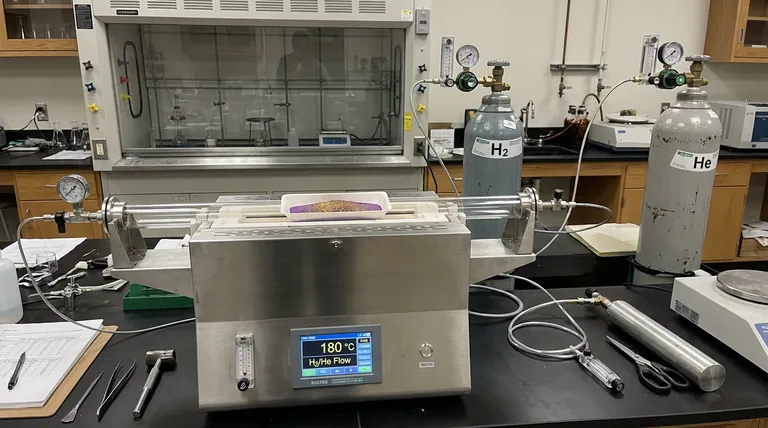
Thermal Precision and Atmosphere Control
Temperature Regulation
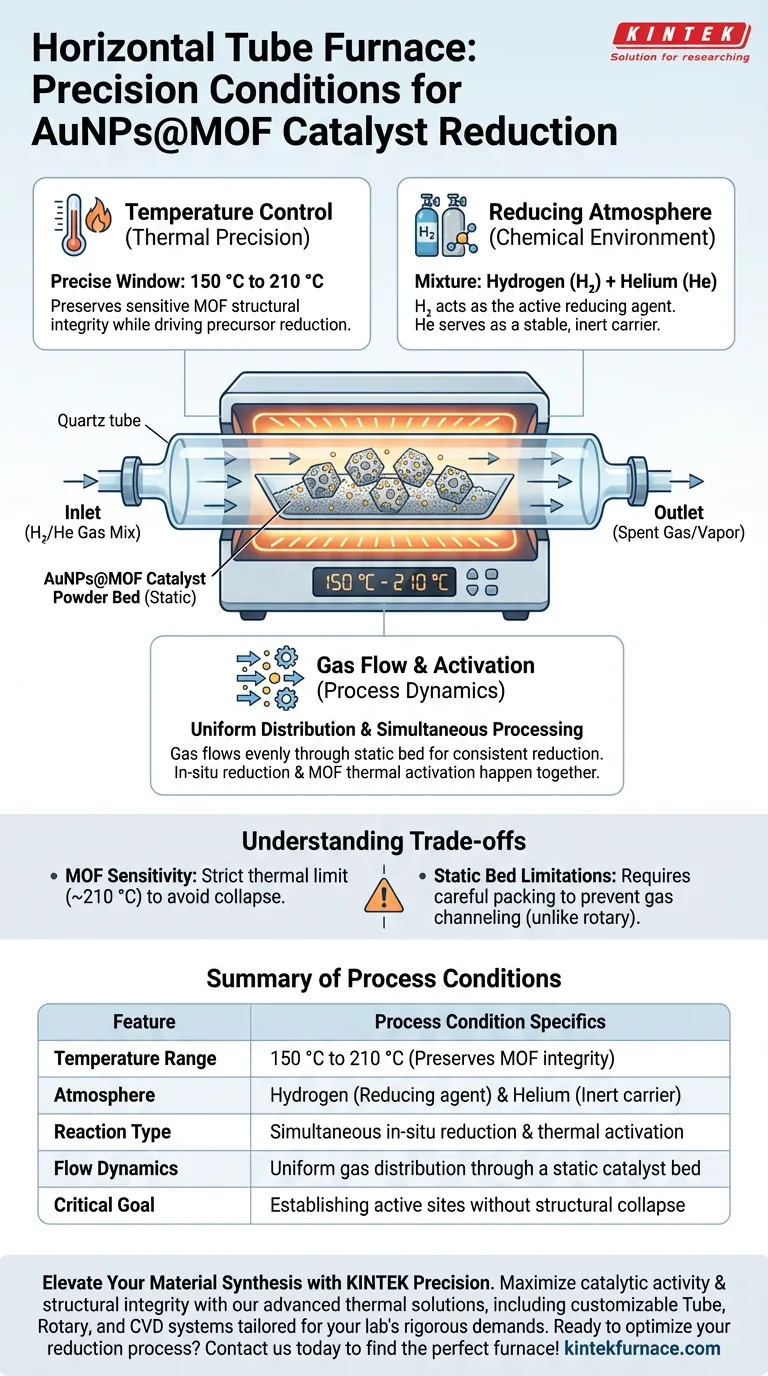
For AuNPs@MOF catalysts, the furnace maintains a relatively low-temperature environment, specifically between 150 °C and 210 °C.
This specific range is critical. It is high enough to drive the reduction of metal precursors but sufficiently low to preserve the structural integrity of the sensitive MOF support.
The Reducing Atmosphere
The process relies on a specific gas mixture composed of hydrogen and helium.
Hydrogen acts as the active reducing agent to convert precursors into metallic gold. Helium serves as an inert carrier gas, stabilizing the flow and ensuring the reducing agent is evenly distributed without unwanted side reactions.
Gas Flow and Structural Impact
Uniform Gas Distribution
A key function of the horizontal tube furnace is ensuring that the reduction gas flows uniformly through the catalyst powder bed.
Without this uniformity, gradients in the gas concentration could lead to uneven reduction. This would result in inconsistent catalytic properties across the batch.
Simultaneous Activation
The furnace environment allows for in-situ processing.
This means the reduction of gold nanoparticles (AuNPs) happens at the exact same time as the thermal activation of the MOF structure. This synchronization is essential for establishing the final active sites of the catalyst.
Understanding the Trade-offs
Sensitivity to Temperature Parameters
While tube furnaces offer high precision, the AuNPs@MOF synthesis is strictly bound by the thermal stability of the MOF.
Unlike oxide-supported catalysts that might withstand 700 °C (as seen in other reduction processes), MOFs can degrade if the furnace overshoots the 210 °C upper limit.
Static Bed Limitations
In a standard horizontal tube furnace, the powder bed is typically static.
While the gas flow is designed to be uniform, the lack of mechanical agitation (unlike a rotary furnace) means that the packing density of the powder must be carefully managed to prevent channeling, where gas bypasses sections of the catalyst.
Making the Right Choice for Your Goal
To maximize the efficacy of your AuNPs@MOF catalyst reduction, align your process parameters with your specific structural goals:
- If your primary focus is preserving MOF topology: Strictly cap your temperature at the lower end of the spectrum (closer to 150 °C) to minimize the risk of thermal collapse while accepting a slower reduction rate.
- If your primary focus is maximizing catalytic activity: Ensure the hydrogen/helium flow rate is optimized to penetrate the entire powder bed, preventing "dead zones" where precursors remain unreduced.
Precision in thermal and flow control is the deciding factor between a heterogeneous mixture and a high-performance catalyst.
Summary Table:
| Feature | Process Condition Specifics |
|---|---|
| Temperature Range | 150 °C to 210 °C (Preserves MOF integrity) |
| Atmosphere | Hydrogen (Reducing agent) & Helium (Inert carrier) |
| Reaction Type | Simultaneous in-situ reduction and thermal activation |
| Flow Dynamics | Uniform gas distribution through a static catalyst bed |
| Critical Goal | Establishing active sites without structural collapse |
Elevate Your Material Synthesis with KINTEK Precision
Maximize the catalytic activity and structural integrity of your sensitive MOFs with KINTEK’s advanced thermal solutions. Backed by expert R&D and manufacturing, KINTEK offers customizable Muffle, Tube, Rotary, Vacuum, and CVD systems designed to meet the rigorous demands of your lab. Whether you need precise atmosphere control for hydrogen reduction or uniform heat distribution for high-temp processing, our equipment is tailored to your unique research needs.
Ready to optimize your reduction process? Contact us today to find the perfect furnace for your laboratory!
Visual Guide
References
- Simon Lukato, Grzegorz Litwinienko. Enhancing the Green Synthesis of Glycerol Carbonate: Carboxylation of Glycerol with CO2 Catalyzed by Metal Nanoparticles Encapsulated in Cerium Metal–Organic Frameworks. DOI: 10.3390/nano14080650
This article is also based on technical information from Kintek Furnace Knowledge Base .
Related Products
- Vertical Laboratory Quartz Tube Furnace Tubular Furnace
- 1700℃ High Temperature Laboratory Tube Furnace with Alumina Tube
- Vacuum Sealed Continuous Working Rotary Tube Furnace Rotating Tube Furnace
- Split Multi Heating Zone Rotary Tube Furnace Rotating Tube Furnace
- Laboratory Vacuum Tilt Rotary Tube Furnace Rotating Tube Furnace
People Also Ask
- What are the key differences between single-zone and multi-zone vertical tube furnaces? Choose the Right Furnace for Your Lab
- What is the purpose of using an industrial-grade vertical tube furnace in phosphorus recovery? High-Fidelity Simulation
- How do heat treatment processes influence the configuration of a vertical tube furnace? Optimize for Quenching, Annealing, and More
- What physical conditions does a vertical tube furnace provide for desulfurization experiments? Precision Heat Control
- How are metal support wires selected for sample suspension? Expert Guide to High-Temp Furnace Materials



















