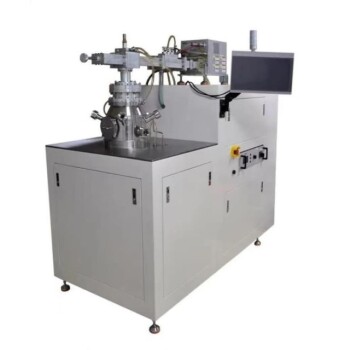
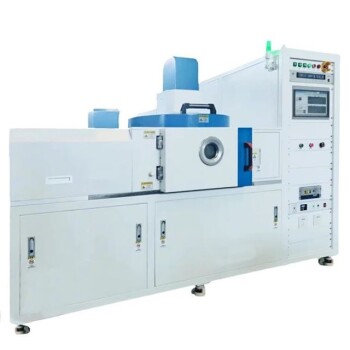
Vapor Phase Aluminizing (VPA) functions as a specialized gas-phase diffusion process conducted within a controlled heating chamber furnace. By heating a mixture of active metal powder and a halide activator, the equipment generates aluminum-rich gases that are driven to the target surface, where they diffuse into a base layer to create a thermally resistant shield.
Core Takeaway: VPA relies on a chemical potential gradient to drive gaseous aluminum precursors into a pre-sprayed NiCoCrAlY layer. This reaction transforms the surface into an NiAl intermetallic compound, providing a double-layer coating known for extremely low thermal conductivity.
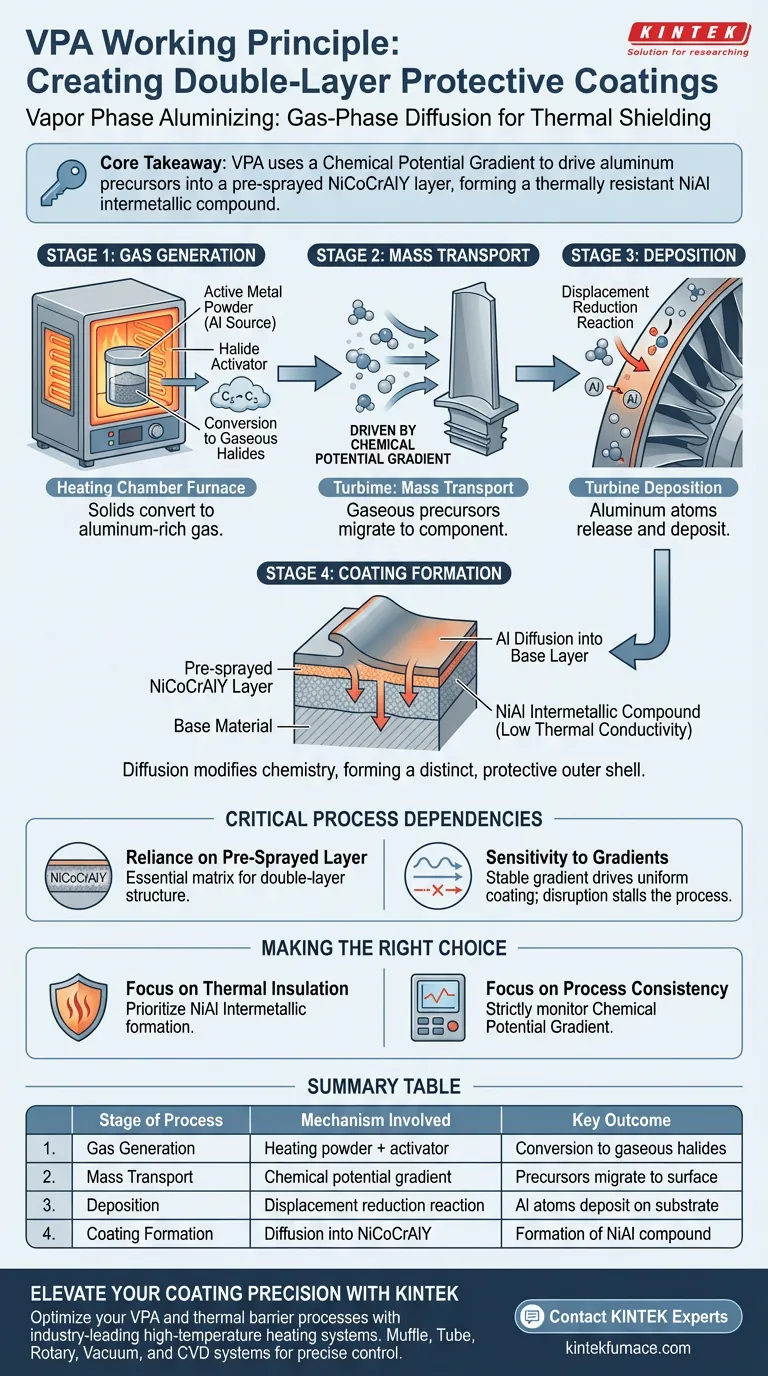
The Mechanism of Gas Generation
Inside the Heating Chamber
The process begins inside a heating chamber furnace. The equipment utilizes a container specifically designed to hold active metal powder mixed with a halide activator.
Conversion to Gaseous Halides
As the furnace applies heat, a chemical transformation occurs within the container. The solid aluminum source reacts with the activator, converting the aluminum into gaseous halides.
This phase change from solid to gas is the fundamental first step. It creates the medium necessary to transport aluminum atoms to the component.
Transport and Deposition Principles
Driven by Chemical Potential
The movement of the gas is not random. It is driven by a chemical potential gradient.
This gradient acts as a force, effectively pushing the gaseous precursors from the source container toward the surface of the turbine blade or component.
The Displacement Reduction Reaction
Once the gaseous halides reach the blade surface, they undergo a displacement reduction reaction.
This chemical reaction releases the aluminum from the gas phase, depositing it directly onto the surface of the component.
Forming the Double-Layer Structure
Diffusion into the Base Layer
The VPA process is designed to work in tandem with a pre-existing coating. The deposited aluminum diffuses into a pre-sprayed NiCoCrAlY layer.
This is not merely a surface overlay; it is a modification of the existing layer's chemistry through diffusion.
The Resulting Intermetallic Compound
The diffusion of aluminum into the NiCoCrAlY layer results in the formation of a distinct outer layer.
This new outer shell consists of an NiAl intermetallic compound. The primary technical advantage of this specific compound is its extremely low thermal conductivity, which provides the necessary thermal protection.
Critical Process Dependencies
Reliance on the Pre-Sprayed Layer
The effectiveness of this specific VPA application depends entirely on the presence of the NiCoCrAlY layer.
Without this specific pre-sprayed base, the aluminum would not have the necessary matrix to form the desired double-layer structure.
Sensitivity to Gradients
The process relies heavily on maintaining a stable chemical potential gradient.
If this gradient is disrupted, the transport of gaseous precursors to the blade surface will stall, resulting in incomplete coating or insufficient aluminum diffusion.
Making the Right Choice for Your Goal
To effectively utilize VPA for double-layer protection, you must align your process controls with the desired material properties.
- If your primary focus is thermal insulation: Prioritize the formation of the NiAl intermetallic compound, as this provides the low thermal conductivity required for high-heat environments.
- If your primary focus is process consistency: strictly monitor the chemical potential gradient inside the furnace, as this is the engine that drives the coating thickness and uniformity.
Success in Vapor Phase Aluminizing lies in precisely controlling the conversion of solid powder to gas to chemically transform a standard alloy coating into a high-performance thermal barrier.
Summary Table:
| Stage of Process | Mechanism Involved | Key Outcome |
|---|---|---|
| Gas Generation | Heating active metal powder + halide activator | Conversion of solids into gaseous aluminum halides |
| Mass Transport | Driven by chemical potential gradient | Gaseous precursors migrate toward the component surface |
| Deposition | Displacement reduction reaction | Aluminum atoms release and deposit onto the substrate |
| Coating Formation | Diffusion into NiCoCrAlY base layer | Formation of low-thermal-conductivity NiAl intermetallic compound |
Elevate Your Coating Precision with KINTEK
Ready to optimize your Vapor Phase Aluminizing (VPA) and thermal barrier coating processes? KINTEK provides industry-leading high-temperature heating systems designed for the most demanding gas-phase diffusion applications.
Backed by expert R&D and precision manufacturing, we offer a comprehensive range of Muffle, Tube, Rotary, Vacuum, and CVD systems, all fully customizable to meet your unique laboratory or industrial needs. Whether you are developing NiAl intermetallic compounds for turbine blades or researching advanced double-layer protective coatings, our technology ensures the stable chemical potential gradients and uniform temperature control essential for success.
Contact our technical specialists today to discuss your project requirements!
Visual Guide
References
- Leszek Ułanowicz, Andrzej Dudziński. Heat-Resistant Protective Coatings Applied to Aircraft Turbine Blades by Supersonic Thermal Spraying and Diffusion-Aluminizing. DOI: 10.3390/coatings14121554
This article is also based on technical information from Kintek Furnace Knowledge Base .
Related Products
- Vacuum Hot Press Furnace Machine for Lamination and Heating
- Multi Heating Zones CVD Tube Furnace Machine for Chemical Vapor Deposition Equipment
- Custom Made Versatile CVD Tube Furnace Chemical Vapor Deposition CVD Equipment Machine
- 915MHz MPCVD Diamond Machine Microwave Plasma Chemical Vapor Deposition System Reactor
- MPCVD Machine System Reactor Bell-jar Resonator for Lab and Diamond Growth
People Also Ask
- What are the primary components of a vacuum hot press furnace? Master the Core Systems for Precise Material Processing
- What safety features are incorporated in vacuum hot press furnaces? Ensure Operator and Equipment Protection
- What are the benefits of the vacuum environment system in a vacuum hot press furnace? Unlock High-Density Sintering
- What industries benefit from the use of vacuum hot press furnaces? Unlock High-Performance Materials for Your Industry
- What control features does a vacuum hot press furnace offer? Precision Control for Advanced Materials Processing