
In the context of biochar characterization, the muffle furnace serves a specific and critical function: the quantitative determination of ash content. By subjecting the biochar to an air atmosphere at approximately 750°C for an extended duration, typically 4 hours, the furnace ensures the complete oxidation and volatilization of all organic components. The material that remains is the inorganic residue, or ash, which serves as a fundamental indicator of the biochar's chemical and physical quality.
The muffle furnace isolates the inorganic fraction of biochar by eliminating all combustible organic matter through controlled thermal oxidation. This process yields the ash content percentage, a vital metric that determines the biochar's pH levels and its electrostatic capacity to interact with water.
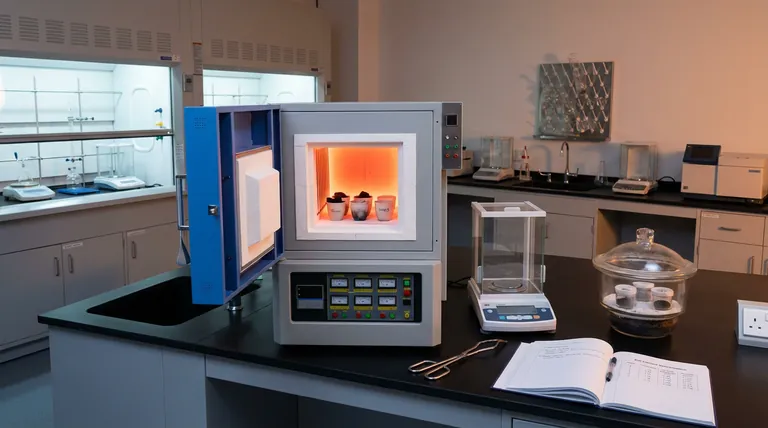
The Process of Ash Determination
Controlled Thermal Oxidation
The primary mechanism relies on creating a high-purity, high-temperature environment.
For biochar, the standard protocol involves heating the chamber to 750°C.
This temperature must be maintained consistently for a set period, generally 4 hours, to ensure the reaction reaches completion.
Elimination of Organic Components
The furnace operates in an air atmosphere, which provides the oxygen necessary for combustion.
Under these conditions, the carbon structure and other organic volatiles within the biochar are fully oxidized.
These components are converted into gases and vented, effectively removing the "bio" portion of the sample.
Isolation of Inorganic Residue
The substance left in the crucible after the heating cycle is the inorganic residue.
This residue comprises minerals and salts that are non-combustible and non-volatile at the applied temperature.
Weighing this residue allows for the precise calculation of ash percentage relative to the original sample mass.
Significance of Ash Data
Predicting pH Levels
The ash content derived from this process is a primary driver of the biochar's alkalinity.
A higher concentration of ash typically indicates a higher pH level.
This data point is essential for determining how the biochar will alter the acidity of the soil it is applied to.
Assessing Electrostatic Interactions
The nature of the ash influences how the biochar interacts with moisture.
Specifically, the inorganic content dictates the electrostatic interactions with water molecules.
Understanding this interaction is crucial for predicting the biochar's ability to retain water or influence nutrient mobility in agricultural applications.
Understanding the Trade-offs
Temperature Sensitivity
While 750°C is the standard for oxidizing organics, it is a high thermal load.
There is a risk that certain volatile inorganic elements could be lost if the temperature exceeds the protocol or if the sample has unique mineral properties.
Precision in temperature control is required to ensure the residue is truly representative of the ash content, not just the heat-resistant minerals.
Time Intensity
Ash determination is not a rapid analytical technique.
The requirement for a 4-hour hold time, combined with the necessary ramp-up and cool-down periods, makes this a time-consuming batch process.
It effectively limits the throughput of sample characterization compared to other rapid spectroscopic methods.
Making the Right Choice for Your Goal
To utilize a muffle furnace effectively for biochar characterization, align your methodology with your specific research objectives:
- If your primary focus is Standardization: Ensure your furnace is calibrated to exactly 750°C for 4 hours to maintain consistency with established quantitative protocols.
- If your primary focus is Soil Amendment: Prioritize the analysis of the resulting ash residue to accurately predict the biochar's impact on soil pH and water retention.
By strictly controlling the oxidation environment, the muffle furnace converts complex biomass into quantifiable inorganic data.
Summary Table:
| Feature | Specification/Detail |
|---|---|
| Primary Function | Quantitative determination of ash content |
| Standard Temperature | 750°C |
| Duration | 4 Hours |
| Atmosphere | Air (for complete oxidation) |
| Key Outcome | Isolation of inorganic minerals and salts |
| Impacted Metrics | Soil pH prediction, water electrostatic interaction |
Elevate Your Biochar Research with KINTEK Precision
Precision is paramount in biochar characterization. KINTEK provides high-performance muffle furnaces engineered for the rigorous demands of ash determination and thermal oxidation. Backed by expert R&D and manufacturing, we offer a comprehensive range of Muffle, Tube, Rotary, Vacuum, and CVD systems, all customizable to meet your unique laboratory requirements.
Our value to you:
- Unmatched Temperature Uniformity: Ensure consistent 750°C environments for repeatable ash data.
- Durable Design: Built for long-duration thermal loads essential for biomass processing.
- Tailored Solutions: Customizable chamber sizes and atmospheres for specialized research.
Ready to enhance your lab's analytical throughput and accuracy? Contact KINTEK today to find your perfect high-temp furnace solution!
References
- Huiying Zhang, Weifeng Chen. Roles of biochars’ properties in their water-holding capacity and bound water evaporation: quantitative importance and controlling mechanism. DOI: 10.1007/s42773-024-00317-2
This article is also based on technical information from Kintek Furnace Knowledge Base .
Related Products
- 1400℃ Muffle Oven Furnace for Laboratory
- 1200℃ Muffle Oven Furnace for Laboratory
- High Temperature Muffle Oven Furnace for Laboratory Debinding and Pre Sintering
- 1700℃ High Temperature Muffle Oven Furnace for Laboratory
- 1800℃ High Temperature Muffle Oven Furnace for Laboratory
People Also Ask
- What is the primary function of a high-temperature laboratory muffle furnace in chemical synthesis? Achieve Precision.
- How does a high-temperature laboratory muffle furnace affect material properties? Transform Anodic Oxide Films Fast
- What is the muffle furnace function in ilmenite oxidative roasting? Enhance Phase Change & Magnetic Separation
- How does a muffle furnace facilitate Ag/ATP catalyst preparation? Optimize Calcination for Superior Performance
- How does a laboratory high-temperature muffle furnace contribute to the final formation of Bismuth Oxide nanosheets?





