
Industrial muffle furnaces and rapid thermal annealing furnaces simulate high-temperature event recording by creating a precisely controlled thermal environment, typically ranging from room temperature to 1000°C. Within this regulated space, the heat triggers the directional oxidation of specific nanoparticles, chemically altering them to "capture" the thermal history of the material.
Core Takeaway While standard furnaces are often used for general material synthesis, their role in event recording is distinct: they drive the conversion of unprotected nanoparticles into non-magnetic hematite. This irreversible chemical change alters the material's magnetic interactions, effectively permanently writing the temperature exposure into the material's structure.
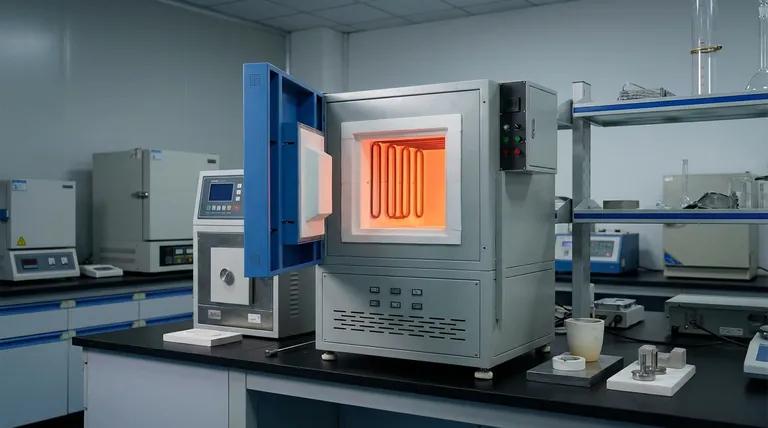
The Simulation Environment
Precise Temperature Control
To validate that a material can record thermal events, researchers must first expose it to known, controlled conditions.
Muffle and rapid thermal annealing furnaces provide this baseline. They maintain stability across a wide spectrum, from room temperature up to 1000°C.
Replicating Real-World Scenarios
These furnaces are not just heating elements; they are simulation chambers.
They allow scientists to mimic specific heat treatment scenarios relevant to metals, alloys, and ceramics. By controlling the ramp rate and dwell time, researchers can simulate rapid heating events or prolonged thermal exposure.
The Mechanism of "Recording"
Triggering Directional Oxidation
The core mechanism of recording a high-temperature event lies in the chemical reaction triggered by the furnace heat.
Inside the material's "superparticulates," there are unprotected nanoparticles. The high-temperature environment forces these specific particles to undergo directional oxidation.
Conversion to Hematite
As the oxidation process occurs, the chemical composition of the nanoparticles changes.
They are converted into non-magnetic hematite. This is the physical "writing" process—the heat acts as the pen, and the nanoparticle is the paper.
Altering Magnetic Interactions
The recording is read by analyzing the magnetic properties of the material.
Because the particles transform from a magnetic state to a non-magnetic hematite state, the overall magnetic interactions within the superparticulates shift. This alteration serves as the permanent record that a high-temperature event occurred.
Understanding the Trade-offs
Simulation vs. Dynamic Reality
While furnaces offer precision, they are static environments.
Real-world high-temperature events (such as friction or combustion) often involve pressure changes and mechanical stress. A muffle furnace focuses purely on the thermal aspect, potentially missing mechanical variables.
Material Specificity
The recording mechanism described relies entirely on the presence of unprotected nanoparticles.
If a material is synthesized with fully protected or encapsulated particles (often done in general synthesis to prevent degradation), this recording mechanism will fail. The material must be specifically engineered to be chemically reactive to heat for this process to work.
Making the Right Choice for Your Goal
To utilize these furnaces effectively, align your equipment settings with your specific material objectives.
- If your primary focus is validating thermal recording: Ensure your sample contains unprotected nanoparticles and utilize the furnace to map the specific temperature threshold where conversion to hematite begins.
- If your primary focus is general material synthesis: Utilize the furnace's atmospheric controls to protect the microstructure, preventing the oxidation and "recording" effect described above.
The precision of the furnace allows you to turn a simple chemical reaction into a reliable data logger for thermal history.
Summary Table:
| Feature | Furnace Role in Event Recording | Impact on Material |
|---|---|---|
| Temperature Range | Room Temp to 1000°C | Provides precise, repeatable thermal baselines |
| Chemical Mechanism | Triggers Directional Oxidation | Converts unprotected nanoparticles into hematite |
| Magnetic Property | Shifts from Magnetic to Non-magnetic | Creates a permanent, readable thermal record |
| Simulation Scope | Controls Ramp Rate and Dwell Time | Mimics real-world heating scenarios (e.g., friction) |
Optimize Your Thermal Research with KINTEK
Unlock the potential of thermal history recording and advanced material synthesis with KINTEK’s industry-leading heating solutions. Backed by expert R&D and precision manufacturing, KINTEK offers a comprehensive range of Muffle, Tube, Rotary, Vacuum, and CVD systems, all fully customizable to meet your laboratory's unique high-temperature requirements.
Whether you are mapping nanoparticle conversion or developing next-generation ceramics, our systems provide the stability and control necessary for breakthrough results. Contact our specialists today to find the perfect furnace for your application!
References
- Andreas Wolf, Karl Mandel. Magnetic Supraparticles Capable of Recording High‐Temperature Events. DOI: 10.1002/adfm.202316212
This article is also based on technical information from Kintek Furnace Knowledge Base .
Related Products
- Laboratory Quartz Tube Furnace RTP Heating Tubular Furnace
- Controlled Inert Nitrogen Hydrogen Atmosphere Furnace
- Spark Plasma Sintering SPS Furnace
- Multi Heating Zones CVD Tube Furnace Machine for Chemical Vapor Deposition Equipment
- Custom Made Versatile CVD Tube Furnace Chemical Vapor Deposition CVD Equipment Machine
People Also Ask
- What physical conditions does a laboratory Tube Furnace provide for SOEC? Precision Heat for Solid Oxide Characterization
- What are the main features and functions of a laboratory tube furnace? Unlock Precise High-Temp Control for Your Lab
- What parameters must be controlled when calcining freeze-dried oxide precursors in a laboratory tube furnace? A Guide
- What conditions does a tube furnace provide for post-ion-implantation? Achieve Precise Microstructural Repair
- What role does a laboratory tube furnace play in geological and mineralogical research? Unlock Earth's Secrets with Precision



















