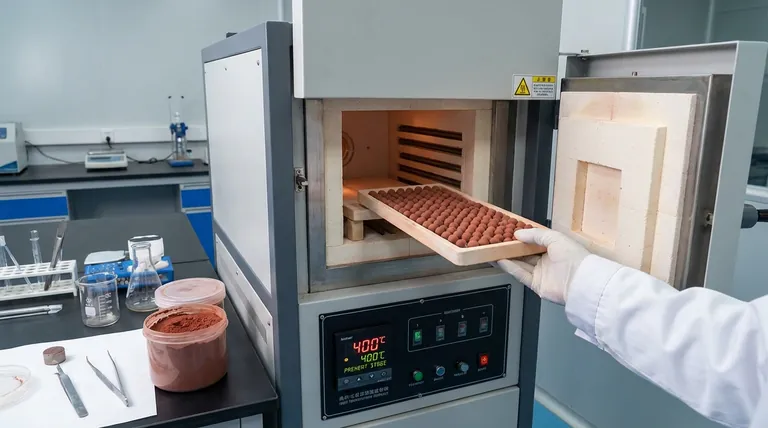
The preheating step acts as a critical stabilization phase designed to prepare raw ceramic pellets for the extreme conditions of sintering. By utilizing a high-temperature furnace to hold the material at 400 °C, producers systematically remove both adsorbed water and mineral structural water, ensuring the pellets are chemically and physically ready for the final firing process.
The primary function of this stage is to prevent the catastrophic structural failure that occurs when internal moisture vaporizes too rapidly. By controlling water removal prior to the 1000 °C sintering stage, this step guarantees the final product achieves a compressive strength exceeding 36 MPa.
The Mechanics of Moisture Removal
Targeting Two Forms of Water
Raw red mud-based pellets contain significant moisture that is not purely superficial. The preheating process specifically targets adsorbed water (surface moisture) and mineral structural water (moisture bound within the chemical lattice).
The 400 °C Threshold
A specialized preheating temperature of 400 °C is required to effectively liberate these different forms of water. This temperature is high enough to drive out moisture from the pellet's interior but low enough to avoid initiating the sintering process prematurely.
Preventing Structural Failure
Mitigating Rapid Vaporization Risks
If pellets containing residual moisture are immediately subjected to the 1000 °C sintering stage, the internal water turns to steam instantly. This rapid vaporization creates immense internal pressure, causing the pellets to burst or experience structural collapse.
Ensuring Mechanical Integrity
The preheating step acts as a controlled release valve, evacuating volatiles gently. This preservation of the internal structure is directly responsible for the final ceramic achieving a high compressive strength of over 36 MPa.
Common Pitfalls to Avoid
The Cost of Rushing the Gradient
Skipping or shortening the 400 °C dwell time is the primary cause of material loss in this process. Attempting to ramp directly to sintering temperatures will almost invariably result in fractured or exploded pellets.
Equipment Utilization
It is notable that a high-temperature furnace is used for this intermediate step. While the target temperature is only 400 °C, using equipment capable of high-temperature stability ensures precise thermal control during this sensitive de-watering phase.
Making the Right Choice for Your Goal
To maximize the quality of red mud-based ceramic pellets, apply the following guidelines:
- If your primary focus is Structural Integrity: rigorous adherence to the 400 °C preheating phase is non-negotiable to prevent bursting.
- If your primary focus is High Compressive Strength: ensure all mineral structural water is fully evacuated to hit the >36 MPa benchmark.
Controlled patience during the preheating phase is the only path to a durable, high-strength ceramic product.
Summary Table:
| Process Phase | Target Temperature | Primary Function | Key Outcome |
|---|---|---|---|
| Preheating | 400 °C | Removal of adsorbed & structural water | Prevents bursting/structural collapse |
| Sintering | 1000 °C | Material densification & bonding | High compressive strength (>36 MPa) |
| Equipment Used | High-Temp Furnace | Precise thermal stability & control | Consistent mechanical integrity |
Maximize Your Pellet Production Quality with KINTEK
Don't let structural failure compromise your output. KINTEK’s high-precision high-temperature furnaces are engineered to provide the exact thermal stability required for critical de-watering and sintering phases. Backed by expert R&D and manufacturing, we offer customizable Muffle, Tube, Rotary, Vacuum, and CVD systems tailored to your unique research or production needs.
Ready to achieve superior mechanical strength in your ceramic materials? Contact our experts today to find the perfect lab-scale or industrial furnace solution.
References
- Zhilei Zhen, Haotian Ma. A Novel Method of Synthesizing Polymeric Aluminum Ferric Sulfate Flocculant and Preparing Red Mud-Based Ceramsite. DOI: 10.3390/ma17061239
This article is also based on technical information from Kintek Furnace Knowledge Base .
Related Products
- High Temperature Muffle Oven Furnace for Laboratory Debinding and Pre Sintering
- 1700℃ High Temperature Laboratory Tube Furnace with Alumina Tube
- 1700℃ Controlled Inert Nitrogen Atmosphere Furnace
- 1700℃ High Temperature Muffle Oven Furnace for Laboratory
- 1200℃ Muffle Oven Furnace for Laboratory
People Also Ask
- Why is controlled heat treatment in a muffle furnace necessary for calcined clay? Achieve Optimal Pozzolanic Activity
- What role does a high-temperature muffle furnace play in STFO synthesis? Achieve Pure Perovskite Results
- What role does a high-temperature muffle furnace play in the formation of biochar catalysts? Master Catalyst Synthesis
- What role does a high-temperature muffle furnace play in the multi-stage synthesis of Li0.5MnFe1.5O4? Key to Pure Spinel
- Why preheat Ni-ZrO2 mixed powders for 20 hours before cladding? Eliminate porosity and enhance material durability.