Knowledge What is the significance of the flow distribution coefficient (fdi)? Optimize Heat Transfer in Annealing Furnaces
Author avatar

Tech Team · Kintek Furnace

Updated 1 day ago

What is the significance of the flow distribution coefficient (fdi)? Optimize Heat Transfer in Annealing Furnaces


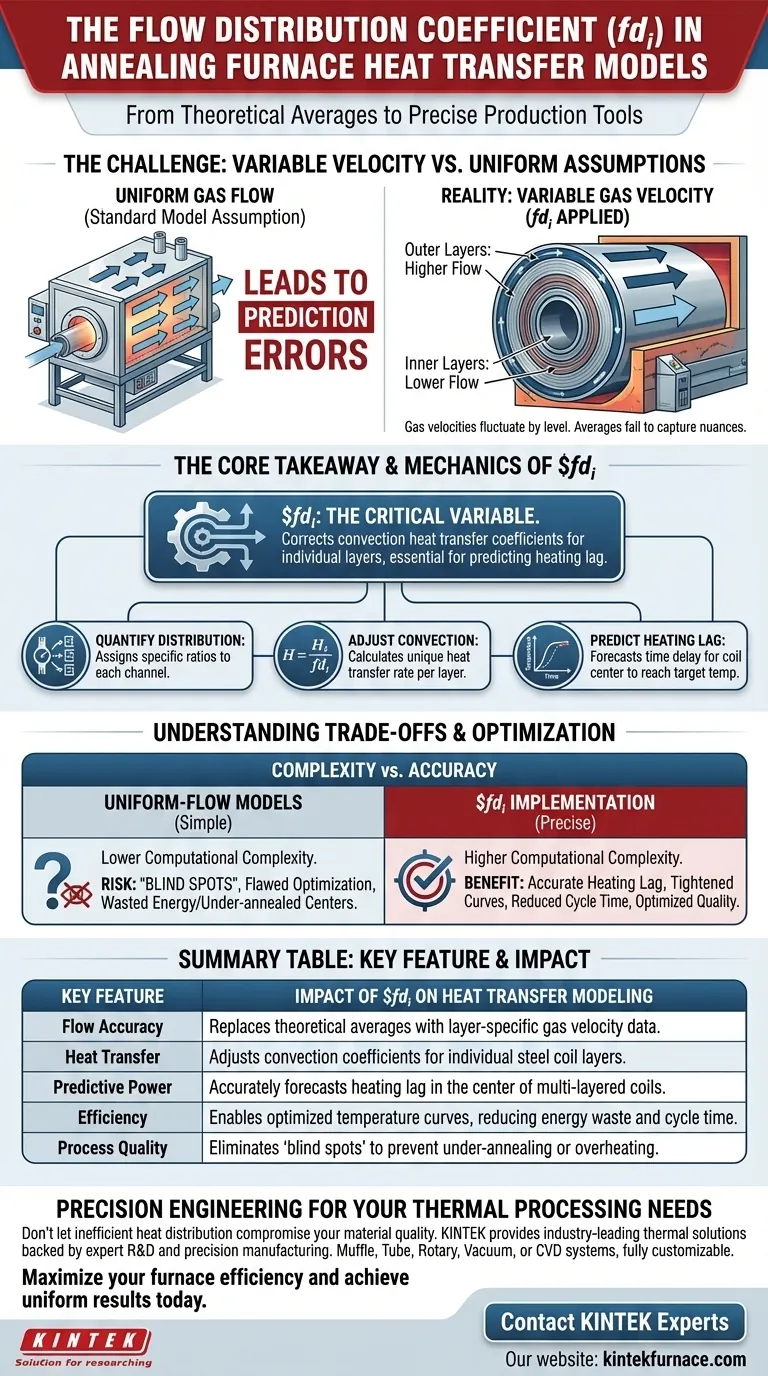
The flow distribution coefficient ($fd_i$) is the critical variable that quantifies exactly how protective gas is distributed across the various flow channels of multi-layered steel coils. By accounting for the reality that gas velocities differ at various coil levels, this coefficient allows heat transfer models to move beyond theoretical averages and simulate specific convection conditions for each layer.

Core Takeaway Standard models often assume uniform gas flow, leading to prediction errors. The $fd_i$ corrects this by adjusting convection heat transfer coefficients for individual layers, which is essential for accurately predicting heating lag and optimizing annealing temperature curves.
What is the significance of the flow distribution coefficient (fdi)? Optimize Heat Transfer in Annealing Furnaces

The Challenge of Internal Furnace Structure

The Reality of Variable Velocity

In the complex internal structure of an annealing furnace, protective gas does not flow uniformly.

Gas velocities fluctuate significantly depending on the specific level of the coil.

Why Averages Fail

Using a single, average velocity for the entire furnace oversimplifies the physical reality.

This approach fails to capture the nuances of heat transfer in multi-layered steel coils, resulting in models that cannot predict temperature variances accurately.

The Mechanics of the Coefficient

Quantifying Distribution Ratios

The primary function of the $fd_i$ is to assign a specific distribution ratio to each flow channel.

This provides a mathematical representation of how much gas is actually reaching different parts of the coil stack.

Adjusting Convection Coefficients

The flow distribution directly dictates the convection heat transfer coefficient.

By incorporating $fd_i$, the model calculates a unique heat transfer rate for each layer, rather than applying a blanket value across the entire batch.

Predicting Heating Lag

One of the most significant outcomes of using this coefficient is the ability to predict heating lag.

Because the model understands that inner layers may receive less convective flow than outer layers, it can accurately forecast the time delay required for the center of the coil to reach the target temperature.

Understanding the Trade-offs

Complexity vs. Accuracy

Implementing the flow distribution coefficient increases the computational complexity of the model compared to simple uniform-flow models.

However, omitting it leads to "blind spots" where the model assumes the steel is heated uniformly when it is not.

The Cost of Optimization

Optimizing annealing temperature curves requires precise inputs.

If the $fd_i$ is ignored or estimated poorly, the resulting optimization curves will be flawed, potentially leading to under-annealed coil centers or wasted energy from overheating outer layers.

Making the Right Choice for Your Goal

To effectively utilize the flow distribution coefficient in your heat transfer models, consider your specific objectives:

  • If your primary focus is Model Fidelity: Ensure your inputs for the $fd_i$ reflect the specific geometry of your multi-layered coils to capture realistic velocity variations.
  • If your primary focus is Process Efficiency: Use the heating lag predictions derived from the $fd_i$ to tighten your annealing temperature curves, reducing cycle time without compromising quality.

By shifting from assumed uniformity to calculated distribution, you transform your model from a theoretical estimate into a precise production tool.

Summary Table:

Key Feature Impact of $fd_i$ on Heat Transfer Modeling
Flow Accuracy Replaces theoretical averages with layer-specific gas velocity data.
Heat Transfer Adjusts convection coefficients for individual steel coil layers.
Predictive Power Accurately forecasts heating lag in the center of multi-layered coils.
Efficiency Enables optimized temperature curves, reducing energy waste and cycle time.
Process Quality Eliminates 'blind spots' to prevent under-annealing or overheating.

Precision Engineering for Your Thermal Processing Needs

Don't let inefficient heat distribution compromise your material quality. KINTEK provides industry-leading thermal solutions backed by expert R&D and precision manufacturing. Whether you require Muffle, Tube, Rotary, Vacuum, or CVD systems, our high-temperature lab furnaces are fully customizable to meet your unique metallurgical and research requirements.

Maximize your furnace efficiency and achieve uniform results today.

Contact KINTEK Experts

Visual Guide

What is the significance of the flow distribution coefficient (fdi)? Optimize Heat Transfer in Annealing Furnaces Visual Guide

References

  1. Yang Xiao-jing, Yu-Ren Li. Study of heat transfer model and buried thermocouple test of bell-type annealing furnace based on thermal equilibrium. DOI: 10.1038/s41598-025-97422-4

This article is also based on technical information from Kintek Furnace Knowledge Base .

Related Products

People Also Ask

Related Products

Controlled Inert Nitrogen Hydrogen Atmosphere Furnace

Controlled Inert Nitrogen Hydrogen Atmosphere Furnace

Discover KINTEK's Hydrogen Atmosphere Furnace for precise sintering & annealing in controlled environments. Up to 1600°C, safety features, customizable.

Vacuum Heat Treat Sintering Furnace Molybdenum Wire Vacuum Sintering Furnace

Vacuum Heat Treat Sintering Furnace Molybdenum Wire Vacuum Sintering Furnace

KINTEK's Vacuum Molybdenum Wire Sintering Furnace excels in high-temperature, high-vacuum processes for sintering, annealing, and material research. Achieve precise 1700°C heating with uniform results. Custom solutions available.

Multi Heating Zones CVD Tube Furnace Machine for Chemical Vapor Deposition Equipment

Multi Heating Zones CVD Tube Furnace Machine for Chemical Vapor Deposition Equipment

KINTEK's Multi-Zone CVD Tube Furnaces offer precision temperature control for advanced thin film deposition. Ideal for research and production, customizable for your lab needs.

1700℃ High Temperature Laboratory Tube Furnace with Quartz or Alumina Tube

1700℃ High Temperature Laboratory Tube Furnace with Quartz or Alumina Tube

KINTEK's Tube Furnace with Alumina Tube: Precision heating up to 1700°C for material synthesis, CVD, and sintering. Compact, customizable, and vacuum-ready. Explore now!

Vacuum Heat Treat Furnace with Ceramic Fiber Liner

Vacuum Heat Treat Furnace with Ceramic Fiber Liner

KINTEK's Vacuum Furnace with Ceramic Fiber Lining offers precise high-temperature processing up to 1700°C, ensuring uniform heat distribution and energy efficiency. Ideal for labs and production.

1400℃ High Temperature Laboratory Tube Furnace with Quartz and Alumina Tube

1400℃ High Temperature Laboratory Tube Furnace with Quartz and Alumina Tube

KINTEK's Tube Furnace with Alumina Tube: Precision high-temperature processing up to 2000°C for labs. Ideal for material synthesis, CVD, and sintering. Customizable options available.

High Temperature Muffle Oven Furnace for Laboratory Debinding and Pre Sintering

High Temperature Muffle Oven Furnace for Laboratory Debinding and Pre Sintering

KT-MD Debinding & Pre-Sintering Furnace for ceramics - precise temperature control, energy-efficient design, customizable sizes. Boost your lab efficiency today!

Split Chamber CVD Tube Furnace with Vacuum Station CVD Machine

Split Chamber CVD Tube Furnace with Vacuum Station CVD Machine

Split Chamber CVD Tube Furnace with Vacuum Station - High precision 1200°C lab furnace for advanced materials research. Customizable solutions available.

Mesh Belt Controlled Atmosphere Furnace Inert Nitrogen Atmosphere Furnace

Mesh Belt Controlled Atmosphere Furnace Inert Nitrogen Atmosphere Furnace

KINTEK Mesh Belt Furnace: High-performance controlled atmosphere furnace for sintering, hardening & heat treatment. Customizable, energy-efficient, precise temperature control. Get a quote now!

1200℃ Split Tube Furnace Laboratory Quartz Tube Furnace with Quartz Tube

1200℃ Split Tube Furnace Laboratory Quartz Tube Furnace with Quartz Tube

Discover KINTEK's 1200℃ Split Tube Furnace with quartz tube for precise high-temperature lab applications. Customizable, durable, and efficient. Get yours now!

1700℃ High Temperature Muffle Oven Furnace for Laboratory

1700℃ High Temperature Muffle Oven Furnace for Laboratory

KT-17M Muffle Furnace: High-precision 1700°C lab furnace with PID control, energy efficiency, and customizable sizes for industrial & research applications.

Vacuum Heat Treat Sintering and Brazing Furnace

Vacuum Heat Treat Sintering and Brazing Furnace

KINTEK Vacuum Brazing Furnaces deliver precision, clean joints with superior temperature control. Customizable for diverse metals, ideal for aerospace, medical, and thermal applications. Get a quote!

Small Vacuum Heat Treat and Tungsten Wire Sintering Furnace

Small Vacuum Heat Treat and Tungsten Wire Sintering Furnace

Compact vacuum tungsten wire sintering furnace for labs. Precise, mobile design with superior vacuum integrity. Ideal for advanced material research. Contact us!

2200 ℃ Tungsten Vacuum Heat Treat and Sintering Furnace

2200 ℃ Tungsten Vacuum Heat Treat and Sintering Furnace

2200°C Tungsten Vacuum Furnace for high-temperature materials processing. Precise control, superior vacuum, customizable solutions. Ideal for research & industrial applications.

1400℃ Muffle Oven Furnace for Laboratory

1400℃ Muffle Oven Furnace for Laboratory

KT-14M Muffle Furnace: Precision 1400°C heating with SiC elements, PID control, and energy-efficient design. Ideal for labs.

Laboratory Muffle Oven Furnace with Bottom Lifting

Laboratory Muffle Oven Furnace with Bottom Lifting

Boost lab efficiency with KT-BL Bottom Lifting Furnace: precise 1600℃ control, superior uniformity, and enhanced productivity for material science and R&D.

1200℃ Controlled Inert Nitrogen Atmosphere Furnace

1200℃ Controlled Inert Nitrogen Atmosphere Furnace

KINTEK 1200℃ Controlled Atmosphere Furnace: Precision heating with gas control for labs. Ideal for sintering, annealing, and material research. Customizable sizes available.

600T Vacuum Induction Hot Press Vacuum Heat Treat and Sintering Furnace

600T Vacuum Induction Hot Press Vacuum Heat Treat and Sintering Furnace

600T Vacuum Induction Hot Press Furnace for precise sintering. Advanced 600T pressure, 2200°C heating, vacuum/atmosphere control. Ideal for research & production.

1700℃ Controlled Inert Nitrogen Atmosphere Furnace

1700℃ Controlled Inert Nitrogen Atmosphere Furnace

KT-17A Controlled Atmosphere Furnace: Precise 1700°C heating with vacuum & gas control. Ideal for sintering, research & material processing. Explore now!

Vacuum Heat Treat Sintering Furnace with Pressure for Vacuum Sintering

Vacuum Heat Treat Sintering Furnace with Pressure for Vacuum Sintering

KINTEK's Vacuum Pressure Sintering Furnace offers 2100℃ precision for ceramics, metals, and composites. Customizable, high-performance, and contamination-free. Get a quote now!


Leave Your Message