
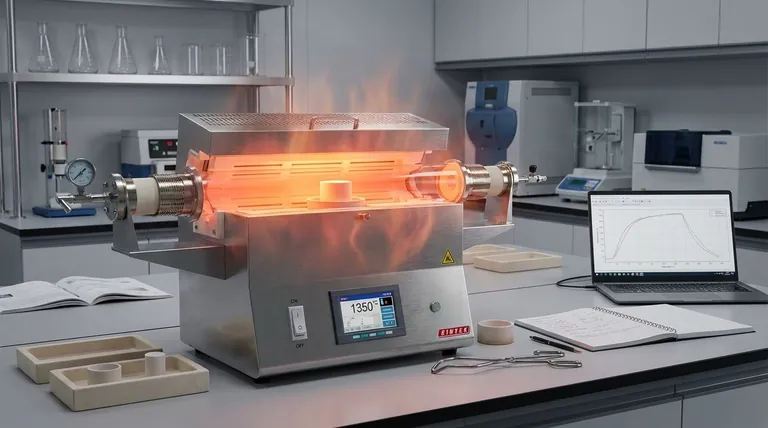
A high-temperature electric furnace acts as the critical vessel for transforming 3Y-TZP powder into a dense, structural ceramic. By providing a precisely controlled thermal environment capable of reaching 1350 degrees Celsius, the furnace initiates the physical mechanisms required for material consolidation. This heat treatment drives solid-state diffusion, which is essential for eliminating porosity and establishing the ceramic's final mechanical strength and toughness.
The core function of the furnace is to facilitate solid-state diffusion through precise thermal regulation. This process converts loose ceramic particles into a unified, dense solid, directly determining the material's durability and fracture resistance.
The Mechanism of Densification
Initiating Solid-State Diffusion
The primary role of the electric furnace is to generate sufficient thermal energy to trigger solid-state diffusion.
At temperatures up to 1350 degrees Celsius, atoms within the 3Y-TZP powder gain enough kinetic energy to move across particle boundaries.
This atomic movement is the fundamental driver that bonds the powder particles together without melting them.
Elimination of Porosity
As diffusion progresses, the furnace's sustained heat forces the reduction of void spaces between particles.
This process, known as densification, systematically removes internal porosity.
The result is a transition from a porous "green" body to a solid material that approaches its theoretical density.
Enhancing Mechanical Properties
The furnace environment facilitates controlled grain growth, which organizes the internal microstructure of the ceramic.
Proper grain development is directly responsible for the material's mechanical performance.
Specifically, this microstructural evolution imparts the high strength and toughness that 3Y-TZP ceramics are known for.
Critical Process Variables
Thermal Field Stability
While high heat is necessary, the precision of the thermal field is equally important.
A high-quality electric furnace maintains a stable temperature profile, ensuring that densification occurs uniformly throughout the ceramic part.
Fluctuations in temperature can lead to uneven sintering, resulting in structural weaknesses.
Time-Temperature Dependence
The sintering process is not instantaneous; it requires a specific duration at peak temperature.
The furnace must sustain the target temperature long enough to allow diffusion to complete its work.
This "holding time" ensures that the material achieves full density and optimal mechanical characteristics.
Understanding the Trade-offs
Temperature Control vs. Material Quality
Achieving the correct temperature is a balancing act.
If the temperature is too low, diffusion will be incomplete, leaving the material porous and weak.
Conversely, while not explicitly detailed in the primary reference for 3Y-TZP, general sintering principles suggest that excessive heat or uncontrolled environments can lead to abnormal grain growth, which may degrade mechanical properties.
The Necessity of Precision
The requirement for a "precisely controlled" environment implies that standard heating equipment is insufficient.
Using a furnace without tight thermal regulation risks producing parts with inconsistent density.
Investing in high-precision equipment is a necessary trade-off to guarantee the reliability of the final ceramic product.
Making the Right Choice for Your Goal
To maximize the performance of 3Y-TZP ceramics, you must align your furnace capabilities with your material requirements.
- If your primary focus is Maximum Density: Ensure your furnace can reliably reach and hold 1350 degrees Celsius to drive complete solid-state diffusion and pore removal.
- If your primary focus is Mechanical Toughness: Prioritize a furnace with precise thermal control to facilitate uniform grain growth, which underpins the material's final strength.
Mastering the thermal environment is the only way to unlock the full structural potential of 3Y-TZP ceramics.
Summary Table:
| Process Phase | Primary Mechanism | Outcome for 3Y-TZP |
|---|---|---|
| Heating Phase | Kinetic Energy Increase | Initiation of solid-state diffusion |
| Soaking Phase | Atomic Migration | Elimination of porosity and void spaces |
| Structural Growth | Controlled Grain Development | Achievement of high fracture toughness |
| Thermal Stability | Uniform Temperature Field | Consistent density and mechanical reliability |
Unlock the Full Potential of Your Ceramic Engineering
To achieve theoretical density and superior fracture resistance in 3Y-TZP, your lab requires precision heating. KINTEK provides industry-leading thermal solutions backed by expert R&D and world-class manufacturing. Whether you need Muffle, Tube, Rotary, Vacuum, or CVD systems, our high-temp furnaces are fully customizable to meet your specific sintering protocols and material requirements.
Ready to elevate your material performance? Contact us today to discuss your unique needs with our technical specialists.
Visual Guide

References
- Satoshi KOBAYASHI, Takumi Sekine. Effect of bioactivation treatment using phosphoric acid on mechanical properties and osteogenesis for 3Y-TZP. DOI: 10.1299/mej.24-00376
This article is also based on technical information from Kintek Furnace Knowledge Base .
Related Products
- High Temperature Muffle Oven Furnace for Laboratory Debinding and Pre Sintering
- Chairside Dental Porcelain Zirconia Sintering Furnace with Transformer for Ceramic Restorations
- Dental Porcelain Zirconia Sintering Ceramic Vacuum Press Furnace
- 2200 ℃ Tungsten Vacuum Heat Treat and Sintering Furnace
- Vacuum Heat Treat Sintering Furnace Molybdenum Wire Vacuum Sintering Furnace
People Also Ask
- What thermal phenomena occur during polymer binder burnout in ceramic green bodies? Lab Furnace Guide
- What role does a high-temperature muffle furnace play in STFO synthesis? Achieve Pure Perovskite Results
- Why is controlled heat treatment in a muffle furnace necessary for calcined clay? Achieve Optimal Pozzolanic Activity
- How does a high-temperature muffle furnace facilitate the formation of LaNbxAl1−xO3+δ perovskite structures? Key Roles
- What role does a high-temperature muffle furnace play in the formation of biochar catalysts? Master Catalyst Synthesis



















