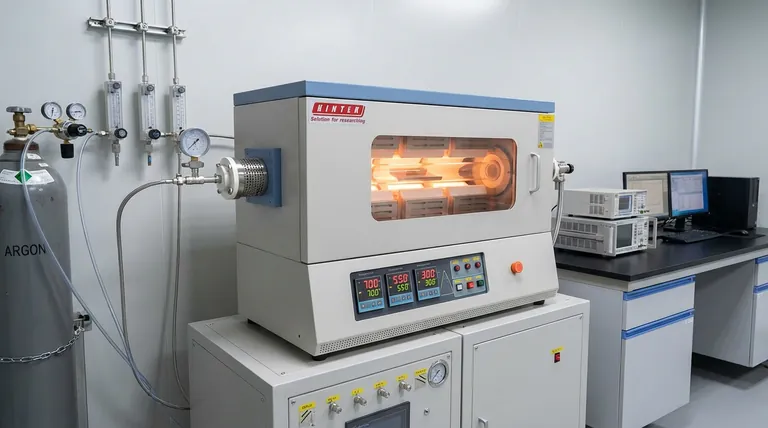
The precise coordination of heating zone partitioning and gas flow control is the deciding factor in the successful Chemical Vapor Deposition (CVD) of Molybdenum Disulfide (MoS2). By creating distinct thermal environments, the furnace allows precursors with vastly different properties—specifically Molybdenum Trioxide (MoO3) and Sulfur—to evaporate at their unique optimal temperatures. When coupled with a controlled flow of high-purity Argon, this ensures the correct ratio of reactants reaches the substrate to form high-quality, large-scale single crystals.
The synergy between independent thermal zones and aerodynamic transport allows incompatible evaporation requirements to coexist within a single system. This balance is required to grow crystals that possess both high crystallinity and the desired triangular morphology.
The Role of Multi-Zone Heating
To achieve high-quality MoS2 growth, the thermal environment must be tailored to the specific chemical properties of the source materials.
Decoupling Precursor Evaporation
Molybdenum Trioxide (MoO3) and Sulfur require significantly different temperatures to sublimate or evaporate effectively.
In a single-zone furnace, you would be forced to compromise on a temperature that is likely too hot for one precursor and too cold for the other.
Partitioning the heating zones allows you to set the specific optimal temperature for each material independently.
Controlling Stoichiometry at the Source
The quality of the final crystal depends heavily on the ratio of Sulfur to Molybdenum vapor entering the reaction zone.
By fine-tuning the temperature of each zone, you directly control the evaporation rate of each precursor.
This ensures that the reaction zone receives a consistent, stoichiometric supply of reactants, preventing sulfur-deficient or metal-rich growth.
The Function of Gas Flow Dynamics
While temperature liberates the precursor materials, the gas flow system is responsible for their delivery and distribution.
Precision Transport with Argon
High-purity Argon serves as the inert carrier vehicle for the reaction.
Its primary role is to pick up the evaporated vapors from the upstream heating zones and transport them to the downstream reaction zone.
Precise flow control ensures that the vapors move at a predictable velocity, preventing them from settling before reaching the target area.
Ensuring Uniform Diffusion
Once the vapors reach the substrate, they must spread out evenly to ensure consistent growth.
Proper flow control facilitates the uniform diffusion of the precursor mixture across the substrate surface.
This uniformity is essential for achieving "large-scale" growth, ensuring the resulting film is consistent from edge to edge.
Operational Challenges and Sensitivities
While this setup provides control, it introduces complexity that requires careful management to avoid common pitfalls.
Managing Thermal Cross-Talk
Even with partitioned zones, heat can bleed from a high-temperature zone (like that used for MoO3) into a lower-temperature zone (like that used for Sulfur).
If the zones are not sufficiently isolated, the Sulfur may evaporate too quickly, leading to an uncontrollable surplus of vapor early in the process.
The Risk of Flow Rate Imbalance
Gas flow is a delicate variable; a flow rate that is too high can blow the reactants past the substrate before they can deposit.
Conversely, a flow rate that is too low may cause reactants to stagnate or deposit upstream, resulting in poor coverage on the target substrate.
Making the Right Choice for Your Goal
The configuration of your furnace should be dictated by the specific characteristics you need in your final material.
- If your primary focus is large-scale uniformity: Prioritize the precision of your gas flow controllers to ensure the Argon carrier diffuses the vapor mixture evenly across the entire substrate area.
- If your primary focus is high crystallinity and purity: Focus on the thermal isolation of your heating zones to ensure MoO3 and Sulfur evaporate strictly at their optimal temperatures without thermal interference.
Mastering these thermal and aerodynamic variables is the key to transitioning from random deposition to controlled, high-performance crystal growth.
Summary Table:
| Parameter | Function in CVD MoS2 Growth | Key Benefit |
|---|---|---|
| Heating Zone Partitioning | Decouples precursor evaporation (MoO3 vs. Sulfur) | Ensures optimal stoichiometry and prevents thermal interference. |
| Gas Flow Control (Argon) | Transports vaporized reactants to the substrate | Maintains predictable velocity and ensures uniform film diffusion. |
| Thermal Isolation | Prevents heat bleed between temperature zones | Stabilizes evaporation rates for consistent, high-purity results. |
| Flow Rate Optimization | Regulates reactant dwell time over the target | Prevents premature deposition and ensures large-scale uniformity. |
Elevate Your Thin-Film Research with KINTEK
Precision is non-negotiable when growing high-performance MoS2 crystals. Backed by expert R&D and manufacturing, KINTEK offers specialized Tube, Vacuum, and CVD systems designed to give you total control over multi-zone thermal profiles and aerodynamic gas flow. Whether you need a standard setup or a fully customizable high-temp furnace tailored to your unique lab requirements, we provide the tools to ensure high crystallinity and perfect morphology every time.
Ready to optimize your CVD process? Contact our technical experts today to discuss how KINTEK can enhance your lab's efficiency and material quality.
References
- Felipe Wasem Klein, Matthieu Paillet. Determining by Raman spectroscopy the average thickness and <i>N</i>-layer-specific surface coverages of MoS<sub>2</sub> thin films with domains much smaller than the laser spot size. DOI: 10.3762/bjnano.15.26
This article is also based on technical information from Kintek Furnace Knowledge Base .
Related Products
- Multi Zone Laboratory Quartz Tube Furnace Tubular Furnace
- Multi Heating Zones CVD Tube Furnace Machine for Chemical Vapor Deposition Equipment
- Split Chamber CVD Tube Furnace with Vacuum Station CVD Machine
- Custom Made Versatile CVD Tube Furnace Chemical Vapor Deposition CVD Equipment Machine
- High Pressure Laboratory Vacuum Tube Furnace
People Also Ask
- What temperature-related capabilities make multi zone tube furnaces valuable for research? Unlock Precision Thermal Control
- What role do multi zone tube furnaces play in new energy research? Unlock Precise Thermal Control for Innovation
- What environmental protection applications utilize multi zone tube furnaces? Unlock Precision in Waste Treatment and Green Tech
- Why are multi zone tube furnaces particularly useful for nanomaterial research? Unlock Precise Thermal Control for Advanced Synthesis
- What are the main applications of multi zone tube furnaces in university laboratories? Unlock Precision in Material Science and Energy Research