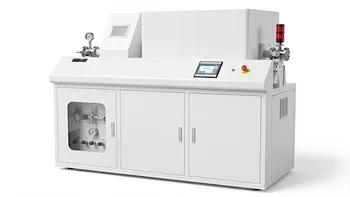
The laboratory muffle furnace is the primary tool for calcination and phase control in catalyst synthesis. By providing a stable, high-temperature environment—typically around 400°C to 450°C—the furnace facilitates the thermal decomposition of organic precursors and guides the recrystallization of amorphous titanium dioxide into the specific anatase phase. This process is fundamental to establishing the catalyst's final crystal structure, active surface area, and chemical purity.
The muffle furnace acts as a precision reactor that transforms soft, organic-laden precursors into hard, crystalline Anatase Titanium Dioxide. Its role is defined by two critical functions: the removal of structural impurities through oxidation and the controlled thermal induction of the anatase lattice structure.
Facilitating the Phase Transformation to Anatase
Guiding Recrystallization from Amorphous States
In the initial stages of synthesis, titanium dioxide often exists in a disordered, amorphous state. The muffle furnace provides the thermal energy required for lattice atom rearrangement, allowing the material to transition into the stable, photocatalytically active anatase crystalline phase.
Preventing the Transition to Rutile
Precise temperature control is vital because higher temperatures can trigger a phase transition from anatase to rutile, which generally possesses lower catalytic activity. By maintaining a steady environment near 400°C, the furnace stabilizes the anatase phase and preserves the single-atom active sites necessary for high performance.
Regulating Crystal Growth and Distribution
The furnace’s ability to follow programmed heating rates (such as 1°C/min or 2°C/min) allows for the gradual growth of TiO2 grains. This controlled approach prevents rapid, erratic crystallization, ensuring a uniform distribution of catalyst particles across the support material.
Purification through Thermal Decomposition
Oxidation of Precursors and Template Agents
Solid precursors generated via the sol-gel method often contain organic ligands, nitrates, and template agents like P-123. The muffle furnace facilitates air oxidation, effectively burning off these organic components to clear the mesoporous space and expose the active catalyst surface.
Elimination of Binders and Surfactants
When preparing TiO2 electrodes or films, organic binders and surfactants are used to maintain the paste's consistency. The high-temperature environment of the muffle furnace removes these additives, ensuring that the final material is chemically pure and free of structural disorder.
Optimization of Specific Surface Area
By thoroughly decomposing organic components, the furnace creates a porous film structure. This porosity is essential for increasing the active surface area, which directly correlates to the number of available sites for chemical reactions.
Structural Sintering and Connectivity
Promoting Particle Necking
At temperatures around 500°C, the muffle furnace promotes neck growth between individual TiO2 nanoparticles. This sintering process creates physical connections between grains, establishing a continuous network that is essential for structural integrity.
Enhancing Charge Transport Efficiency
By reducing lattice defects and minimizing the Urbach energy (a measure of structural disorder), the furnace optimizes the electrical connectivity of the catalyst. This enhancement facilitates more efficient charge transport, which is a critical factor in the performance of photocatalytic and electrochemical systems.
Understanding the Trade-offs
Temperature Sensitivity and Sintering Risks
While high temperatures are necessary for crystallinity, excessive heat can lead to over-sintering. This reduces the total surface area and can cause the collapse of delicate mesoporous structures, ultimately degrading the catalyst's effectiveness.
The Challenge of Phase Purity
The window for pure anatase production is narrow; if the furnace calibration drifts or the program is too aggressive, rutile impurities will form. This requires rigorous monitoring of the heating duration and maximum temperature to maintain the desired physicochemical characteristics.
How to Apply This to Your Project
Recommendations for Optimal Catalyst Preparation
- If your primary focus is maximizing photocatalytic activity: Set the muffle furnace to approximately 350°C–400°C to ensure a pure anatase phase while preventing the formation of rutile.
- If your primary focus is structural durability in thin films: Utilize a higher sintering temperature near 500°C with a slow ramp rate to promote strong electrical connectivity and particle necking.
- If your primary focus is high-porosity mesoporous materials: Focus on a prolonged oxidation stage at 550°C to ensure the complete removal of template agents like P-123.
By mastering the thermal program of the muffle furnace, you dictate the transition from a raw chemical precursor to a highly specialized, crystalline catalyst.
Summary Table:
| Process Function | Key Temperature/Parameter | Resulting Impact on TiO2 |
|---|---|---|
| Phase Transformation | 400°C – 450°C | Transitions amorphous TiO2 to active Anatase; avoids Rutile phase. |
| Thermal Purification | Air Oxidation Stage | Removes organic ligands, templates (P-123), and binders. |
| Structural Sintering | ~500°C (Slow Ramp) | Promotes particle necking for better charge transport and durability. |
| Grain Regulation | 1°C/min - 2°C/min | Ensures uniform crystal distribution and high specific surface area. |
Achieve Unmatched Precision in Your Catalyst Synthesis with KINTEK
Precise thermal management is the difference between a high-performance catalyst and a failed experiment. KINTEK specializes in advanced laboratory equipment and consumables, providing the high-stability thermal environments required for sensitive phase transformations.
We offer a comprehensive range of high-temperature furnaces, including:
- Muffle & Tube Furnaces for precise calcination and sintering.
- Rotary & Atmosphere Furnaces for uniform material processing.
- Vacuum, CVD, and Induction Melting Furnaces for specialized chemical vapor deposition.
- Dental & Custom High-Temp Solutions tailored to your unique research specifications.
Don't let temperature fluctuations compromise your Anatase purity. Partner with KINTEK for reliable, customizable heating solutions designed for the modern laboratory.
Contact KINTEK Today to Optimize Your Process
References
- Xinze Du, Z. Conrad Zhang. Selective nucleophilic α-C alkylation of phenols with alcohols via Ti=Cα intermediate on anatase TiO2 surface. DOI: 10.1038/s41467-023-40101-7
This article is also based on technical information from Kintek Furnace Knowledge Base .
Related Products
- 1200℃ Muffle Oven Furnace for Laboratory
- Laboratory Muffle Oven Furnace with Bottom Lifting
- 1400℃ Muffle Oven Furnace for Laboratory
- 1800℃ High Temperature Muffle Oven Furnace for Laboratory
- High Temperature Muffle Oven Furnace for Laboratory Debinding and Pre Sintering
People Also Ask
- How does a high-temperature laboratory muffle furnace affect material properties? Transform Anodic Oxide Films Fast
- What is the primary function of a high-temperature laboratory muffle furnace in chemical synthesis? Achieve Precision.
- How is a laboratory muffle furnace used in 3D-printed PP-CF cross-linking? Achieve Thermal Stability at 150 °C
- What is the critical role of a laboratory high-temperature muffle furnace in TiO2/LDH? Unlock Superior Crystallization
- How is a laboratory high-temperature muffle furnace used to evaluate porous Co-Al materials? Precision Thermal Analysis