
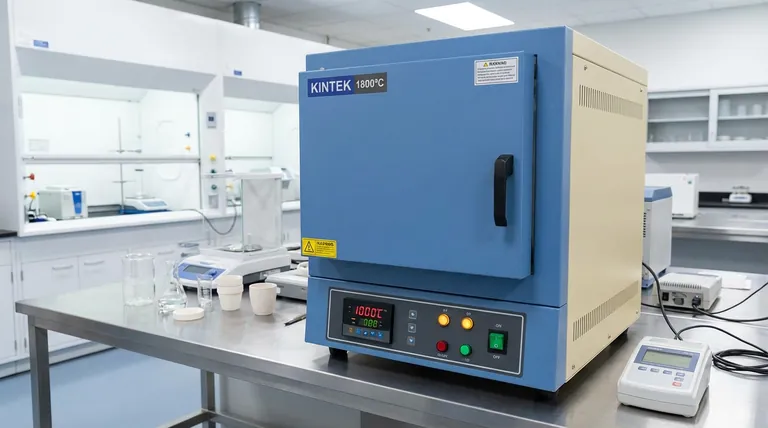
The primary role of a high-temperature muffle furnace in this context is to drive the sintering process at precisely 1000 °C. This specific thermal environment is required to decompose impregnated precursor salts and trigger the solid-phase reactions that convert these precursors into the final Pr2Ni0.8Co0.2O4+delta (PNCO) crystal phase.
By facilitating controlled high-temperature sintering, the furnace ensures the transformation of raw precursors into a stable PNCO nanofilm that is chemically compatible with and mechanically bonded to the LSC framework.
The Mechanism of Phase Formation
Decomposition of Precursors
The initial function of the furnace is to supply sufficient thermal energy to break down the precursor salts absorbed during impregnation.
At these elevated temperatures, the salts decompose, effectively removing volatile components. This step clears the way for the remaining elements to begin reacting.
Triggering Solid-Phase Reactions
Once decomposition occurs, the furnace maintains the environment necessary for solid-phase reactions.
These reactions are responsible for combining the constituent elements into the desired oxide material. Without this sustained heat, the chemical transformation would remain incomplete.
Crystallization of the PNCO Phase
The ultimate goal of this thermal treatment is the formation of the specific Pr2Ni0.8Co0.2O4+delta (PNCO) crystal structure.
The 1000 °C setpoint provides the thermodynamic conditions required to stabilize this specific phase. This ensures the electrode component achieves the correct electronic and ionic properties.
Ensuring Structural Integrity
Creating Chemical Compatibility
Beyond simple phase formation, the muffle furnace ensures the new material works in harmony with the existing structure.
The controlled heat treatment fosters chemical compatibility between the newly formed PNCO nanofilm and the underlying LSC (Lanthanum Strontium Cobaltite) framework. This prevents adverse reactions that could degrade performance.
Establishing Mechanical Adhesion
The sintering process physically bonds the materials together.
High-temperature treatment promotes strong mechanical adhesion of the PNCO nanofilm to the LSC backbone. This integration is critical for the durability of the electrode during operation.
Critical Process Considerations
The Necessity of Precision
While high heat is the catalyst, the precision of the thermal environment is the controlling variable.
Just as with other high-performance materials like superalloys or Pziopiezoceramics, the uniformity of the heat is essential. Inconsistencies in the furnace chamber could lead to incomplete phase formation or weak bonding in localized areas.
Temperature Specificity
The process relies on hitting the 1000 °C target specifically for PNCO formation.
Operating significantly below this temperature may fail to trigger the necessary solid-phase reactions. Conversely, excessive heat could damage the underlying LSC framework or alter the stoichiometry of the nanofilm.
Making the Right Choice for Your Goal
To optimize the post-treatment of PNCO-impregnated electrodes, consider the following objectives:
- If your primary focus is Phase Purity: Ensure your furnace can maintain a stable 1000 °C to guarantee the complete decomposition of salts and the correct crystallization of the PNCO phase.
- If your primary focus is Mechanical Durability: Prioritize thermal uniformity during the hold time to maximize the adhesion strength between the PNCO nanofilm and the LSC framework.
Success in this process depends entirely on using the furnace not just as a heater, but as a precision tool for crystallographic engineering.
Summary Table:
| Process Phase | Temperature | Key Outcome |
|---|---|---|
| Precursor Decomposition | 1000 °C | Removal of volatile components from salts |
| Solid-Phase Reaction | 1000 °C | Chemical transformation into PNCO oxide |
| Crystallization | 1000 °C | Formation of Pr2Ni0.8Co0.2O4+delta phase |
| Structural Integration | 1000 °C | Chemical compatibility & mechanical bonding to LSC |
Elevate Your Electrode Performance with KINTEK
Precise crystallographic engineering requires uncompromising thermal control. KINTEK provides high-performance Muffle, Tube, and Vacuum furnace systems specifically designed to meet the rigorous 1000 °C demands of PNCO and LSC material processing.
Backed by expert R&D and advanced manufacturing, our laboratory furnaces are fully customizable to ensure perfect thermal uniformity and mechanical adhesion for your unique electrochemical needs.
Ready to optimize your sintering process? Contact KINTEK today for a customized solution.
References
- Binbin Liu, Tao Li. Pr<sub>2</sub>Ni<sub>0.8</sub>Co<sub>0.2</sub>O<sub>4+<i>δ</i></sub> impregnated La<sub>0.6</sub>Sr<sub>0.4</sub>CoO<sub>3−<i>δ</i></sub> oxygen electrode for efficient CO<sub>2</sub> electroreduction in solid oxide electrolysis cells. DOI: 10.1039/d4ra01848f
This article is also based on technical information from Kintek Furnace Knowledge Base .
Related Products
- 1700℃ High Temperature Muffle Oven Furnace for Laboratory
- 1800℃ High Temperature Muffle Oven Furnace for Laboratory
- 1400℃ Muffle Oven Furnace for Laboratory
- 1200℃ Muffle Oven Furnace for Laboratory
- High Temperature Muffle Oven Furnace for Laboratory Debinding and Pre Sintering
People Also Ask
- What is the primary function of a high-temperature laboratory muffle furnace in chemical synthesis? Achieve Precision.
- How does a high-temperature laboratory muffle furnace affect material properties? Transform Anodic Oxide Films Fast
- What role does a muffle furnace play in BCZY712 electrolyte powder production? Achieve Perfect Phase Purity
- How does the two-stage sintering process contribute to the synthesis of MeCuFeO3 perovskite? Optimize crystal purity.
- What is the role of a high-temperature muffle furnace in guava leaf carbonization? Master Precise Pyrolysis Control



















