
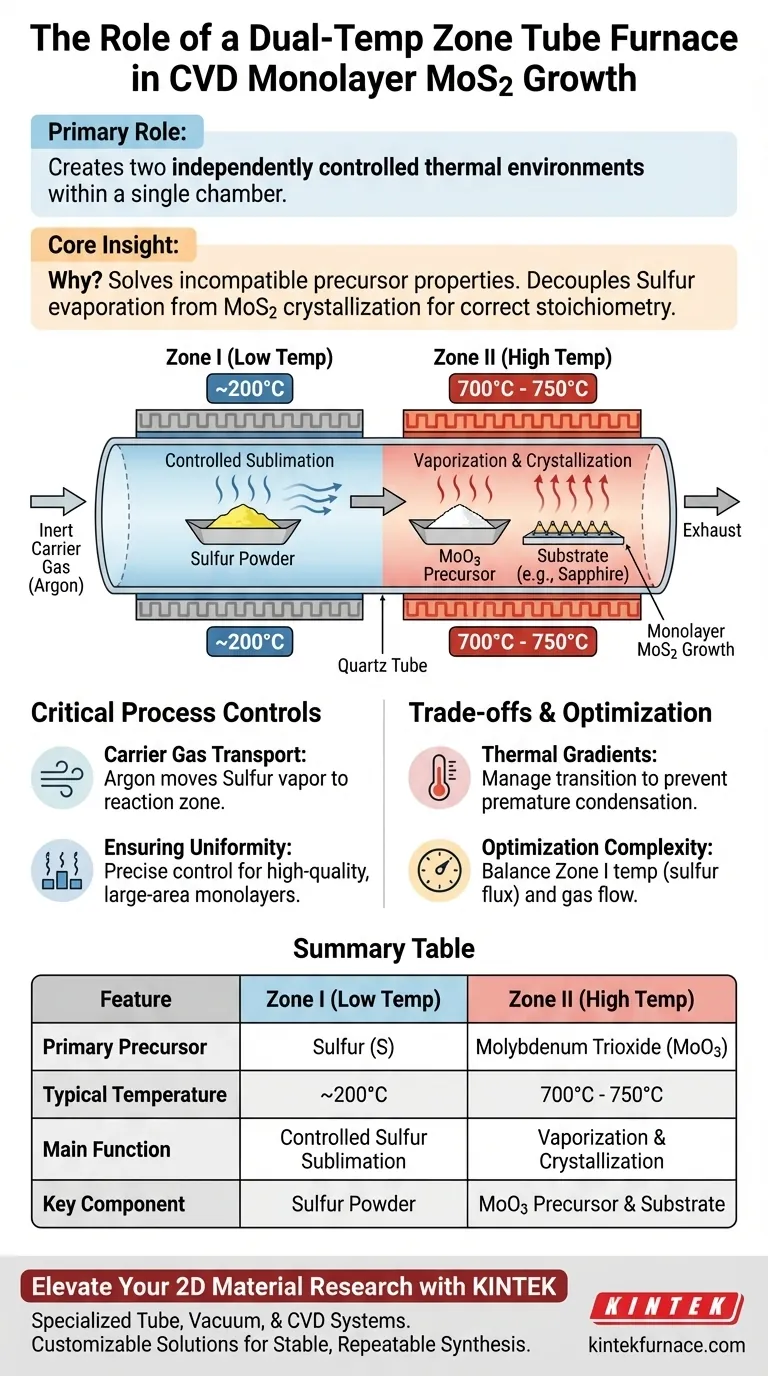
The primary role of a dual-temperature zone tube furnace in CVD is to create two distinct, independently controlled thermal environments within a single reaction chamber. This configuration is essential because the two precursor materials—Sulfur and Molybdenum Trioxide (MoO3)—have vastly different sublimation points. By maintaining a low-temperature zone (approximately 200°C) for sulfur and a high-temperature zone (approximately 700°C) for the molybdenum source and substrate, the system ensures stable vapor generation and facilitates the precise chemical reaction required for monolayer growth.
Core Insight: The dual-zone configuration solves the problem of incompatible precursor properties. It allows you to decouple the evaporation rate of the sulfur from the crystallization temperature of the molybdenum disulfide, ensuring the correct stoichiometric ratio reaches the substrate.
The Mechanics of Dual-Zone CVD
Managing Disparate Sublimation Points
The synthesis of Molybdenum Disulfide (MoS2) requires two solid precursors: Sulfur powder and Molybdenum Trioxide (MoO3) powder.
These materials cannot be processed at the same temperature. Sulfur sublimates at a relatively low temperature, while MoO3 requires significantly higher heat to vaporize and react.
The Low-Temperature Zone (Zone I)
This zone is typically set to approximately 200°C (though specific protocols may vary).
Its sole purpose is the controlled sublimation of the sulfur powder. By isolating the sulfur in this cooler zone, the furnace prevents rapid, uncontrolled evaporation that would occur if the sulfur were exposed to the high reaction temperatures immediately.
The High-Temperature Zone (Zone II)
This zone is maintained at a much higher temperature, typically around 700°C to 750°C.
This zone houses both the MoO3 precursor and the deposition substrate (often sapphire or silica). The high heat triggers the vaporization of MoO3 and provides the thermal energy necessary for the chemical reaction and subsequent crystallization of MoS2 on the substrate surface.
Critical Process Controls
Transport via Carrier Gas
While the furnace provides the heat, an inert carrier gas (typically high-purity Argon) provides the transport mechanism.
The gas flows from the low-temperature zone to the high-temperature zone. It carries the sulfur vapor downstream, where it mixes with the MoO3 vapor to react at the substrate site.
Ensuring Uniformity and Quality
The precise control of the two temperature zones ensures that precursor vapors arrive at the substrate at specific, controlled rates.
This stability is what enables the growth of high-quality, large-area monolayers with uniform atomic thickness and triangular morphology. Without this balance, the growth results in uneven, bulk, or low-quality crystals.
Understanding the Trade-offs
Sensitivity to Thermal Gradients
While dual-zone furnaces offer precision, they introduce complexity regarding the thermal gradient between zones.
If the transition between the 200°C zone and the 700°C zone is not managed correctly, vapors may condense prematurely in the cooler region between the heaters. This can starve the reaction zone of necessary precursors.
Optimization Complexity
Dual-zone systems require more parameters to be optimized compared to single-zone systems.
You must balance the temperature of Zone I (which dictates sulfur flux) against the flow rate of the carrier gas. If Zone I is too hot, sulfur is exhausted too quickly; if it is too cool, the reaction becomes sulfur-deficient, leading to poor film quality.
Making the Right Choice for Your Goal
The dual-zone tube furnace is the industry standard for research-grade MoS2 synthesis. How you configure it depends on your specific output requirements.
- If your primary focus is Monolayer Purity: Prioritize the precision of the low-temperature zone to prevent sulfur oversaturation, which can lead to multilayer growth.
- If your primary focus is Crystal Size: Focus on optimizing the high-temperature zone (700°C+) to encourage slower, more ordered thermodynamic growth on the substrate.
Summary: The dual-temperature zone furnace transforms a complex chemical incompatibility into a controllable variable, acting as the fundamental enabler for growing high-quality 2D materials.
Summary Table:
| Feature | Zone I (Low Temp) | Zone II (High Temp) |
|---|---|---|
| Primary Precursor | Sulfur (S) | Molybdenum Trioxide (MoO3) |
| Typical Temperature | ~200°C | 700°C - 750°C |
| Main Function | Controlled Sulfur Sublimation | Vaporization & Crystallization |
| Key Component | Sulfur Powder | MoO3 Precursor & Substrate |
Elevate Your 2D Material Research with KINTEK
Precise thermal gradients are the secret to high-quality monolayer growth. Backed by expert R&D and world-class manufacturing, KINTEK offers specialized Tube, Vacuum, and CVD systems designed specifically for the rigorous demands of material science.
Whether you need a standard dual-zone configuration or a fully customizable high-temp furnace tailored to your unique research needs, our team provides the technical expertise to ensure your synthesis is stable and repeatable.
Ready to optimize your CVD process?
Contact us today to find your custom furnace solution!
Visual Guide
References
- Krishna Rani Sahoo, Tharangattu N. Narayanan. Vanadium Doped Magnetic MoS<sub>2</sub> Monolayers of Improved Electrical Conductivity as Spin‐Orbit Torque Layer. DOI: 10.1002/adfm.202502408
This article is also based on technical information from Kintek Furnace Knowledge Base .
Related Products
- Magnesium Extraction and Purification Condensing Tube Furnace
- Multi Heating Zones CVD Tube Furnace Machine for Chemical Vapor Deposition Equipment
- Split Multi Heating Zone Rotary Tube Furnace Rotating Tube Furnace
- 1400℃ High Temperature Laboratory Tube Furnace with Alumina Tube
- Multi Zone Laboratory Quartz Tube Furnace Tubular Furnace
People Also Ask
- What are the advantages of using a condensing tube furnace for magnesium extraction? Achieve High Purity and Efficient Metal Recovery
- What is the heating rate of a tube furnace? Balancing Speed with Safety for Your Lab
- Why use a tube furnace instead of a muffle furnace for annealing? Achieve Superior Process Control
- What factors should be considered when selecting a tube furnace? Choose the Right Furnace for Your Lab Needs
- What are the applications of a tube furnace? Master Precise Thermal Processing for Advanced Materials



















