
Pre-heating industrial-grade ceramic molds is a fundamental process control step designed to manage the thermal shock that occurs when molten metal enters a casting shell. By raising the mold temperature to approximately 900°C prior to pouring, you significantly reduce the quenching effect, ensuring the metal remains fluid enough to fill complex cavities while establishing the thermal conditions necessary for a specific internal structure.
By minimizing the dramatic temperature difference between the melt and the mold, pre-heating prevents premature solidification defects and orchestrates the controlled cooling rates required to achieve a uniform equiaxed grain microstructure.
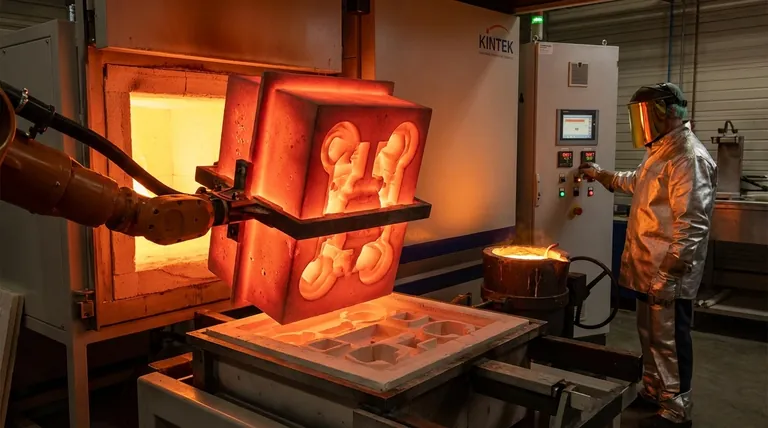
Managing Thermal Dynamics
Reducing the Quenching Effect
When molten superalloys come into contact with a cooler surface, they lose heat rapidly. This phenomenon, known as the quenching effect, can cause the metal to solidify instantaneously upon contact with the mold wall.
Pre-heating the ceramic mold mitigates this thermal shock. By bringing the mold closer to the temperature of the alloy, you create a thermal buffer that preserves the energy within the molten metal.
Controlling the Cooling Rate
The structural integrity of a casting is defined by how it cools. Pre-heating allows for precise control over the alloy's cooling rate.
Rather than freezing chaotically, the metal cools according to a regulated thermal gradient. This controlled solidification is the primary mechanism that facilitates the formation of a uniform equiaxed grain microstructure, which is essential for the mechanical properties of the final component.
Ensuring Casting Integrity
Achieving Complete Mold Filling
For the casting to be successful, the liquid metal must reach every corner of the mold cavity before it solidifies.
Pre-heating ensures the metal retains its fluidity for a longer duration. This extended flow time allows the melt to navigate intricate geometries and fill the mold completely.
Preventing Flow-Related Defects
Inadequate thermal management is a leading cause of casting rejection. If the metal cools too quickly while flowing, it creates internal voids or incomplete sections.
By maintaining high mold temperatures, you directly prevent common defects such as cold shuts (where two flow fronts fail to fuse) and misruns (where the metal freezes before filling the mold).
Common Pitfalls to Avoid
The Consequence of Inadequate Heating
Failing to reach the target pre-heat temperature (e.g., 900°C) compromises the entire process.
If the mold is too cool, the reduction in the quenching effect will be insufficient. This leads to rapid, uncontrolled solidification at the mold walls, which disrupts the formation of the desired equiaxed grain structure.
Balancing Flow and Solidification
The goal is not simply to keep the metal hot, but to achieve a specific thermal balance.
If the temperature is not maintained uniformly, you risk inconsistent filling. The pre-heating process must be thorough to ensure that defect prevention (cold shuts/misruns) and microstructural goals (equiaxed grains) are achieved simultaneously.
Optimizing Your Casting Strategy
To ensure high-yield production of equiaxed components, align your thermal parameters with your specific quality targets:
- If your primary focus is Geometric Complexity: Prioritize pre-heating to the upper limits of the acceptable range to maximize fluidity and eliminate misruns in thin sections.
- If your primary focus is Material Properties: Strict adherence to the 900°C target is required to dictate the precise cooling rate that yields a uniform equiaxed grain microstructure.
Mastering the pre-heat temperature is the single most effective way to synchronize mold filling with microstructural evolution.
Summary Table:
| Key Benefit | Primary Mechanism | Impact on Casting Quality |
|---|---|---|
| Reduced Quenching | Mitigates thermal shock between melt and mold | Prevents premature solidification and surface defects |
| Enhanced Fluidity | Maintains molten metal energy for longer durations | Ensures complete filling of complex mold geometries |
| Grain Control | Regulates the alloy's cooling rate | Facilitates a uniform equiaxed microstructure |
| Defect Prevention | Balances flow and solidification dynamics | Eliminates cold shuts, misruns, and internal voids |
Elevate Your Investment Casting Precision with KINTEK
Achieving a perfect equiaxed grain structure requires absolute thermal control. Backed by expert R&D and world-class manufacturing, KINTEK provides high-performance Muffle, Tube, and Vacuum furnace systems designed specifically for the rigorous demands of industrial mold pre-heating and alloy processing.
Whether you need standard lab equipment or a fully customizable high-temperature furnace tailored to your unique casting geometry, our team ensures your facility achieves maximum yield and material integrity.
Ready to optimize your thermal dynamics? Contact our engineering experts today to find the perfect solution for your production needs.
References
- Sergiy Byelikov, Sergiy Pychek. COMPARATIVE ANALYSIS OF THE COMPLEX OF PROPERTIES OF NICKEL-BASED SUPERALLOY. DOI: 10.15588/1607-6885-2025-1-2
This article is also based on technical information from Kintek Furnace Knowledge Base .
Related Products
- Vacuum Heat Treat Furnace with Ceramic Fiber Liner
- Vacuum Dental Porcelain Sintering Furnace for Dental Laboratories
- Dental Porcelain Zirconia Sintering Ceramic Vacuum Press Furnace
- High Temperature Muffle Oven Furnace for Laboratory Debinding and Pre Sintering
- Chairside Dental Porcelain Zirconia Sintering Furnace with Transformer for Ceramic Restorations
People Also Ask
- How does vacuum heat treating affect the grain structure of metal alloys? Achieve Precise Microstructure Control
- What are the benefits of using vacuum heat treating furnaces for metal alloys? Achieve Superior Metal Properties and Performance
- What is one of the most important uses of vacuum heat treating furnaces in aerospace? Achieve Superior Strength in Aircraft Alloys
- How does a vacuum heat treat furnace work? Achieve Pristine, High-Performance Results
- What is the difference between heat treat and vacuum heat treat? Achieve Superior Metal Properties with Pristine Finishes



















