
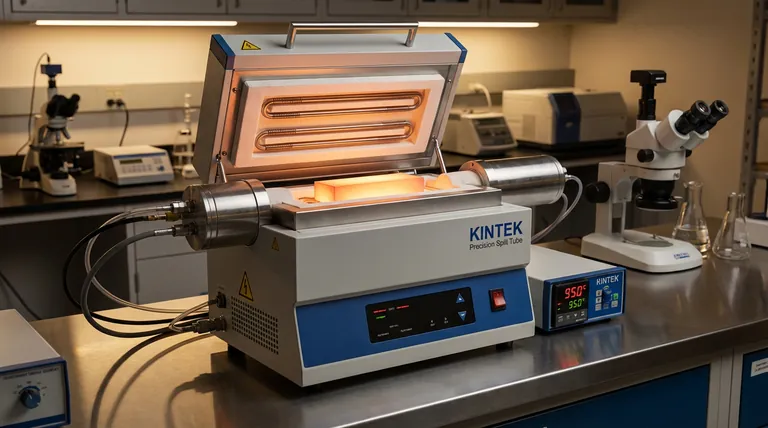
A precision temperature-controlled annealing furnace directly dictates the final grain size of cold-rolled TWIP (Twinning-Induced Plasticity) steel by strictly regulating the recrystallization process. By maintaining exact heating temperatures—such as 950 °C—and precise holding times, the system effectively suppresses the natural tendency of grains to grow excessively. This control enables the production of specific fine-grained structures, typically around the 10-micrometer scale, which are required to achieve high yield strength.
Precision control is the defining factor between a standard alloy and a high-performance material. By preventing excessive grain growth during the critical annealing phase, these furnaces allow you to engineer a specific microstructure that maximizes the steel's yield strength.
The Mechanics of Microstructure Control
Regulating Recrystallization
The primary function of the furnace is to manage the recrystallization of the steel after cold rolling.
During this phase, deformed grains are replaced by a new set of defect-free grains. The furnace ensures this process occurs uniformly without allowing the new grains to merge and expand uncontrollably.
Managing Time and Temperature
Precise adherence to parameters, such as a heating temperature of 950 °C, is critical for success.
However, temperature is only half the equation; the furnace also regulates the holding time. This combination ensures the material reaches the desired state without "soaking" long enough to trigger unwanted coarsening.
Suppressing Grain Growth
Without precision control, grains naturally seek to lower their energy by growing larger.
A high-precision system actively suppresses this excessive growth. This allows the operator to "lock in" the microstructure at the optimal moment, rather than letting the thermodynamics run unchecked.
Impact on Mechanical Properties
Achieving the 10-Micrometer Scale
The target for high-performance TWIP steel is often a specific, fine-grained structure.
Reference data suggests that precision annealing enables the consistent preparation of grains at the 10-micrometer scale. This level of refinement is difficult to achieve with standard furnaces that lack tight thermal regulation.
Enhancing Yield Strength
There is a direct correlation between grain size and the mechanical integrity of the steel.
By ensuring the grains remain fine (small), the furnace facilitates the production of high-yield-strength TWIP steel. Large, coarse grains would result in a material that yields under significantly less stress.
Understanding the Trade-offs
The Risk of Thermal Overshoot
If the furnace lacks precision, even a slight overshoot in temperature can have exponential effects on grain growth.
Once grains begin to coarsen (grow large), the process is generally irreversible. This results in a softer material that fails to meet yield strength specifications.
Balancing Time vs. Structure
There is a delicate balance between ensuring full recrystallization and preventing growth.
If the holding time is too short to avoid growth, the steel may retain internal stresses from cold rolling. Conversely, if the time is too long, the suppression of grain growth fails, and the fine 10-micrometer structure is lost.
Making the Right Choice for Your Goal
To optimize your TWIP steel production, align your furnace parameters with your specific mechanical requirements.
- If your primary focus is maximum yield strength: Prioritize a furnace with tight thermal tolerance to strictly maintain the 10-micrometer grain scale and suppress growth.
- If your primary focus is process repeatability: Ensure your system can identically replicate the 950 °C holding cycle to guarantee consistent recrystallization across different batches.
Ultimate material performance is not just about applying heat; it is about the disciplined architectural control of the steel's internal structure.
Summary Table:
| Parameter | Process Role | Impact on TWIP Steel |
|---|---|---|
| 950 °C Control | Regulates Recrystallization | Prevents thermal overshoot and irreversible grain coarsening |
| Holding Time | Manages Thermal Soaking | Ensures full recrystallization while suppressing excessive growth |
| Grain Refinement | Architectural Control | Maintains 10-micrometer scale for optimal microstructure |
| Mechanical Output | Yield Strength Optimization | Produces high-performance steel with superior stress resistance |
Engineer Superior Material Properties with KINTEK
Unlock the full potential of your TWIP steel and advanced alloys through the disciplined architectural control of internal microstructures. Backed by expert R&D and manufacturing, KINTEK offers high-performance Muffle, Tube, Rotary, Vacuum, and CVD systems—all fully customizable to meet your specific lab or production requirements.
Whether you need to maintain a strict 10-micrometer grain scale or ensure 950 °C cycle repeatability, our precision thermal solutions provide the reliability you need to maximize yield strength. Contact KINTEK today to discover how our high-temperature furnaces can elevate your material science outcomes.
References
- Xiaozhou Zhou, Lei Jiang. Machine-Learning-Assisted Composition Design for High-Yield-Strength TWIP Steel. DOI: 10.3390/met14080952
This article is also based on technical information from Kintek Furnace Knowledge Base .
Related Products
- Controlled Inert Nitrogen Hydrogen Atmosphere Furnace
- Split Multi Heating Zone Rotary Tube Furnace Rotating Tube Furnace
- Mesh Belt Controlled Atmosphere Furnace Inert Nitrogen Atmosphere Furnace
- Small Vacuum Heat Treat and Tungsten Wire Sintering Furnace
- 1200℃ Controlled Inert Nitrogen Atmosphere Furnace
People Also Ask
- How does hydrogen furnace annealing assist in preparing mechanically alloyed powders for compaction?
- How does atmospheric annealing in a controlled hydrogen furnace affect the cold compaction behavior of metal powders?
- What are the characteristics and uses of hydrogen atmosphere in furnaces? Achieve Superior Surface Purity and Bonding
- What are the characteristics and uses of hydrogen atmospheres in furnaces? Unlock Clean Metal Processing
- What controlled-atmosphere furnace conditions are required for sintering powder metallurgy copper alloy compacts? Ideal Setup










