
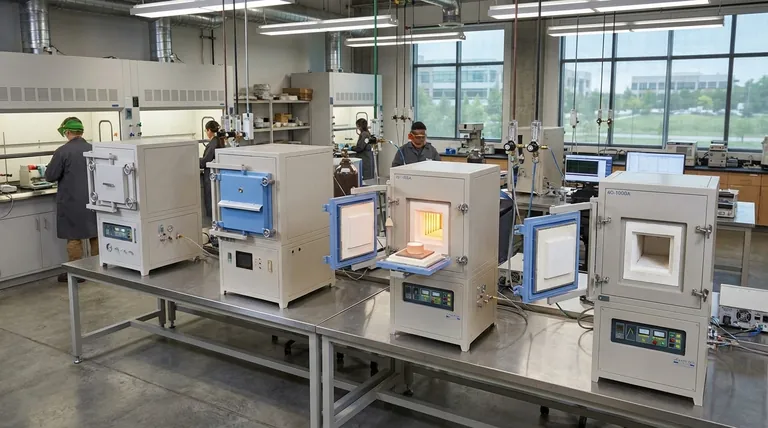
In material processing, atmosphere furnaces are specialized ovens used for high-temperature applications like heat treatment, sintering, and annealing. Their defining feature is the ability to precisely control the gaseous environment surrounding a material, which is critical for preventing unwanted chemical reactions like oxidation and for achieving specific structural or chemical properties. This control is fundamental to producing high-performance materials, from hardened steel components to advanced ceramic parts.
The core purpose of an atmosphere furnace is to move beyond simple heating and master the chemical environment around a material. This allows engineers to either perfectly preserve a material’s existing properties or intentionally and precisely alter them to meet demanding performance requirements.
The Core Principle: Why Control the Atmosphere?
An atmosphere furnace gives you command over the chemical reactions that occur at high temperatures. This control is generally exercised for one of two fundamental reasons: to protect the material or to change it.
To Prevent Unwanted Reactions
Many materials react with oxygen in the air at high temperatures, a process known as oxidation. This can create a brittle, undesirable oxide layer (like rust on steel) that compromises the material's surface finish, strength, and integrity.
Atmosphere furnaces prevent this by replacing the air with a protective, inert gas such as nitrogen or argon. Similarly, they can prevent decarburization, the loss of carbon from the surface of steel, which would otherwise reduce its hardness.
To Promote Desired Reactions
Conversely, a furnace can be used to introduce a chemically reactive atmosphere to intentionally modify a material's surface. This is a form of controlled chemical reaction driven by heat.
A classic example is carburizing, where a carbon-rich atmosphere (using gases like carbon monoxide) is used to diffuse carbon into the surface of low-carbon steel. This creates a hard, wear-resistant outer case while leaving the core tough and ductile.
To Ensure Structural Purity
For processes like the sintering of ceramics or the crystal growth of advanced materials, atmosphere control is vital. It ensures that no impurities from the air are incorporated into the material's structure.
This leads to better densification, higher purity, and more uniform crystal structures, which are critical for achieving desired mechanical, electrical, or optical properties.
Key Applications in Modern Processing
The ability to manipulate a material's environment at high temperatures makes atmosphere furnaces indispensable across various industries.
Heat Treatment and Annealing
In processes like annealing, the goal is to soften a metal, relieve internal stresses, and refine its grain structure to improve ductility. Performing this in a controlled atmosphere ensures the material achieves these properties without suffering from surface oxidation.
Sintering of Ceramics and Powders
Sintering involves heating compacted powders to a temperature below their melting point to fuse the particles together into a solid, dense object. An atmosphere furnace provides the clean, oxygen-free environment needed to create high-purity ceramic components with minimal defects.
Advanced Material Synthesis
These furnaces are crucial in the research and production of new materials. For example, synthesizing cathode materials for lithium-ion batteries requires a high-temperature, controlled-oxygen environment to achieve the correct crystallinity and purity, which directly impacts battery performance and lifespan.
Understanding the Trade-offs
While powerful, choosing and operating an atmosphere furnace involves strategic decisions and acknowledging its limitations compared to simpler heating methods.
Protective vs. Reactive Atmospheres
The most fundamental choice is the purpose of the atmosphere itself. An inert gas is used for protection, while a reactive gas is a tool for surface engineering. The latter requires far more precise control over gas composition, temperature, and time to achieve the desired outcome.
Atmosphere vs. Vacuum Furnaces
A vacuum furnace represents the ultimate protective environment by removing virtually all gases. This is ideal for extremely sensitive materials where even trace amounts of gas could cause contamination, such as in the processing of some nanomaterials or superconducting alloys. However, vacuum systems are often more complex and costly to operate than standard atmosphere furnaces.
The Cost of Control
The primary trade-off is complexity and cost. Maintaining a specific gas mixture, ensuring the furnace chamber is sealed, and monitoring the atmosphere adds operational overhead compared to a simple furnace that operates in ambient air. This investment is only justified when the material's performance demands it.
Making the Right Choice for Your Goal
Selecting the correct thermal environment depends entirely on the intended outcome for your material.
- If your primary focus is preserving the material's bulk properties and surface finish: An inert atmosphere (like nitrogen or argon) is required to shield the material from oxidation and other surface reactions.
- If your primary focus is enhancing surface hardness or wear resistance: A reactive atmosphere, designed for processes like carburizing or nitriding, is the correct tool to drive specific surface chemistry.
- If your primary focus is achieving the absolute highest purity and preventing any gas interaction: A vacuum furnace is the superior choice, especially for highly reactive or sensitive materials.
Ultimately, mastering the furnace atmosphere is what elevates high-temperature processing from simple heating to precise material engineering.
Summary Table:
| Purpose | Atmosphere Type | Key Applications |
|---|---|---|
| Prevent Oxidation | Inert (e.g., Nitrogen, Argon) | Heat Treatment, Annealing |
| Promote Reactions | Reactive (e.g., Carbon-rich) | Carburizing, Surface Hardening |
| Ensure Purity | Controlled Gas or Vacuum | Sintering, Crystal Growth, Battery Synthesis |
Ready to elevate your material processing with precision? Leveraging exceptional R&D and in-house manufacturing, KINTEK provides diverse laboratories with advanced high-temperature furnace solutions. Our product line, including Muffle, Tube, Rotary Furnaces, Vacuum & Atmosphere Furnaces, and CVD/PECVD Systems, is complemented by our strong deep customization capability to precisely meet unique experimental requirements. Whether you're in steel hardening, ceramic sintering, or advanced material synthesis, we can help you achieve superior results. Contact us today to discuss your needs and discover how our tailored solutions can enhance your lab's efficiency and outcomes!
Visual Guide

Related Products
- 1400℃ Controlled Inert Nitrogen Atmosphere Furnace
- 1700℃ Controlled Inert Nitrogen Atmosphere Furnace
- Controlled Inert Nitrogen Hydrogen Atmosphere Furnace
- 1200℃ Controlled Inert Nitrogen Atmosphere Furnace
- Mesh Belt Controlled Atmosphere Furnace Inert Nitrogen Atmosphere Furnace
People Also Ask
- Why is controlled-atmosphere heating required for functional ceramics and sensors? Master Defect Engineering
- Why is thorough binder burnout necessary before sintering advanced ceramics? Ensure Peak Density & Zero Defects
- How do controlled-atmosphere furnaces support polymer pyrolysis? Master SiC & Si3N4 Ceramic Conversion
- How does real-time dilatometric analysis in a controlled-atmosphere furnace optimize PZT ceramic sintering?
- How do controlled-atmosphere furnaces verify ceramic powder sinterability? Get True Empirical Densification Data



















