
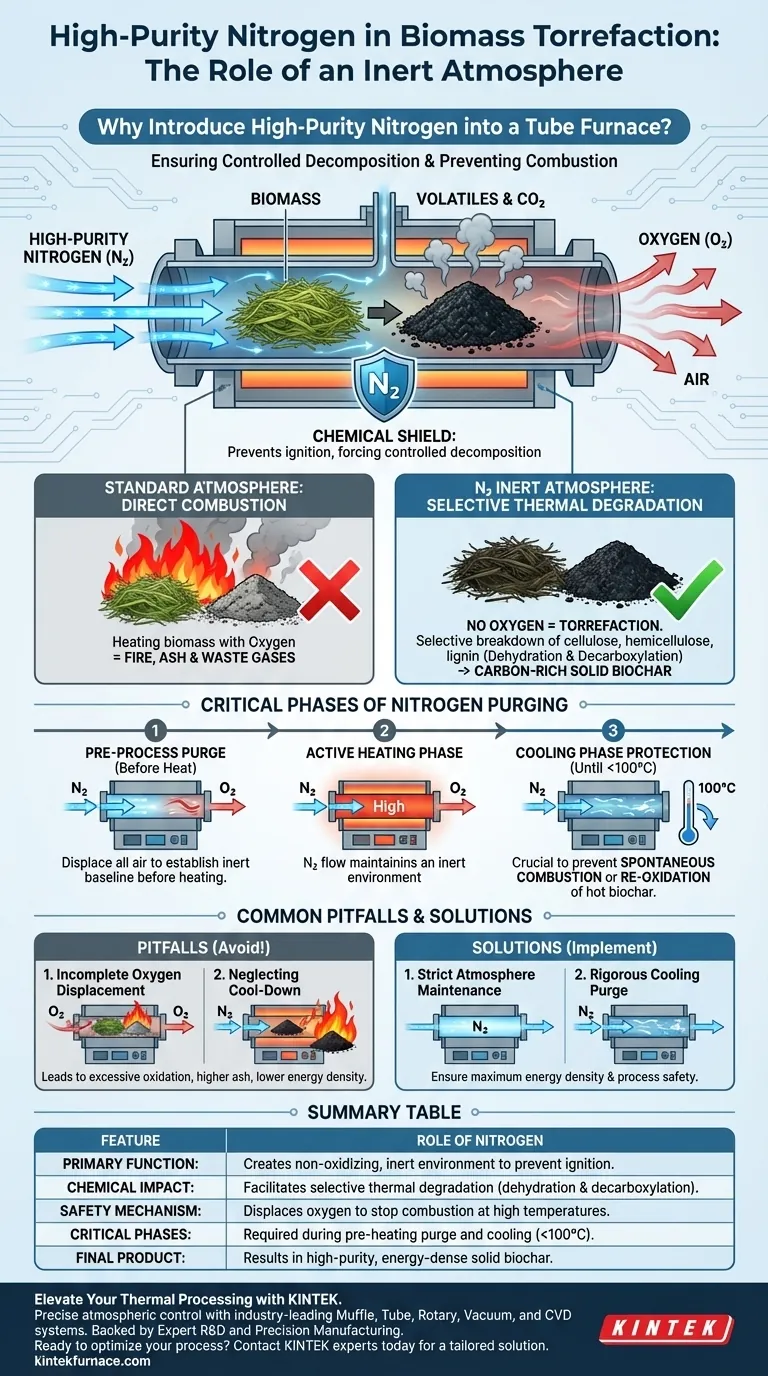
The primary purpose of introducing high-purity nitrogen into a tube furnace is to create a strictly non-oxidizing, inert environment. By displacing oxygen, nitrogen prevents the biomass from igniting during high-intensity thermal treatment, forcing it to undergo controlled decomposition rather than combustion.
Core Takeaway Nitrogen acts as a "chemical shield" that fundamentally changes the reaction from burning to roasting. It ensures the process results in energy-dense, solid biochar by permitting the selective degradation of biomass components without the destructive presence of oxygen.
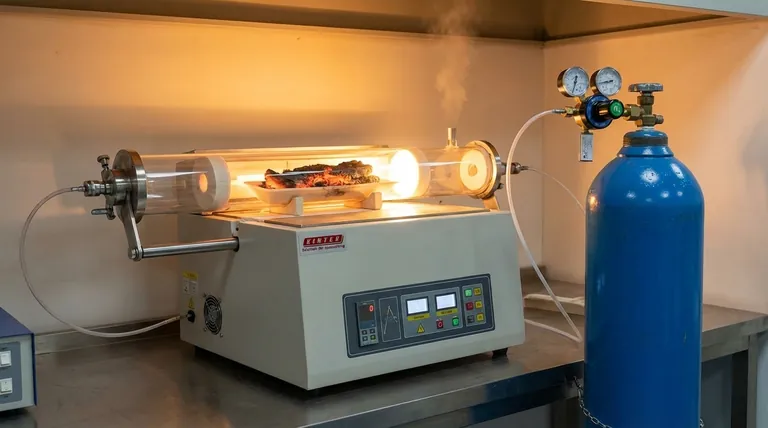
The Mechanism of Inert Atmospheres
Preventing Direct Combustion
In a standard atmosphere, heating biomass to torrefaction temperatures would trigger direct combustion, converting the material into ash and waste gases.
The introduction of high-purity nitrogen creates an oxygen-deficient environment. This eliminates the oxidizer required for fire, ensuring the biomass does not burn even when subjected to intense heat.
Enabling Selective Thermal Degradation
Once combustion is suppressed, the biomass undergoes a specific chemical transformation known as torrefaction.
Nitrogen facilitates the selective breakdown of cellulose, hemicellulose, and lignin. This occurs through dehydration (removing water) and decarboxylation (releasing CO2), leaving behind a carbon-rich solid structure.
Critical Phases of Nitrogen Purging
Pre-Process Purging
The nitrogen flow must begin before the heating cycle initiates.
A complete purge is essential to displace all air currently within the heat treatment equipment. This establishes the inert baseline required before temperatures rise.
The Cooling Phase Protection
The role of nitrogen extends beyond the active heating phase.
The inert atmosphere must be maintained throughout the cooling process until the material temperature drops below 100°C. Exposing hot biochar to oxygen prematurely can lead to spontaneous combustion or rapid re-oxidation, ruining the product quality.
Common Pitfalls to Avoid
Incomplete Oxygen Displacement
Failure to maintain a strictly "lean-oxygen" or oxygen-free atmosphere is the most common cause of process failure.
Even minor oxygen ingress can lead to excessive oxidation. This degrades the final product, resulting in a material with higher ash content and lower energy density than intended.
Neglecting the Cool-Down
Operators often underestimate the reactivity of the material immediately after heating.
Stopping the nitrogen flow while the biomass is still above 100°C allows reactive elements in the air to attack the hot surface. This compromises the purity and stability of the resulting bio-reductants.
Ensuring Product Quality for Your Project
To maximize the effectiveness of your torrefaction process, consider your specific operational goals:
- If your primary focus is Maximum Energy Density: Ensure the nitrogen atmosphere is strictly maintained to facilitate deep dehydration and decarboxylation, concentrating carbon content.
- If your primary focus is Process Safety: Rigorously enforce nitrogen purging during the cooling phase to strictly prevent spontaneous combustion of the hot solids.
High-quality biochar is defined not just by how it is heated, but by how well it is protected from oxygen throughout the entire thermal cycle.
Summary Table:
| Feature | Role of Nitrogen in Torrefaction |
|---|---|
| Primary Function | Creates a non-oxidizing, inert environment to prevent ignition. |
| Chemical Impact | Facilitates selective thermal degradation (dehydration & decarboxylation). |
| Safety Mechanism | Displaces oxygen to stop combustion at high temperatures. |
| Critical Phases | Required during pre-heating purge and cooling (until <100°C). |
| Final Product | Results in high-purity, energy-dense solid biochar. |
Elevate Your Thermal Processing with KINTEK
Precise atmospheric control is the difference between successful carbonization and wasted material. KINTEK provides industry-leading Muffle, Tube, Rotary, Vacuum, and CVD systems, all engineered to maintain the strict inert environments required for high-purity biomass torrefaction.
Backed by expert R&D and precision manufacturing, our lab high-temp furnaces are fully customizable to meet your unique research or production needs. Ensure the stability and energy density of your biochar with equipment designed for perfection.
Ready to optimize your process? Contact KINTEK experts today for a tailored solution.
Visual Guide
References
- Andreja Škorjanc, Danijela Urbancl. Advancing Energy Recovery: Evaluating Torrefaction Temperature Effects on Food Waste Properties from Fruit and Vegetable Processing. DOI: 10.3390/pr13010208
This article is also based on technical information from Kintek Furnace Knowledge Base .
Related Products
- Vacuum Sealed Continuous Working Rotary Tube Furnace Rotating Tube Furnace
- 1400℃ High Temperature Laboratory Tube Furnace with Alumina Tube
- 1700℃ High Temperature Laboratory Tube Furnace with Alumina Tube
- 1200℃ Split Tube Furnace Laboratory Quartz Tube Furnace with Quartz Tube
- Vertical Laboratory Quartz Tube Furnace Tubular Furnace
People Also Ask
- What is the purpose of rotary tube furnaces? Achieve Uniform Heat Treatment for Powders and Granules
- What are the key advantages of using a rotary tube furnace? Achieve Dynamic, Uniform Heating for Powders
- How does the amount of material processed vary between batch and continuous rotary tube furnaces? Scale Your Production Efficiently
- What are the advantages of rotary tube furnaces in fuel compatibility? Boost Efficiency and Cut Costs
- What is the temperature range of some rotary tube furnaces? Achieve Uniform Heating Up to 1200°C



















