
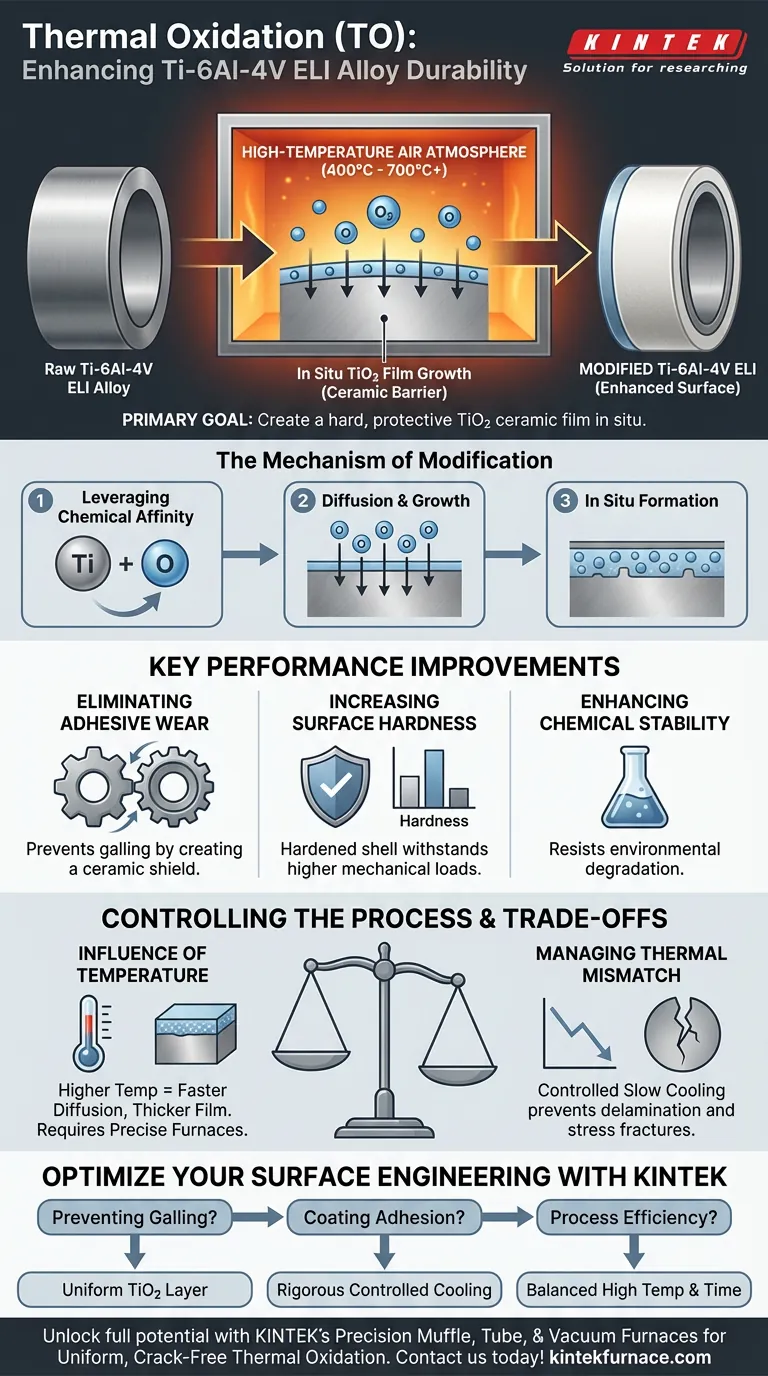
Thermal Oxidation (TO) is a surface engineering process that fundamentally enhances the durability of Ti-6Al-4V ELI alloy by creating a hard ceramic barrier. By subjecting the alloy to high temperatures in a controlled air atmosphere, the process leverages titanium's natural affinity for oxygen to grow a protective Titanium Dioxide ($\text{TiO}_2$) film directly on the surface. This modification is primarily used to overcome the material's inherent tribological weaknesses, such as poor wear resistance.
The central purpose of Thermal Oxidation is to grow a protective oxide film in situ that significantly increases surface hardness and chemical stability, specifically solving critical failure modes like adhesive wear and galling in friction components.
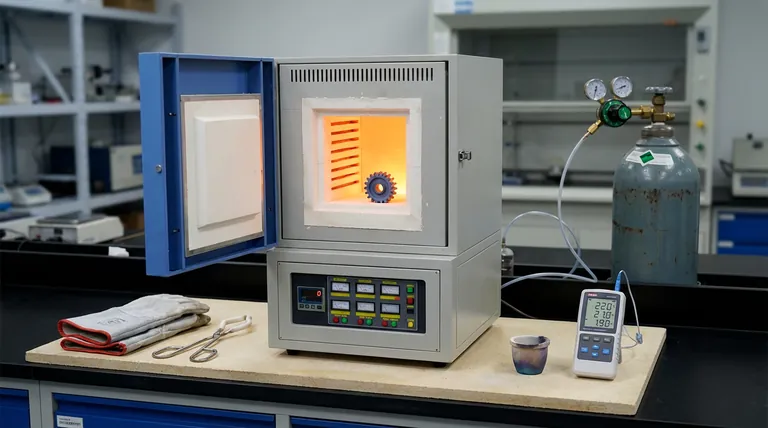
The Mechanism of Modification
Leveraging Chemical Affinity
The process relies on the high reactivity of titanium alloys with oxygen. When the Ti-6Al-4V ELI alloy is exposed to a high-temperature environment (typically within a furnace), oxygen atoms adsorb onto the surface.
Diffusion and Growth
These oxygen atoms do not merely sit on top; they diffuse into the alloy substrate. This diffusion triggers a chemical reaction that nucleates and grows a $\text{TiO}_2$ oxide layer.
In Situ Formation
Unlike a coating that is mechanically bonded to the exterior, this oxide film is grown from the bulk material itself. This results in an "in situ" modification where the protective layer is integral to the metal surface.
Key Performance Improvements
Eliminating Adhesive Wear
The primary engineering challenge with standard titanium alloys is their tendency toward "galling" or adhesive wear when rubbing against other surfaces. The TO process creates a ceramic-like shield that prevents direct metal-to-metal contact, drastically reducing this friction-induced damage.
Increasing Surface Hardness
The formation of the oxide layer significantly hardens the exterior of the component. This hardened shell allows the component to withstand higher mechanical loads without surface deformation.
Enhancing Chemical Stability
Beyond physical toughness, the $\text{TiO}_2$ film acts as a chemically stable barrier. This improves the alloy's resistance to environmental degradation, ensuring consistent performance over time.
Controlling the Process Variables
The Influence of Temperature
Temperature acts as the accelerator for this process. Higher oxidation temperatures generally speed up the diffusion of oxygen atoms and increase chemical reaction rates.
Impact on Film Morphology
Research indicates that increased temperatures lead to thicker, more uniform oxide layers with larger grain sizes. Proper thermal management ensures that the oxide coverage is consistent across the entire geometry of the part.
Equipment Precision
Achieving these results requires precise equipment, such as tube or muffle furnaces. These environments must maintain specific temperatures (often between 400°C and 700°C or higher) for extended periods to guide uniform nucleation.
Understanding the Trade-offs
Managing Thermal Mismatch
While a thick oxide layer is desirable for hardness, the process introduces thermal stress between the oxide film and the titanium substrate. If the material is cooled too quickly, these stresses can cause the protective layer to crack or peel off.
The Importance of Cooling Rates
To mitigate delamination, the process often requires a slow furnace cooling method. This gradual reduction in temperature allows thermal stresses to release naturally, ensuring the oxide film remains intact and adherent.
Balancing Kinetics and Quality
There is a balance to strike regarding process duration and temperature. While higher heat accelerates growth, precise control is needed to prevent excessive grain growth or brittle oxide structures that could compromise the film's protective qualities.
Making the Right Choice for Your Goal
To maximize the benefits of Thermal Oxidation for your specific application, consider the following:
- If your primary focus is preventing galling: Prioritize achieving a uniform, continuous $\text{TiO}_2$ layer to ensure complete separation of friction pairs.
- If your primary focus is coating adhesion: rigorous control of the cooling phase is essential to prevent thermal stress fractures and peeling.
- If your primary focus is process efficiency: Higher temperatures can reduce treatment time, but must be balanced against the risk of creating a brittle or non-uniform oxide structure.
Thermal Oxidation is the definitive solution for converting the naturally soft surface of Ti-6Al-4V ELI into a wear-resistant, chemically stable interface without compromising the bulk properties of the alloy.
Summary Table:
| Feature | Impact on Ti-6Al-4V ELI Alloy |
|---|---|
| Primary Goal | Growth of a protective TiO2 ceramic film |
| Surface Hardness | Significantly increased to resist mechanical loads |
| Wear Mechanism | Eliminates adhesive wear and galling |
| Process Method | High-temperature diffusion in air-controlled furnaces |
| Equipment Needs | Precise Muffle or Tube furnaces (400°C - 700°C) |
| Critical Factor | Controlled cooling to prevent oxide delamination |
Optimize Your Ti-Alloy Surface Engineering with KINTEK
Unlock the full potential of your Ti-6Al-4V ELI components with precision heat treatment. Backed by expert R&D and manufacturing, KINTEK provides the high-performance Muffle, Tube, and Vacuum furnaces essential for achieving uniform, crack-free thermal oxidation. Whether you are aiming to eliminate galling or maximize surface hardness, our customizable lab high-temp systems are engineered to meet your unique materials science needs.
Ready to elevate your alloy performance? Contact us today to find the perfect thermal solution!
Visual Guide
References
- Krzysztof Aniołek, Jan Rak. Effect of Temperature on Thermal Oxidation Behavior of Ti-6Al-4V ELI Alloy. DOI: 10.3390/ma17164129
This article is also based on technical information from Kintek Furnace Knowledge Base .
Related Products
- Laboratory Quartz Tube Furnace RTP Heating Tubular Furnace
- Multi Heating Zones CVD Tube Furnace Machine for Chemical Vapor Deposition Equipment
- 1700℃ High Temperature Laboratory Tube Furnace with Alumina Tube
- Vacuum Heat Treat Sintering Furnace with Pressure for Vacuum Sintering
- 1200℃ Controlled Inert Nitrogen Atmosphere Furnace
People Also Ask
- What physical conditions does a laboratory Tube Furnace provide for SOEC? Precision Heat for Solid Oxide Characterization
- What are the main features and functions of a laboratory tube furnace? Unlock Precise High-Temp Control for Your Lab
- What role does a laboratory tube furnace play in geological and mineralogical research? Unlock Earth's Secrets with Precision
- What conditions does a tube furnace provide for post-ion-implantation? Achieve Precise Microstructural Repair
- What conditions do tube furnaces provide for Au-Seeded TiO2 nanowires? Master Precision Thermal Synthesis



















