
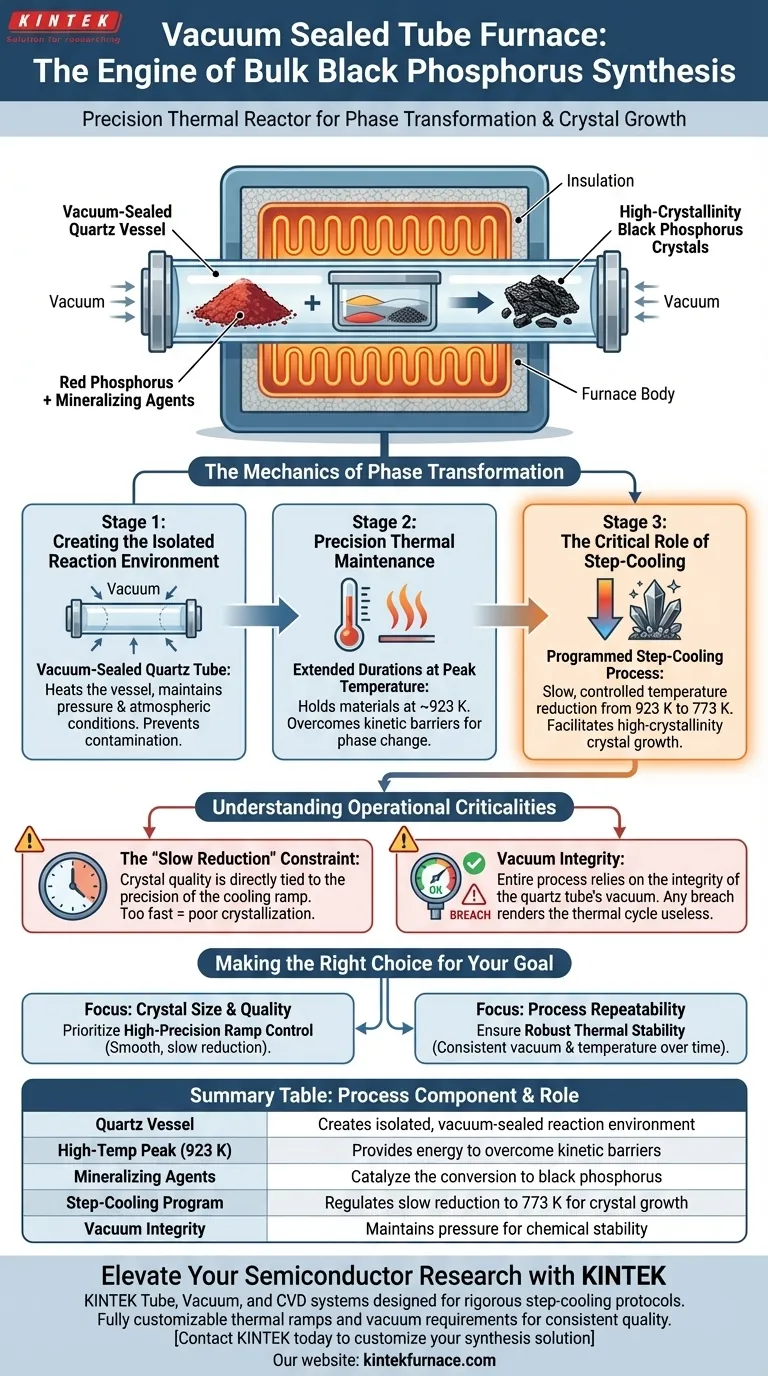
The primary function of a vacuum sealed tube furnace in this context is to act as a precision thermal reactor that facilitates the phase transformation of red phosphorus into black phosphorus. It creates a stable high-temperature environment within a vacuum-sealed quartz tube and executes a specific cooling program to drive crystal growth.
The furnace ensures the success of the synthesis not merely by heating the material, but by controlling the rate of cooling. By maintaining a vacuum and slowly lowering the temperature from 923 K to 773 K, the system allows mineralizing agents to effectively convert red phosphorus into high-crystallinity black phosphorus.
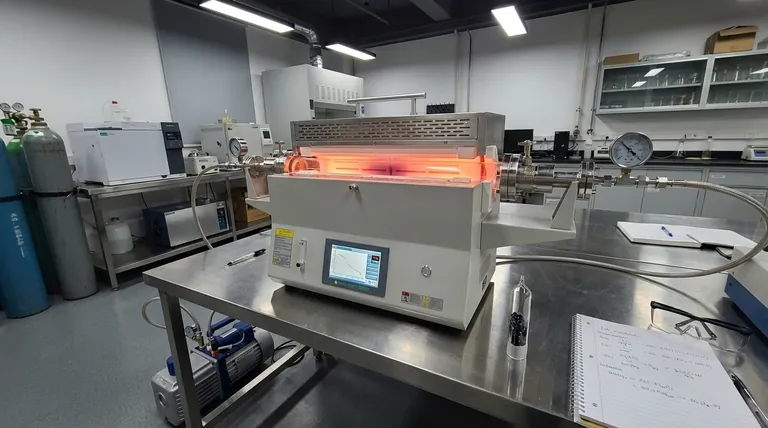
The Mechanics of Phase Transformation
Creating the Isolated Reaction Environment
The foundation of this process is the vacuum-sealed quartz tube.
The furnace does not act directly on the phosphorus; rather, it heats the quartz vessel. This isolation is critical for maintaining the specific pressure and atmospheric conditions required for the reaction.
Inside this vacuum, the red phosphorus is exposed to mineralizing agents. The sealed environment ensures that these agents can catalyze the phase change without external contamination or atmospheric interference.
Precision Thermal Maintenance
The synthesis of bulk Black Phosphorus is not an instantaneous event; it requires extended durations of heat.
The tube furnace provides the necessary thermal stability to hold materials at peak temperatures (starting around 923 K). This prolonged exposure energy overcomes the kinetic barriers associated with changing the material's atomic structure.
The Critical Role of Step-Cooling
The most distinct function of the furnace in this specific synthesis is the execution of a programmed step-cooling process.
Unlike processes that simply heat and hold, this method requires a slow, controlled reduction in temperature. The furnace regulates the decline from 923 K down to 773 K.
It is during this slow cooling phase that the high-crystallinity black phosphorus crystals actually grow.
Understanding Operational Criticalities
While the tube furnace is a versatile tool, its application in black phosphorus synthesis relies on strict adherence to thermal profiles.
The "Slow Reduction" Constraint The quality of the final crystal is directly tied to the precision of the cooling ramp. A furnace that cools too quickly, or fluctuates during the step-down process, will likely result in poor crystallization or incomplete phase transformation.
Vacuum Integrity The process relies entirely on the integrity of the quartz tube's vacuum. While the furnace provides the heat, any breach in the vacuum seal compromises the pressure conditions required for the mineralizing agents to function, rendering the thermal cycle useless.
Making the Right Choice for Your Goal
To achieve the best results in black phosphorus synthesis, focus on the programmable features of your equipment.
- If your primary focus is Crystal Size and Quality: Prioritize a furnace with high-precision ramp control to ensure the temperature reduction between 923 K and 773 K is as smooth and slow as possible.
- If your primary focus is Process Repeatability: Ensure your furnace offers robust thermal stability to maintain the exact vacuum and temperature conditions over the extended durations required for synthesis.
Mastering the use of the vacuum sealed tube furnace allows you to turn a volatile raw material into a stable, high-performance semiconductor.
Summary Table:
| Process Component | Role in Synthesis |
|---|---|
| Quartz Vessel | Creates an isolated, vacuum-sealed reaction environment |
| High-Temp Peak (923 K) | Provides energy to overcome kinetic barriers for phase change |
| Mineralizing Agents | Catalyze the conversion of red phosphorus to black phosphorus |
| Step-Cooling Program | Regulates the slow reduction to 773 K for crystal growth |
| Vacuum Integrity | Maintains pressure conditions required for chemical stability |
Elevate Your Semiconductor Research with KINTEK
Precision phase transformation requires uncompromising thermal stability. KINTEK provides industry-leading Tube, Vacuum, and CVD systems designed to handle the rigorous step-cooling protocols essential for high-crystallinity Black Phosphorus synthesis.
Backed by expert R&D and manufacturing, our lab high-temp furnaces are fully customizable to your specific cooling ramps and vacuum requirements. Ensure consistent repeatability and superior crystal quality in every batch.
Contact KINTEK today to customize your synthesis solution
Visual Guide
References
- Jian Feng, Ke Xu. Effectively Enhanced Photocatalytic Performance of BP/BiOBr 2D/2D Z-Scheme Heterojunction. DOI: 10.3390/molecules30030538
This article is also based on technical information from Kintek Furnace Knowledge Base .
Related Products
- Vacuum Sealed Continuous Working Rotary Tube Furnace Rotating Tube Furnace
- High Pressure Laboratory Vacuum Tube Furnace
- Vacuum Hot Press Furnace Machine Heated Vacuum Press Tube Furnace
- Laboratory Vacuum Tilt Rotary Tube Furnace Rotating Tube Furnace
- Magnesium Extraction and Purification Condensing Tube Furnace
People Also Ask
- What is the purpose of rotary tube furnaces? Achieve Uniform Heat Treatment for Powders and Granules
- What are the key advantages of using a rotary tube furnace? Achieve Dynamic, Uniform Heating for Powders
- How does the amount of material processed vary between batch and continuous rotary tube furnaces? Scale Your Production Efficiently
- What are the advantages of rotary tube furnaces in fuel compatibility? Boost Efficiency and Cut Costs
- What is the temperature range of some rotary tube furnaces? Achieve Uniform Heating Up to 1200°C



















