
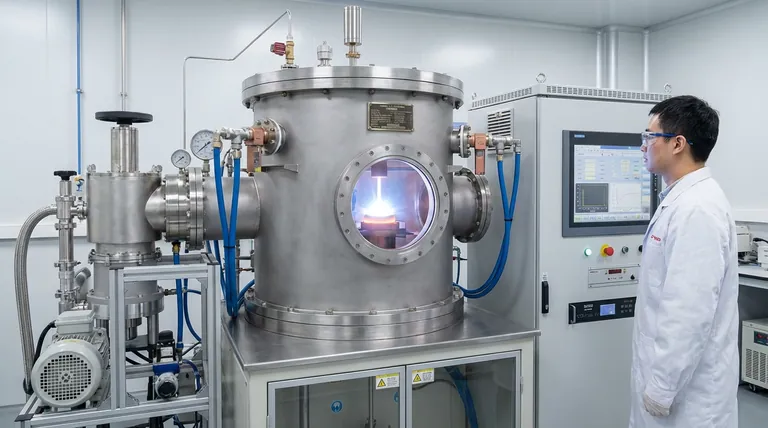
The primary function of a Vacuum Arc Melting (VAM) furnace in the synthesis of Al25CoCrFeNiNd is to melt high-melting-point elements and fuse them into a high-purity alloy using electric arcs generated between a tungsten electrode and a water-cooled copper crucible. This process takes place in a strict vacuum environment to prevent the oxidation of reactive components—specifically Aluminum and Neodymium—thereby securing the material's precise chemical composition.
By combining intense localized heat with a protective vacuum atmosphere, the VAM furnace acts as a purification and homogenization tool, ensuring that highly reactive and refractory elements are successfully alloyed without atmospheric contamination.
The Critical Mechanisms of VAM Synthesis
Prevention of Elemental Oxidation
The synthesis of Al25CoCrFeNiNd involves elements with high chemical reactivity, particularly Aluminum and Neodymium.
If exposed to oxygen at melting temperatures, these elements would form brittle oxides/slag rather than integrating into the alloy matrix. The furnace’s high-vacuum environment eliminates atmospheric oxygen, ensuring these active elements are preserved in their metallic state.
High-Temperature Melting Capabilities
Complex concentrated alloys often combine elements with vastly different melting points, such as Chromium (high melting point) and Aluminum (lower melting point).
The VAM furnace utilizes a tungsten electrode to generate a high-temperature electric arc. This intense, focused heat ensures that even the most refractory components, like Cobalt and Iron, are fully melted alongside lower-melting elements.
Contamination Control
A critical feature of this specific furnace type is the water-cooled copper crucible.
Unlike ceramic crucibles used in induction melting, the water-cooled copper prevents the molten alloy from reacting with the container walls. This guarantees that no foreign impurities are introduced into the Al25CoCrFeNiNd melt, maintaining the strict purity required for research and high-performance applications.
Achieving Compositional Uniformity
Electromagnetic Stirring
Melting raw materials is only half the battle; ensuring they mix evenly is the other.
As indicated by supplementary technical data, VAM furnaces often employ electromagnetic stirring. This utilizes non-contact fluid dynamics to induce strong convection within the melt pool.
Elimination of Segregation
Without adequate mixing, heavier elements (like Neodymium) might separate from lighter ones (like Aluminum).
The convection currents generated by the arc and stirring mechanisms eliminate this elemental segregation. This ensures the atoms are mixed at a thermodynamic level, resulting in a chemically uniform material structure.
Understanding the Trade-offs
While VAM is excellent for purity and handling reactive elements, it requires specific operational protocols to be effective.
The Necessity of Multiple Cycles
A single melting pass is rarely sufficient for complex concentrated alloys. Because the water-cooled crucible chills the bottom of the ingot rapidly, the material must often be flipped and remelted multiple times.
Batch Processing Limitations
The VAM process is typically a batch operation suited for smaller ingots or "buttons." It provides exceptional control for research samples or high-value components but lacks the continuous throughput of other industrial casting methods.
Making the Right Choice for Your Goal
When synthesizing complex alloys like Al25CoCrFeNiNd, the equipment must align with your metallurgical priorities.
- If your primary focus is Chemical Purity: The VAM furnace is essential for preventing the loss of reactive elements like Neodymium and Aluminum to oxidation.
- If your primary focus is Microstructural Homogeneity: You must utilize electromagnetic stirring and perform multiple melt-flip cycles to ensure the six distinct elements do not segregate.
The Vacuum Arc Melting furnace ultimately bridges the gap between raw, reactive elements and a stable, high-performance alloy by exerting total control over the thermal and atmospheric environment.
Summary Table:
| Feature | Function in Al25CoCrFeNiNd Synthesis |
|---|---|
| Vacuum Environment | Prevents oxidation of reactive Aluminum (Al) and Neodymium (Nd). |
| Tungsten Electrode | Generates high-temp arcs to melt refractory elements like Cr and Fe. |
| Water-Cooled Crucible | Eliminates contamination by preventing reaction with container walls. |
| Electromagnetic Stirring | Ensures compositional homogeneity and prevents elemental segregation. |
Elevate Your Advanced Material Synthesis with KINTEK
Precision is paramount when synthesizing complex concentrated alloys like Al25CoCrFeNiNd. KINTEK provides industry-leading Vacuum, CVD, Muffle, and Tube systems, backed by expert R&D and manufacturing to ensure your materials reach peak purity and homogeneity. Our high-temperature lab furnaces are fully customizable to meet your unique research or production requirements.
Ready to optimize your alloying process? Contact KINTEK today to discuss your custom furnace solution with our specialists.
References
- Shimaa El‐Hadad, M. M. Rashad. Magnetic Properties of Al25Co(25-x)CrxFe25-yNi25Ndy Compositionally Complex Alloys. DOI: 10.1007/s11661-025-07818-0
This article is also based on technical information from Kintek Furnace Knowledge Base .
Related Products
- Vacuum Induction Melting Furnace
- Vacuum Heat Treat Sintering and Brazing Furnace
- Small Vacuum Heat Treat and Tungsten Wire Sintering Furnace
- Vacuum Heat Treat Sintering Furnace Molybdenum Wire Vacuum Sintering Furnace
- Vacuum Heat Treat Sintering Furnace with Pressure for Vacuum Sintering
People Also Ask
- What are the core functions of the High Vacuum Induction Melting (VIM) furnace? Optimize DD5 Superalloy Purification
- What are the advantages of using a VIM furnace to control residual oxygen pressure? Achieve Superior Metal Uniformity
- What is the role of VIM and directional solidification in aero-engine blade substrates? Engineering Extreme Durability
- Why is a Vacuum Induction Melting furnace (VIM) used for Cu-Zn-Al-Sn alloys? Achieve Precision Composition Control
- What role does a Vacuum Induction Melting furnace play in the production of high-aluminum nickel-based superalloys?



















