
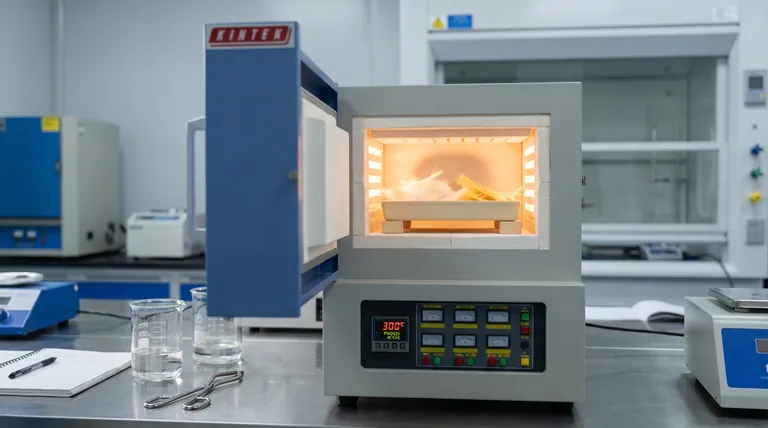
The primary function of a muffle furnace in this process is to provide a strictly controlled, high-temperature environment—typically reaching 300°C—to drive the chemical conversion of electrospun polyamic acid (PAA) into polyimide (PI). This equipment is essential for managing precise heating rates and constant temperature durations, which are necessary to facilitate the molecular rearrangement required for thermal imidization.
The muffle furnace is not merely a heat source; it is a precision tool used to orchestrate the formation of imide rings. This chemical transformation is the sole mechanism that endows the final flexible microfibers with the mechanical strength, thermal stability, and chemical resistance required for industrial use.
The Mechanics of Thermal Imidization
Driving Chemical Conversion
The core objective of the process is transforming the precursor material, polyamic acid (PAA), into the final polyimide (PI) structure.
The muffle furnace supplies the thermal energy required to initiate and sustain this reaction. By maintaining temperatures around 300°C, the furnace ensures the complete conversion of the polymer structure.
Facilitating Molecular Rearrangement
Heat alone is not enough; the way heat is applied determines the quality of the fiber.
The furnace allows for the precise control of heating rates and dwelling times. This controlled application of heat facilitates the orderly rearrangement of polymer molecular chains, leading to the formation of stable imide rings.
Determining Final Material Properties
The success of the imidization process directly correlates to the physical characteristics of the microfiber.
Proper furnace operation ensures the substrate achieves high mechanical strength and thermal stability. Without this precise heat treatment, the material would lack the chemical resistance necessary for practical applications.
Why a Muffle Furnace is Used
Isolation and Purity
A distinct advantage of a muffle furnace is its ability to isolate the material from the fuel and combustion byproducts.
This creates a contamination-free environment, which is critical when processing sensitive polymer nanofibers. The design ensures that the microfibers interact only with the heat and the controlled atmosphere, not with impurities that could degrade the material.
Uniform Thermal Distribution
Muffle furnaces are engineered to provide consistent, uniform heating across the entire chamber.
This uniformity ensures that the integrity and strength of the microfibers are consistent throughout the batch. It prevents "hot spots" that could cause uneven imidization, which would result in structural weaknesses in the flexible substrate.
Understanding the Trade-offs
Sensitivity to Heating Rates
While the furnace allows for control, the process is highly sensitive to the heating rate parameters set by the operator.
If the temperature ramps up too quickly, the solvent in the PAA may evaporate too violently, or the molecular rearrangement may occur unevenly. This can lead to defects in the fiber morphology, compromising the mechanical strength of the final PI substrate.
Atmosphere Limitations
While muffle furnaces isolate materials from combustion, standard models typically operate under an air atmosphere unless specifically equipped for gas flow.
For processes requiring absolute protection from oxidation, the operator must ensure the furnace can support a controlled atmosphere (such as nitrogen). Relying on a standard air atmosphere muffle furnace without considering the material's oxidation sensitivity can lead to unwanted surface reactions.
Making the Right Choice for Your Goal
To maximize the quality of your polyimide microfibers, align your furnace settings with your specific objectives:
- If your primary focus is Mechanical Strength: Prioritize a slow, steady heating rate to allow for gradual molecular rearrangement and the formation of robust imide rings without structural defects.
- If your primary focus is Process Reproducibility: rigorous calibration of the furnace's temperature controller is essential to ensure the exact 300°C environment is maintained across every batch.
Precision in thermal management is the difference between a brittle precursor and a high-performance polyimide material.
Summary Table:
| Feature | Role in PI Microfiber Processing |
|---|---|
| Core Function | Chemical conversion of Polyamic Acid (PAA) to Polyimide (PI) |
| Typical Temp | 300°C (Optimized for imide ring formation) |
| Key Outcome | Enhanced mechanical strength and thermal stability |
| Environment | Contamination-free isolation from combustion byproducts |
| Critical Factor | Precise heating rates to prevent structural defects |
Elevate Your Polyimide Research with Precision Thermal Solutions
To transform delicate precursors into high-performance materials, you need more than just heat—you need absolute control. KINTEK provides industry-leading muffle and vacuum systems specifically engineered to manage the sensitive heating rates required for successful thermal imidization.
Backed by expert R&D and manufacturing, KINTEK offers Muffle, Tube, Rotary, Vacuum, and CVD systems—all customizable to ensure your flexible microfibers achieve maximum mechanical strength and purity.
Ready to optimize your thermal processing? Contact us today to discuss your unique lab requirements with our technical experts.
References
- Donglai Han, Shuo Yang. Simultaneous photocatalytic degradation and SERS detection of tetracycline with self-sustainable and recyclable ternary PI/TiO2/Ag flexible microfibers. DOI: 10.1038/s41378-023-00624-x
This article is also based on technical information from Kintek Furnace Knowledge Base .
Related Products
- 1400℃ Muffle Oven Furnace for Laboratory
- 1700℃ High Temperature Muffle Oven Furnace for Laboratory
- 1800℃ High Temperature Muffle Oven Furnace for Laboratory
- 1200℃ Muffle Oven Furnace for Laboratory
- High Temperature Muffle Oven Furnace for Laboratory Debinding and Pre Sintering
People Also Ask
- What is the primary function of a high-temperature laboratory muffle furnace in chemical synthesis? Achieve Precision.
- How does a high-temperature laboratory muffle furnace affect material properties? Transform Anodic Oxide Films Fast
- What is the role of a laboratory high-temperature muffle furnace in H13 steel treatment? Optimize Tool Performance
- What is the function of a muffle furnace in MOF-derived zirconia conversion? Optimize Phase & Pore Engineering
- How does a laboratory high-temperature muffle furnace contribute to the final formation of Bismuth Oxide nanosheets?



















