
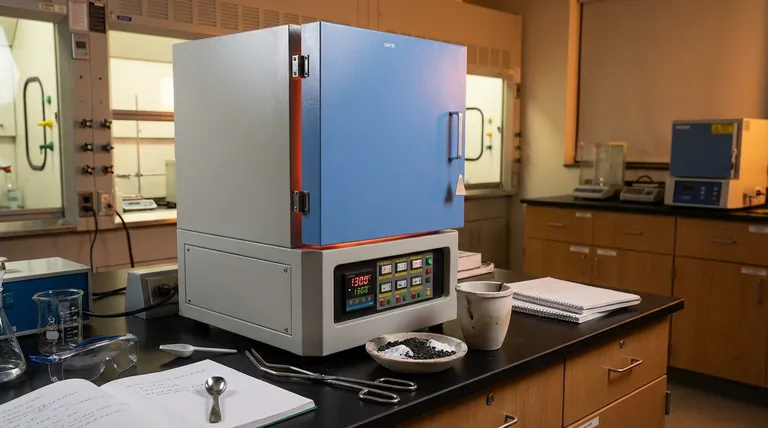
The high-temperature muffle furnace acts as a precision thermal reactor, primarily serving to create the specific energetic conditions required for the chemical transformation of ilmenite. By maintaining a stable temperature range between 1573K and 1673K ($1300^{\circ}\text{C} - 1400^{\circ}\text{C}$), the furnace facilitates the decomposition of fluxes and drives the complete reduction of iron oxides.
The furnace provides the necessary thermal stability to decompose soda ash fluxes and synthesize sodium-based titanate phases, effectively separating metallic iron from the titanium slag.
The Mechanics of Carbothermic Conversion
precise Thermal Regulation
The muffle furnace does not simply heat the material; it maintains a uniform thermal field.
This consistency is vital for process reliability. The furnace creates an environment where energy is evenly distributed, ensuring that the entire batch of ilmenite pellets reaches the activation energy required for reaction without localized hot or cold spots.
Flux Decomposition and Reaction
Within this controlled environment, the furnace heat triggers the decomposition of fluxes, specifically soda ash.
As the soda ash breaks down into sodium oxide, it reacts with the titanium dioxide present in the ilmenite. This reaction produces low-melting-point sodium titanate, a critical intermediate step in the smelting process.
Critical Phase Transformations
Reduction of Iron Oxides
The high-temperature environment (approx. $1300^{\circ}\text{C}$) promotes the reduction of iron oxides found within the ilmenite concentrate.
The furnace ensures this reduction is complete, converting oxides into metallic iron. This leads to the aggregation of metallic iron beads, which is essential for efficiently separating the titanium slag from the pig iron later in the process.
Formation of Titanate Phases
Beyond simple separation, the furnace conditions directly induce the formation of specific material structures.
The process targets the synthesis of sodium-based titanate electrode material phases. The sustained heat facilitates the solid-state reactions required to develop these specific layered crystal structures, which are valuable for advanced applications.
Understanding the Trade-offs
Temperature Sensitivity
The specific window of 1573K to 1673K is non-negotiable for optimal results.
If the temperature falls below this threshold, the reduction of iron oxides may be incomplete, leading to impure separation. Conversely, excessive temperatures could lead to unnecessary energy consumption or alter the desired crystal structure of the titanate phases.
Duration Dependence
The process relies on a specific duration, typically around 120 minutes.
This time commitment is necessary to allow the diffusion-controlled reactions to complete. Rushing the heating cycle within the furnace risks producing materials with poor structural integrity or high residual impurities.
Making the Right Choice for Your Goal
To maximize the efficacy of carbothermic smelting, you must tailor your furnace operation to your specific end-product requirements.
- If your primary focus is Iron Separation: Ensure the furnace maintains a steady $1300^{\circ}\text{C}$ to promote the maximum aggregation of metallic iron beads for easy physical separation.
- If your primary focus is Electrode Material Synthesis: Prioritize precise temperature control between 1573K and 1673K to guarantee the correct layered structure of the sodium-based titanate phases.
Success in this process relies not just on reaching high temperatures, but on maintaining the precise thermal stability required for complex phase transformations.
Summary Table:
| Process Component | Temperature Range | Primary Function in Ilmenite Smelting |
|---|---|---|
| Thermal Regulation | 1573K - 1673K | Maintains uniform thermal field for consistent chemical transformation. |
| Flux Decomposition | ~1300°C | Breaks down soda ash into sodium oxide to react with titanium dioxide. |
| Iron Reduction | ~1300°C | Completes iron oxide reduction and promotes metallic iron bead aggregation. |
| Phase Synthesis | High Stability | Facilitates solid-state reactions for layered sodium-based titanate structures. |
Optimize Your Smelting Precision with KINTEK
Achieving the perfect phase transformation in carbothermic smelting requires uncompromising thermal stability. KINTEK provides high-performance Muffle, Tube, and Vacuum furnace systems specifically engineered for the rigorous demands of material synthesis and mineral processing.
Backed by expert R&D and manufacturing, our systems are fully customizable to meet your unique temperature and atmospheric requirements. Whether you are focusing on high-purity iron separation or advanced electrode material synthesis, our technology ensures precise control for every batch.
Ready to elevate your lab's smelting results? Contact our technical experts today to find the perfect furnace solution for your application.
References
- Formation of Electrode Materials in the Process of Carbothermic Flux Smelting of Ilmenite Concentrate and Hydrothermal Refining of Titanium Slag. DOI: 10.3390/pr13051554
This article is also based on technical information from Kintek Furnace Knowledge Base .
Related Products
- 1700℃ High Temperature Muffle Oven Furnace for Laboratory
- 1800℃ High Temperature Muffle Oven Furnace for Laboratory
- 1200℃ Muffle Oven Furnace for Laboratory
- 1400℃ Muffle Oven Furnace for Laboratory
- High Temperature Muffle Oven Furnace for Laboratory Debinding and Pre Sintering
People Also Ask
- What is the primary function of a high-temperature laboratory muffle furnace in chemical synthesis? Achieve Precision.
- How does a high-temperature laboratory muffle furnace affect material properties? Transform Anodic Oxide Films Fast
- What role does a muffle furnace play in BCZY712 electrolyte powder production? Achieve Perfect Phase Purity
- What role does a muffle furnace play in sintering photocathodes? Enhance Electrode Conductivity & Catalytic Activity
- How does the two-stage sintering process contribute to the synthesis of MeCuFeO3 perovskite? Optimize crystal purity.



















