
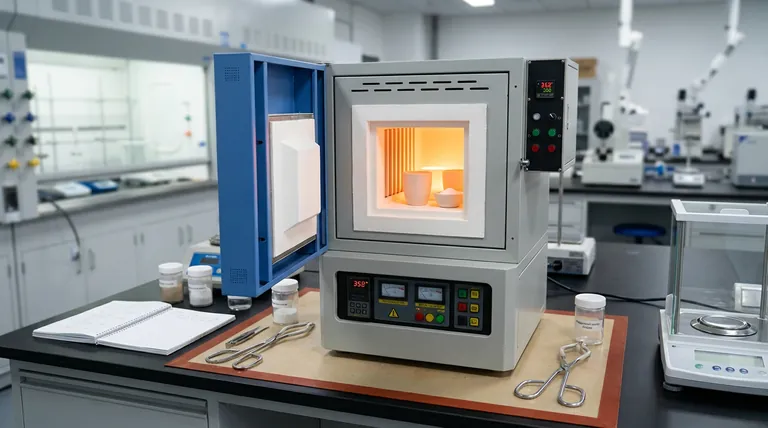
A box muffle furnace functions as a high-precision calcination chamber designed to thermally decompose magnesium precursors under strictly controlled conditions. Its primary mechanism involves maintaining a stable environment at approximately 350°C to dehydrate magnesium hydroxide, converting it into active magnesium oxide powder.
The furnace’s value lies in its ability to provide high thermal uniformity, which ensures the complete decomposition of precursors without overheating. This precise regulation determines the specific surface area and grain size of the powder, directly defining its reactivity for applications such as Magnesium Silicate Hydrate (M-S-H) synthesis.
The Thermal Decomposition Process
Controlled Dehydration
The fundamental mechanism at work is the application of consistent thermal energy to drive off chemically bound water.
In the preparation of active magnesium oxide, the furnace is typically set to 350°C. At this temperature, the magnesium hydroxide precursor undergoes a dehydration reaction, releasing water vapor and leaving behind the oxide.
Lattice Reorganization
As water and potentially carbon dioxide (depending on the precursor) are expelled, the material undergoes a structural shift.
The heat facilitates a lattice reorganization, transitioning the material from a hydroxide structure into the crystal lattice of magnesium oxide. This reorganization is essential for establishing the alkalinity and chemical stability of the final powder.
Ensuring Complete Conversion
The box muffle design ensures that heat is distributed evenly throughout the chamber.
This uniformity guarantees that the decomposition reaction reaches completion across the entire sample batch. The result is a consistent, white active magnesium oxide powder free from unreacted precursor material.
Control of Material Properties
Regulating Specific Surface Area
The reactivity of magnesium oxide is heavily dependent on its specific surface area.
By controlling the calcination temperature and duration, the furnace allows you to maximize this surface area. This creates a "highly reactive" magnesium source, which is a critical requirement for subsequent synthesis processes like creating M-S-H.
Grain Size Management
The static, stable heat of the muffle furnace allows for the precise control of grain growth.
Rapid temperature fluctuations or uneven heating can lead to inconsistent particle sizes. The muffle furnace minimizes these variables, resulting in a powder with a uniform grain size distribution.
Understanding the Trade-offs
Temperature Sensitivity
While the furnace provides control, the process is highly sensitive to the selected setpoint.
If the temperature is too low (below 350°C), decomposition may be incomplete, leaving residual hydroxide. Conversely, excessive temperatures can cause sintering, which drastically reduces the specific surface area and renders the powder unreactive ("dead-burned").
Static Environment Limitations
Box muffle furnaces typically operate as static environments, unlike rotary kilns.
This means that gas exchange (removal of water vapor) relies on diffusion or simple venting. If the sample bed is packed too densely, the released water vapor may become trapped, potentially altering the local reaction environment within the powder bed.
How to Apply This to Your Project
To ensure optimal reactivity in your magnesium oxide powder, tailor your furnace settings to your specific end-goal.
- If your primary focus is M-S-H synthesis: Maintain a strict temperature of 350°C to ensure high specific surface area and maximum reactivity.
- If your primary focus is catalytic support: Ensure the furnace venting is adequate to fully remove carbon dioxide and water to promote high alkalinity.
True control over magnesium oxide quality comes not just from heating the material, but from precisely regulating the thermal profile to engineer the microstructure.
Summary Table:
| Feature | Mechanism/Function | Impact on Magnesium Oxide |
|---|---|---|
| Temperature Control | Precise 350°C stabilization | Ensures dehydration without sintering (dead-burning) |
| Thermal Uniformity | Even heat distribution | Guarantees complete conversion across the entire batch |
| Atmosphere Management | Controlled gas exchange | Influences alkalinity and specific surface area (SSA) |
| Structural Shift | Lattice reorganization | Transforms hydroxide structure into reactive oxide lattice |
Elevate Your Material Synthesis with KINTEK Precision
Achieving the perfect reactivity in magnesium oxide requires more than just heat; it requires absolute thermal stability. KINTEK provides industry-leading high-temperature solutions—including Muffle, Tube, Rotary, Vacuum, and CVD systems—engineered to deliver the precise control your research demands. Backed by expert R&D and manufacturing, our furnaces are fully customizable to meet your unique calcination and synthesis needs.
Ready to optimize your powder production? Contact KINTEK today to discuss how our lab high-temp furnaces can bring superior uniformity and performance to your facility.
References
- Qiang Song, Fuan Cheng. The Properties of Magnesium Silicate Hydrate Prepared from the Magnesium Silicate Minerals in the Earth’s Crust. DOI: 10.3390/buildings14051188
This article is also based on technical information from Kintek Furnace Knowledge Base .
Related Products
- Magnesium Extraction and Purification Condensing Tube Furnace
- High Temperature Muffle Oven Furnace for Laboratory Debinding and Pre Sintering
- 1400℃ Muffle Oven Furnace for Laboratory
- 1200℃ Muffle Oven Furnace for Laboratory
- Laboratory Muffle Oven Furnace with Bottom Lifting
People Also Ask
- What are the advantages of using a condensing tube furnace for magnesium extraction? Achieve High Purity and Efficient Metal Recovery
- How does a two-stage sintering process in a tube furnace contribute to high-performance sodium-ion battery cathodes?
- What are some thermal processes that tube furnaces are used for? Achieve Precise Heat Treatment with Uniformity
- What is the chemical vapor transport technique? A Guide to High-Purity Crystal Growth
- How does the atmosphere differ between tube furnaces and box furnaces? Optimize Your Heat Treatment Process







