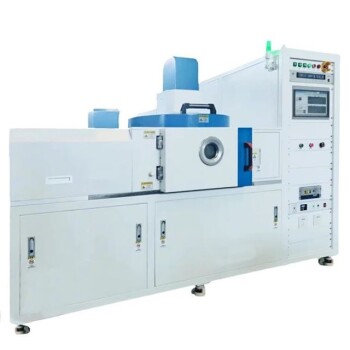
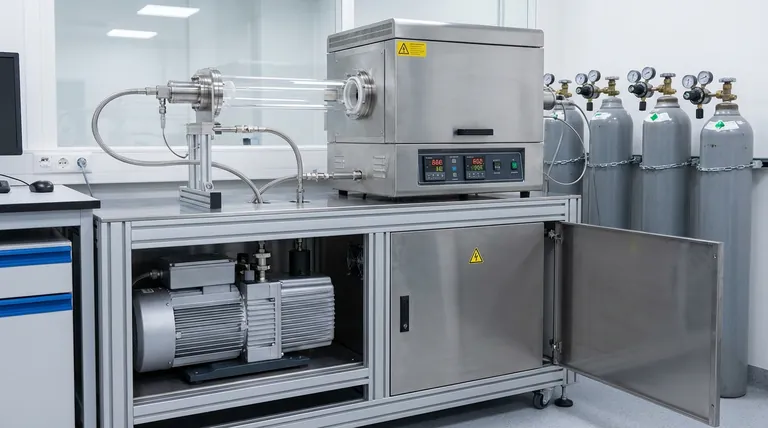
The primary function of a high-performance vacuum pump in a PECVD system is to establish a strictly controlled low-pressure environment within the quartz reaction tube. This component evacuates residual gases to achieve pressures around 5x10^-2 Torr, effectively removing contaminants like oxygen and water vapor while enabling the precise manipulation of particle dynamics essential for synthesizing high-quality Gallium Nitride (GaN).
Ideally, the vacuum system does not just empty the chamber; it creates the specific thermodynamic conditions required for high-purity crystal growth. By removing impurities and regulating pressure, the pump allows you to tune the physical properties of the plasma and the resulting film.
Achieving High Material Purity
Eliminating Environmental Contaminants
The most immediate role of the vacuum pump is the removal of residual air from the reaction chamber.
Before the deposition process can begin, the pump must evacuate the quartz reaction tube to remove atmospheric gases. This is critical because impurities such as oxygen and water vapor are chemically active and can degrade the electrical and structural properties of Gallium Nitride (GaN).
Establishing the Baseline Environment
A high-performance pump is required to reach specific low-pressure thresholds, typically in the range of 5x10^-2 Torr.
Reaching this vacuum level ensures that the background environment is sufficiently clean. Without this deep evacuation, the synthesized material would suffer from unintended oxidation or defect incorporation.
Controlling Deposition Dynamics
Modifying the Mean Free Path
Beyond cleaning the chamber, the vacuum pump allows for the active adjustment of working pressure during the deposition process.
Pressure directly correlates to the mean free path of the reactive particles—the average distance a particle travels before colliding with another. By controlling the vacuum level, you control the energy and trajectory of the ions and radicals hitting the substrate.
Influencing Film Quality and Rate
The ability to adjust pressure is a direct lever for controlling deposition rates.
Changes in the mean free path influence how reactive species transport through the plasma to the growth surface. This regulation allows engineers to optimize the film quality, ensuring the GaN layer is uniform and structurally sound.
Operational Trade-offs and Considerations
Balancing Purity against Deposition Speed
While lower pressures generally yield higher purity by reducing background contaminants, they also alter the plasma density.
Operating at the lowest possible pressure increases the mean free path, which can improve film directionality but may alter the deposition rate. You must find the optimal working pressure that balances the exclusion of impurities with the required growth kinetics for your specific application.
System Stability
A vacuum pump must do more than reach a low pressure; it must maintain it consistently against the flow of process gases.
Fluctuations in vacuum pressure will cause variances in the mean free path during the growth cycle. This can lead to inconsistent film layers or structural defects within the GaN crystal lattice.
Making the Right Choice for Your Goal
To optimize your PECVD process for Gallium Nitride synthesis, consider how the vacuum specifications align with your material requirements:
- If your primary focus is electrical purity: Prioritize a pump capable of reaching deeper ultimate vacuums (below 5x10^-2 Torr) to ensure the absolute minimum presence of oxygen and water vapor.
- If your primary focus is film uniformity and structure: Focus on the system’s ability to maintain a stable, precise working pressure to strictly control the mean free path of reactive particles.
High-quality GaN synthesis relies on the vacuum pump not just as an exhaust system, but as a critical control instrument for the chemical environment.
Summary Table:
| Feature | Function in PECVD GaN Synthesis | Impact on Material Quality |
|---|---|---|
| Contaminant Removal | Eliminates oxygen and water vapor | Prevents oxidation and reduces structural defects |
| Pressure Control | Establishes ~5x10^-2 Torr baseline | Ensures a clean, repeatable starting environment |
| Mean Free Path | Regulates particle collision distance | Controls ion energy and film uniformity |
| Deposition Rate | Adjusts working pressure/plasma density | Balances growth kinetics with film directionality |
| System Stability | Maintains consistent vacuum levels | Prevents layering inconsistencies and lattice strain |
Elevate Your GaN Synthesis with KINTEK Precision
High-performance Gallium Nitride synthesis demands a perfectly controlled chemical environment. KINTEK provides industry-leading R&D and manufacturing expertise, offering a comprehensive range of Muffle, Tube, Rotary, Vacuum, and CVD systems—all fully customizable to meet your specific research or production needs.
Whether you require deeper ultimate vacuums for superior electrical purity or stable pressure regulation for uniform film growth, our expert team is here to help you configure the ideal setup.
Ready to optimize your PECVD process? Contact us today to discuss your project requirements!
Visual Guide

References
- Olzat Toktarbaiuly, Г. Сугурбекова. ENHANCEMENT OF POWER CONVERSION EFFICIENCY OF DYE-SENSITIZED SOLAR CELLS VIA INCORPORATION OF GAN SEMICONDUCTOR MATERIAL SYNTHESIZED IN HOT-WALL CHEMICAL VAPOR DEPOSITION FURNACE. DOI: 10.31489/2024no4/131-139
This article is also based on technical information from Kintek Furnace Knowledge Base .
Related Products
- Slide PECVD Tube Furnace with Liquid Gasifier PECVD Machine
- Inclined Rotary Plasma Enhanced Chemical Deposition PECVD Tube Furnace Machine
- Inclined Rotary Plasma Enhanced Chemical Deposition PECVD Tube Furnace Machine
- Split Chamber CVD Tube Furnace with Vacuum Station CVD Machine
- RF PECVD System Radio Frequency Plasma Enhanced Chemical Vapor Deposition
People Also Ask
- What are the main advantages of PECVD tube furnaces compared to CVD tube furnaces? Lower Temp, Faster Deposition, and More
- What is plasma in the context of PECVD? Unlock Low-Temperature Thin Film Deposition
- What are the typical conditions for plasma-enhanced CVD processes? Achieve Low-Temperature Thin Film Deposition
- What plasma source is used in PE-CVD tube furnaces? Unlock Low-Temperature, High-Quality Deposition
- What are the advantages of using a tube furnace CVD system for Cu(111)/graphene? Superior Scalability and Quality