
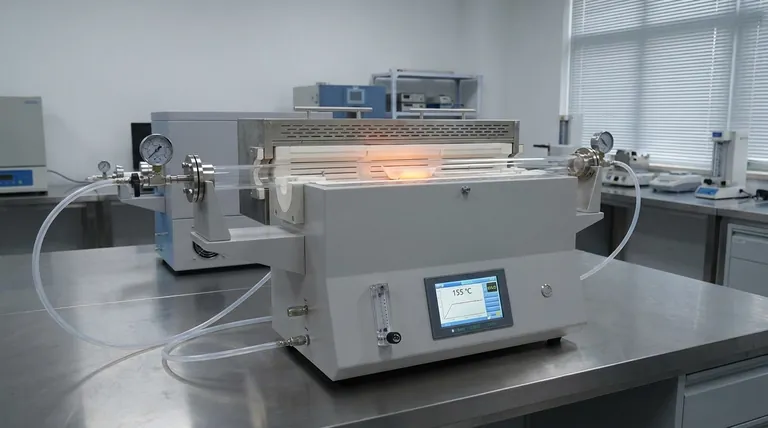
The necessity of using a tube furnace for this specific heat treatment lies in its ability to provide a strictly controlled atmosphere and precise thermal regulation. Specifically, the furnace maintains a protective argon environment while executing a slow heating ramp (3 K/min) and a long-duration temperature hold at 155 °C to facilitate physical diffusion.
Core Takeaway The tube furnace is the critical enabler for the "melt-diffusion" strategy in cathode preparation. By holding the material at 155 °C under argon, it utilizes sulfur's low melting point to liquify and uniformly infiltrate the porous TiO2–TiN composite without oxidation or evaporation.
The Role of Environmental Control
Protection via Argon Atmosphere
The primary function of the tube furnace in this context is to isolate the materials from the external environment. By maintaining a continuous flow of argon gas, the furnace creates an inert shield around the TiO2–TiN/S mixture.
Preventing Oxidation and Reaction
This protective environment is non-negotiable for high-performance composites. It prevents the sulfur from reacting with oxygen in the air and protects the titanium nitride (TiN) and titanium dioxide (TiO2) components from unwanted surface oxidation during the heating process.
Precision in Thermal Regulation
Controlled Ramp Rates
The tube furnace allows for a programmable heating profile, specifically a ramp rate of 3 K per minute. This gradual increase in temperature ensures that the material is heated evenly throughout, preventing thermal shock or uneven melting of the sulfur.
Sustained Temperature Stabilization
The process requires the temperature to be stabilized exactly at 155 °C for 12 hours. The tube furnace maintains this specific temperature with high accuracy, ensuring the environment remains stable long enough for the physical processes to complete.
The Mechanism of Sulfur Infusion
Leveraging Low Melting Points
The target temperature of 155 °C is strategically chosen because it is just above the melting point of sulfur. The tube furnace maintains the sulfur in a liquid state with low viscosity, which is ideal for infiltration.
Infiltration of Porous Structures
The ultimate goal of this thermal treatment is uniform diffusion. Over the 12-hour holding period, the molten sulfur is drawn into the porous structure of the TiO2–TiN composite via capillary action, resulting in a tightly integrated cathode material.
Understanding the Trade-offs
Process Duration vs. Uniformity
The primary trade-off of this method is time; a 12-hour hold plus ramping time is significant. However, rushing this process with faster heating methods would likely result in sulfur coating only the surface of the composite rather than penetrating the pores.
Equipment Complexity
Unlike simple drying ovens, a tube furnace requires gas supply management (Argon) and vacuum sealing capabilities. While this increases operational complexity, it is the only way to ensure the purity and structural integrity of the final sulfur composite.
Optimizing for High-Performance Cathodes
To achieve the best results with your TiO2–TiN/S mixtures, consider these strategic priorities:
- If your primary focus is Conductivity: Ensure the argon flow is constant and leak-free to prevent oxidation of the conductive TiN component.
- If your primary focus is Capacity Retention: Strictly adhere to the 12-hour duration at 155 °C to maximize sulfur loading inside the pores rather than on the surface.
The tube furnace is not just a heating element; it is a precision tool for engineering the microstructure of sulfur cathodes.
Summary Table:
| Parameter | Specification | Purpose |
|---|---|---|
| Atmosphere | Argon (Inert) | Prevents sulfur oxidation and protects TiN/TiO2 purity |
| Heating Rate | 3 K/min | Ensures uniform thermal distribution and prevents shock |
| Hold Temperature | 155 °C | Lowers sulfur viscosity for optimal capillary infiltration |
| Process Time | 12 Hours | Maximizes uniform diffusion into porous structures |
Elevate Your Material Research with KINTEK Precision
Don't let oxidation or uneven heating compromise your high-performance cathodes. KINTEK provides industry-leading Tube, Muffle, Vacuum, and CVD systems specifically designed for rigorous laboratory standards.
Our expert-backed R&D team ensures every furnace offers the precise thermal regulation and controlled atmosphere needed for sensitive processes like TiO2–TiN/S melt-diffusion. Whether you need a standard setup or a customized solution for unique research needs, we deliver the reliability your materials require.
Contact KINTEK today to optimize your heat treatment process!
References
- Ka Chun Li, Xijun Hu. Single-step synthesis of titanium nitride-oxide composite and AI-driven aging forecast for lithium–sulfur batteries. DOI: 10.1039/d4ta00234b
This article is also based on technical information from Kintek Furnace Knowledge Base .
Related Products
- Vacuum Sealed Continuous Working Rotary Tube Furnace Rotating Tube Furnace
- 1400℃ High Temperature Laboratory Tube Furnace with Alumina Tube
- 1700℃ High Temperature Laboratory Tube Furnace with Alumina Tube
- 1200℃ Split Tube Furnace Laboratory Quartz Tube Furnace with Quartz Tube
- Vertical Laboratory Quartz Tube Furnace Tubular Furnace
People Also Ask
- What is the purpose of rotary tube furnaces? Achieve Uniform Heat Treatment for Powders and Granules
- What are the key advantages of using a rotary tube furnace? Achieve Dynamic, Uniform Heating for Powders
- How does the amount of material processed vary between batch and continuous rotary tube furnaces? Scale Your Production Efficiently
- What are the advantages of rotary tube furnaces in fuel compatibility? Boost Efficiency and Cut Costs
- What is the temperature range of some rotary tube furnaces? Achieve Uniform Heating Up to 1200°C



















