
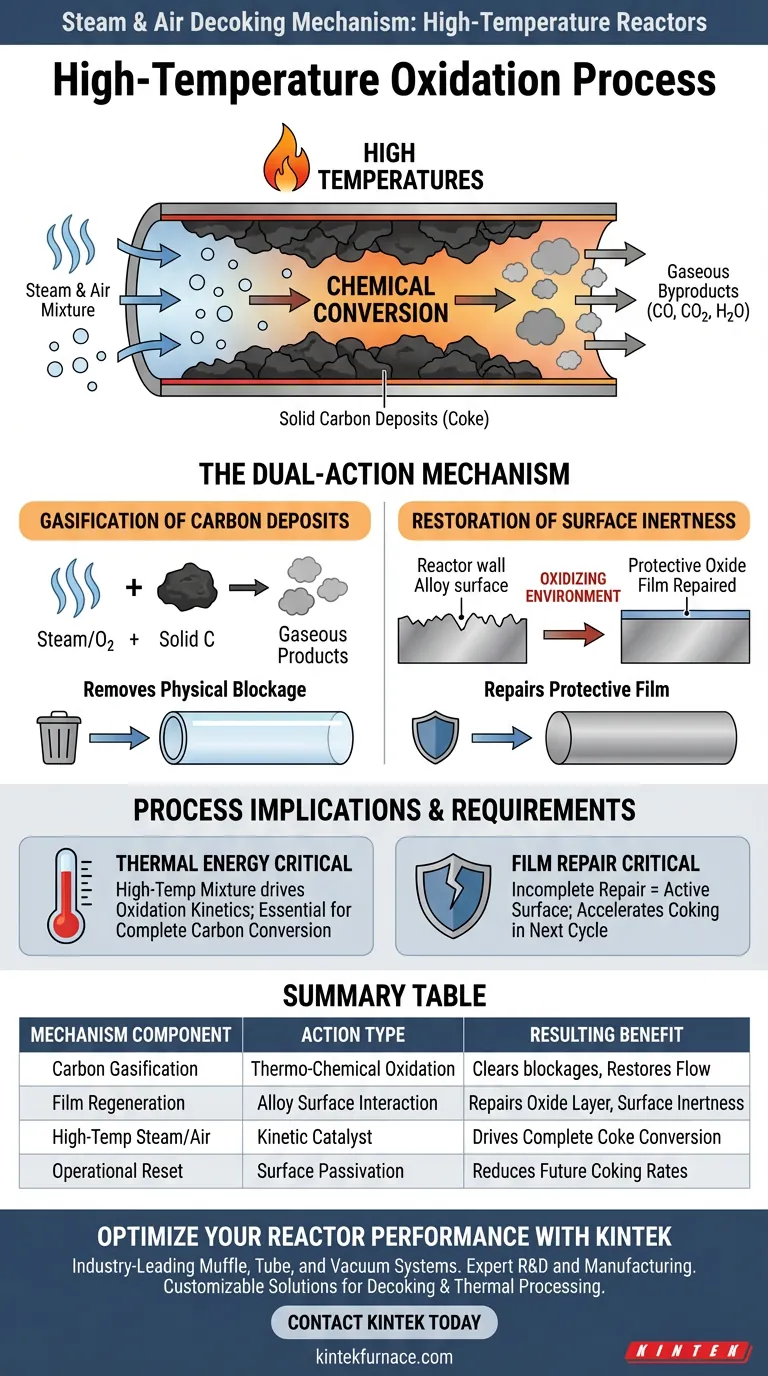
The decoking mechanism functions through high-temperature oxidation. By introducing a specific mixture of steam and air into the reactor, the process chemically converts solid carbon deposits on reaction tube walls into gas. This reaction effectively clears physical blockages that accumulate during operation.
The steam and air mixture serves a dual purpose: it removes carbon deposits through gasification and simultaneously regenerates the protective oxide film on alloy surfaces to restore material inertness.
The Dual-Action Mechanism
The effectiveness of steam-air decoking lies in its ability to address both the physical obstruction (the coke) and the chemical state of the reactor material (the alloy).
Gasification of Carbon Deposits
The primary function of the steam and air mixture is to remove physical blockage.
When introduced at high temperatures, the oxygen and steam react with the solid carbon (coke) adhering to the tube walls.
This oxidation reaction transforms the solid carbon into gaseous byproducts, allowing them to be flushed out of the system.
Restoration of Surface Inertness
Removing the coke is only half of the requirement; the reactor walls must also be prepared for the next run.
The process leverages the oxidizing environment to chemically interact with the exposed alloy surfaces.
This interaction repairs the protective film on the metal, restoring the material's surface inertness.
This step is critical, as a restored surface helps mitigate rapid coke formation in the subsequent cracking cycle.
Understanding Process Implications
While this mechanism is vital for reactor maintenance, it relies on strict operational conditions to be effective.
The Requirement for Thermal Energy
This process is not a passive wash; it is a thermal-chemical reaction.
It strictly requires a high-temperature mixture to drive the oxidation kinetics. Without sufficient heat, the conversion of carbon to gas will remain incomplete.
The Criticality of Film Repair
The restoration of the protective film is not merely a byproduct; it is a necessity for longevity.
If the decoking process clears the carbon but fails to fully repair the oxide film, the alloy surface may remain active.
An active surface can lead to accelerated coking rates immediately upon restarting the reactor, reducing the efficiency of the next cycle.
Ensuring Long-Term Reactor Health
To maximize the benefits of the steam-air decoking process, align your operational focus with the specific needs of your reactor's lifecycle.
- If your primary focus is Flow Restoration: Ensure the temperature of the steam-air mixture is sufficiently high to drive the complete gasification of all physical carbon deposits.
- If your primary focus is Asset Longevity: Prioritize the duration and quality of the oxidizing phase to guarantee the protective alloy film is fully regenerated before returning to production.
Effective decoking is not just about cleaning tubes; it is about resetting the chemical integrity of your reactor surfaces.
Summary Table:
| Mechanism Component | Action Type | Resulting Benefit |
|---|---|---|
| Carbon Gasification | Thermo-Chemical Oxidation | Clears physical blockages & restores flow |
| Film Regeneration | Alloy Surface Interaction | Repairs protective oxide layer & surface inertness |
| High-Temp Steam/Air | Kinetic Catalyst | Drives complete conversion of solid coke to gas |
| Operational Reset | Surface Passivation | Reduces coking rates in subsequent cycles |
Optimize Your Reactor Performance with KINTEK
Don't let carbon buildup compromise your laboratory efficiency. KINTEK provides industry-leading Muffle, Tube, and Vacuum systems backed by expert R&D and manufacturing. Our high-temperature furnaces are fully customizable to meet your unique decoking and thermal processing needs, ensuring both asset longevity and material inertness.
Ready to enhance your thermal processing capabilities? Contact KINTEK today to consult with our experts on the perfect high-temp solution for your lab.
Visual Guide
References
- Hamed Mohamadzadeh Shirazi, Kevin M. Van Geem. Effect of Reactor Alloy Composition on Coke Formation during Butane and Ethane Steam Cracking. DOI: 10.1021/acs.iecr.3c03180
This article is also based on technical information from Kintek Furnace Knowledge Base .
Related Products
- 1400℃ High Temperature Laboratory Tube Furnace with Alumina Tube
- 1700℃ High Temperature Laboratory Tube Furnace with Alumina Tube
- 1700℃ Controlled Inert Nitrogen Atmosphere Furnace
- 1800℃ High Temperature Muffle Oven Furnace for Laboratory
- 1700℃ High Temperature Muffle Oven Furnace for Laboratory
People Also Ask
- How does zone-melting in tube furnaces synthesize bismuth micro-wires? Master Single-Crystal Thermoelectric Growth
- How are high-temp tube furnaces used to measure diffusion coefficients per Fick's law? Master Precision Annealing
- How are high-temperature laboratory tube furnaces applied in long-term vacuum homogenization heat treatments for intermetallic samples?
- How do high-temperature laboratory tube furnaces ensure environmental stability? Precision Thermal Reduction Tips
- How are high-temperature tube furnaces applied in testing ceramic-supported alloy membranes? Insights



















