
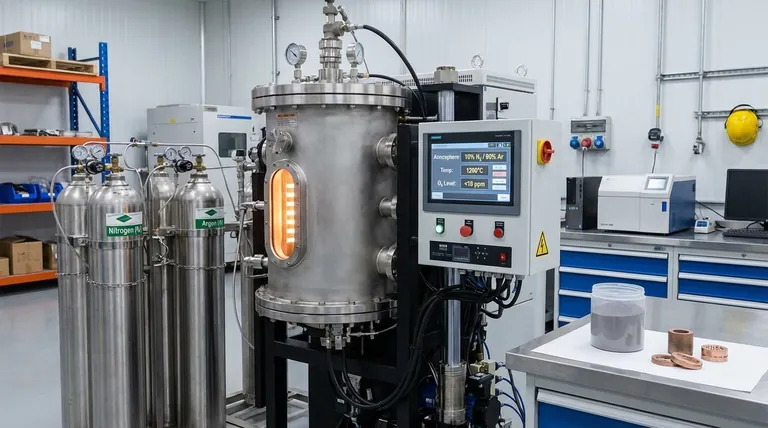
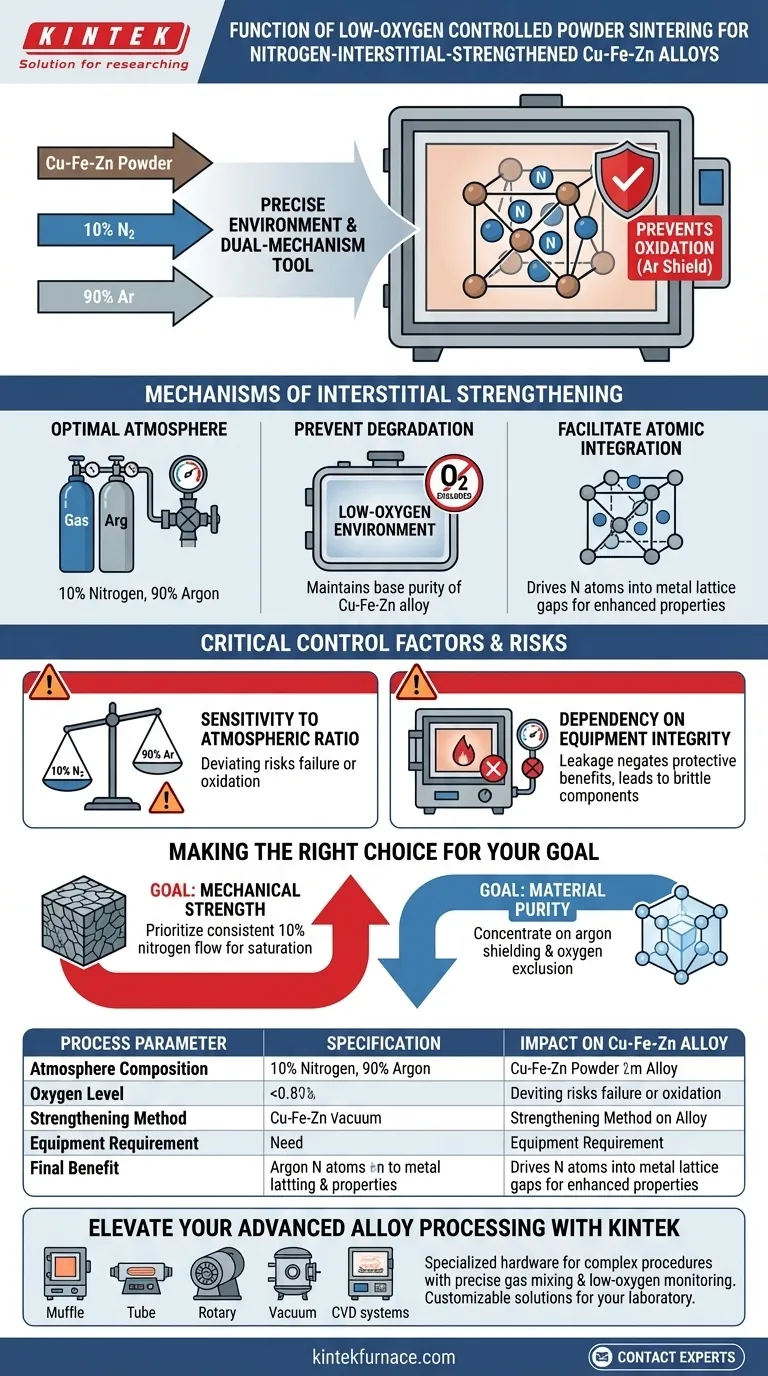
The primary function of the low-oxygen controlled powder sintering process is to create a precise environment that enables interstitial nitrogen solid solution. By utilizing a specific atmosphere of 10% Nitrogen (N2) and 90% Argon (Ar), this process simultaneously prevents raw material oxidation and facilitates the integration of nitrogen atoms into the metal lattice, resulting in significant mechanical strengthening.
By strictly controlling the atmospheric composition, this process acts as a dual-mechanism tool: it protects the Cu-Fe-Zn alloy from high-temperature degradation while actively utilizing nitrogen atoms to reinforce the material's internal structure.
Mechanisms of Interstitial Strengthening
The effectiveness of this sintering process relies on the manipulation of the atomic environment. It moves beyond simple heating to actively alter the chemical interaction between the gas phase and the solid metal.
Creating the Optimal Atmosphere
The process operates under a rigorously defined mixed atmosphere. This mixture consists of 10% Nitrogen and 90% Argon. This specific ratio is calculated to balance inert protection with active strengthening elements.
Preventing Material Degradation
Standard high-temperature sintering often exposes metal powders to oxygen, leading to structural weaknesses. This controlled process creates a low-oxygen environment that prevents excessive oxidation of the metal raw materials. This ensures the base purity of the Cu-Fe-Zn alloy is maintained throughout the thermal cycle.
Facilitating Atomic Integration
The core objective is to drive nitrogen atoms into the metal lattice gaps. The controlled atmosphere facilitates the effective entry of these atoms into the interstitial spaces of the crystal structure. This atomic "stuffing" is the fundamental driver behind the enhanced mechanical properties of the alloy.
Critical Control Factors and Risks
While this process offers significant strengthening benefits, it relies heavily on precision. The "trade-off" for superior mechanical properties is the requirement for exacting process control.
Sensitivity to Atmospheric Ratio
The success of the process hinges on the 10% N2 / 90% Ar balance. Deviating from this mixture risks failing to achieve the necessary solid solution state or allowing oxidation to compromise the metal.
Dependency on Equipment Integrity
To maintain a low-oxygen environment, the sintering equipment must be capable of rigorous sealing and monitoring. Any leakage or inability to sustain the specific gas pressure negates the protective benefits, leading to oxidized, brittle components rather than strengthened ones.
Making the Right Choice for Your Goal
To successfully implement this process for Cu-Fe-Zn alloys, you must align your processing parameters with your desired material outcomes.
- If your primary focus is mechanical strength: Prioritize the consistency of the 10% nitrogen flow to maximize the saturation of nitrogen atoms within the lattice gaps.
- If your primary focus is material purity: Concentrate on the integrity of the argon shielding and oxygen exclusion to prevent surface or internal oxidation of the raw materials.
Mastering the precise balance of this atmospheric control is the defining factor in producing high-performance nitrogen-interstitial-strengthened alloys.
Summary Table:
| Process Parameter | Specification / Mechanism | Impact on Cu-Fe-Zn Alloy |
|---|---|---|
| Atmosphere Composition | 10% N2 + 90% Ar | Balances inert protection with reactive strengthening |
| Oxygen Level | Ultra-Low (Controlled) | Prevents raw material oxidation and degradation |
| Strengthening Method | Interstitial Solid Solution | Drives nitrogen atoms into metal lattice gaps |
| Equipment Requirement | Rigorous Sealing & Monitoring | Ensures atmospheric integrity and material purity |
| Final Benefit | Mechanical Strengthening | Significantly enhanced structural properties |
Elevate Your Advanced Alloy Processing with KINTEK
Precise atmospheric control is the difference between a brittle component and a high-performance alloy. KINTEK provides the specialized hardware necessary for complex procedures like nitrogen-interstitial strengthening.
Backed by expert R&D and manufacturing, KINTEK offers Muffle, Tube, Rotary, Vacuum, and CVD systems, all of which can be customized with precise gas mixing and low-oxygen monitoring to meet your unique sintering needs. Whether you are developing Cu-Fe-Zn alloys or other advanced materials, our high-temperature furnaces provide the stability and purity your research demands.
Ready to optimize your sintering environment? Contact our experts today to find the perfect customizable solution for your laboratory.
Visual Guide
References
- Xiaohui Qiu, Jianda Zhou. Interstitial N‐Strengthened Copper‐Based Bioactive Conductive Dressings Combined with Electromagnetic Fields for Enhanced Wound Healing. DOI: 10.1002/adhm.202501303
This article is also based on technical information from Kintek Furnace Knowledge Base .
Related Products
- Controlled Inert Nitrogen Hydrogen Atmosphere Furnace
- Mesh Belt Controlled Atmosphere Furnace Inert Nitrogen Atmosphere Furnace
- Spark Plasma Sintering SPS Furnace
- 1200℃ Controlled Inert Nitrogen Atmosphere Furnace
- 9MPa Air Pressure Vacuum Heat Treat and Sintering Furnace
People Also Ask
- How does hydrogen furnace annealing assist in preparing mechanically alloyed powders for compaction?
- How does atmospheric annealing in a controlled hydrogen furnace affect the cold compaction behavior of metal powders?
- What are the characteristics and uses of hydrogen atmosphere in furnaces? Achieve Superior Surface Purity and Bonding
- What are the characteristics and uses of hydrogen atmospheres in furnaces? Unlock Clean Metal Processing
- What controlled-atmosphere furnace conditions are required for sintering powder metallurgy copper alloy compacts? Ideal Setup



















