
The primary function of a composite tungsten wire mesh wick is to optimize the circulation of liquid sodium by decoupling capillary pressure from flow resistance. By layering meshes of different specifications, specifically 50 mesh and 400 mesh, the structure creates a powerful driving force to move the fluid while simultaneously ensuring the pathway remains open enough for efficient backflow.
Core Takeaway A single mesh size forces a compromise between pumping power and flow restriction. The composite wick eliminates this bottleneck, providing the high capillary pressure needed to prevent dry-out without choking the flow of liquid sodium, particularly in long, thin heat pipes.
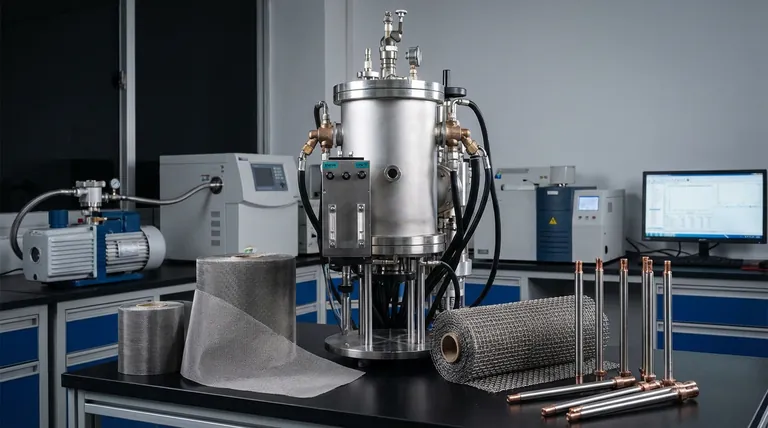
The Mechanics of Composite Wicks
The Dual-Layer Strategy
The effectiveness of this wick relies on combining tungsten wire meshes of vastly different specifications.
The design typically integrates a coarse layer (such as 50 mesh) with a fine layer (such as 400 mesh). This hybrid approach allows the heat pipe to leverage the physical advantages of both geometries simultaneously.
Generating Capillary Driving Force
The finer mesh layer (400 mesh) is responsible for the capillary driving force.
Because the pores are smaller, they generate significantly higher capillary pressure. This pressure acts as the "pump" that pulls the liquid sodium from the condenser back to the evaporator, ensuring continuous movement even against gravity.
Maintaining Fluid Permeability
The coarser mesh layer (50 mesh) addresses the issue of flow resistance.
If the entire wick were made of fine mesh, the friction would be too high for the fluid to move quickly. The coarser layer creates a more open structure, providing high permeability that allows the liquid sodium to flow back with minimal resistance.
Operational Benefits
Preventing Evaporator Dry-Out
The most critical function of this composite structure is ensuring the evaporation section never runs dry.
By balancing the driving force with low resistance, the wick supplies liquid sodium to the hot zone faster than it evaporates. This stability is essential for maintaining the heat pipe's thermal conductivity and preventing failure.
Supporting High-Aspect-Ratio Structures
This wick design is particularly beneficial for high-aspect-ratio structures (long and thin pipes).
In these geometries, the fluid must travel longer distances, which typically increases flow resistance. The composite tungsten mesh overcomes this distance challenge, maintaining effective circulation where a standard homogenous wick might fail.
Understanding the Trade-offs
Complexity vs. Performance
While the reference highlights cost-effective manufacturing, composite wicks are inherently more complex than single-layer designs.
The engineering challenge lies in ensuring perfect contact between the layers. If the interface between the 50 mesh and 400 mesh is not uniform, the capillary continuity can break, disrupting the fluid loop.
The Specificity of Sodium
This specific configuration is optimized for liquid sodium, which is used in high-temperature applications.
The mesh sizes (50/400) are selected specifically for the surface tension and viscosity properties of sodium. Using this exact composite structure for a different working fluid (like water or ammonia) would likely require re-optimizing the mesh specifications to achieve the same balance.
Making the Right Choice for Your Goal
If you are evaluating heat pipe designs, consider how the wick structure aligns with your operational constraints:
- If your primary focus is Reliability: Prioritize the composite design to ensure the evaporation section does not dry out under high thermal loads.
- If your primary focus is Geometry: Use this wick type for high-aspect-ratio applications where fluid must travel long distances without losing pressure.
The composite wick effectively solves the hydrodynamic conflict between pumping and flow, enabling high performance in demanding thermal environments.
Summary Table:
| Feature | Layer Specification | Primary Function |
|---|---|---|
| Capillary Layer | 400 Mesh (Fine) | Generates high capillary pressure to pump liquid sodium. |
| Permeability Layer | 50 Mesh (Coarse) | Reduces flow resistance to ensure rapid fluid backflow. |
| Total System | Composite Structure | Decouples pressure from friction for high-aspect-ratio pipes. |
Elevate Your High-Temperature Research with KINTEK
Don’t let thermal bottlenecks compromise your precision. KINTEK provides industry-leading high-temperature solutions, including Muffle, Tube, Rotary, Vacuum, and CVD systems, all backed by our expert R&D and manufacturing. Whether you need specialized heat pipe components or fully customizable lab furnaces, our engineering team is ready to deliver systems tailored to your unique requirements.
Ready to optimize your thermal performance? Contact KINTEK today and let us design the perfect solution for your lab.
Visual Guide

References
- Shuaijie Sha, Junjie Wang. Experimental and numerical simulation study of sodium heat pipe with large aspect ratio. DOI: 10.2298/tsci231030059s
This article is also based on technical information from Kintek Furnace Knowledge Base .
Related Products
People Also Ask
- How does vacuum sintering improve dimensional tolerances? Achieve Uniform Shrinkage and Precision
- What are the key components of a vacuum sintering furnace? Essential Parts for Precision Material Processing
- What is the purpose of setting a mid-temperature dwell stage? Eliminate Defects in Vacuum Sintering
- What are the main structural components of a vacuum sintering furnace? Unlock Precision in High-Temperature Processing
- What are the main types of sintering furnaces? Find the Perfect Match for Your Materials
