
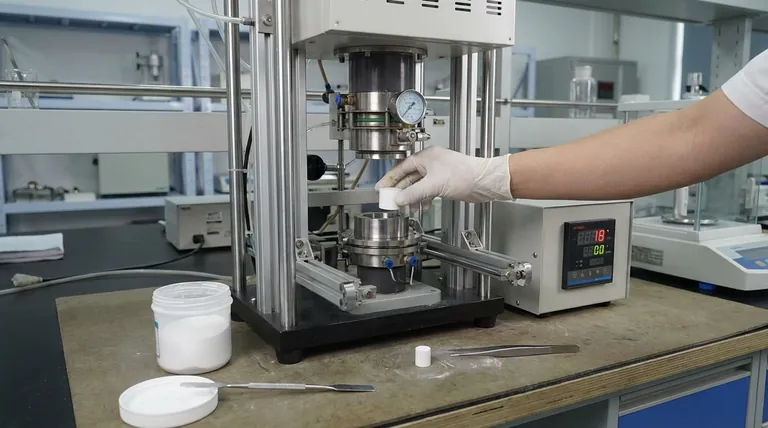
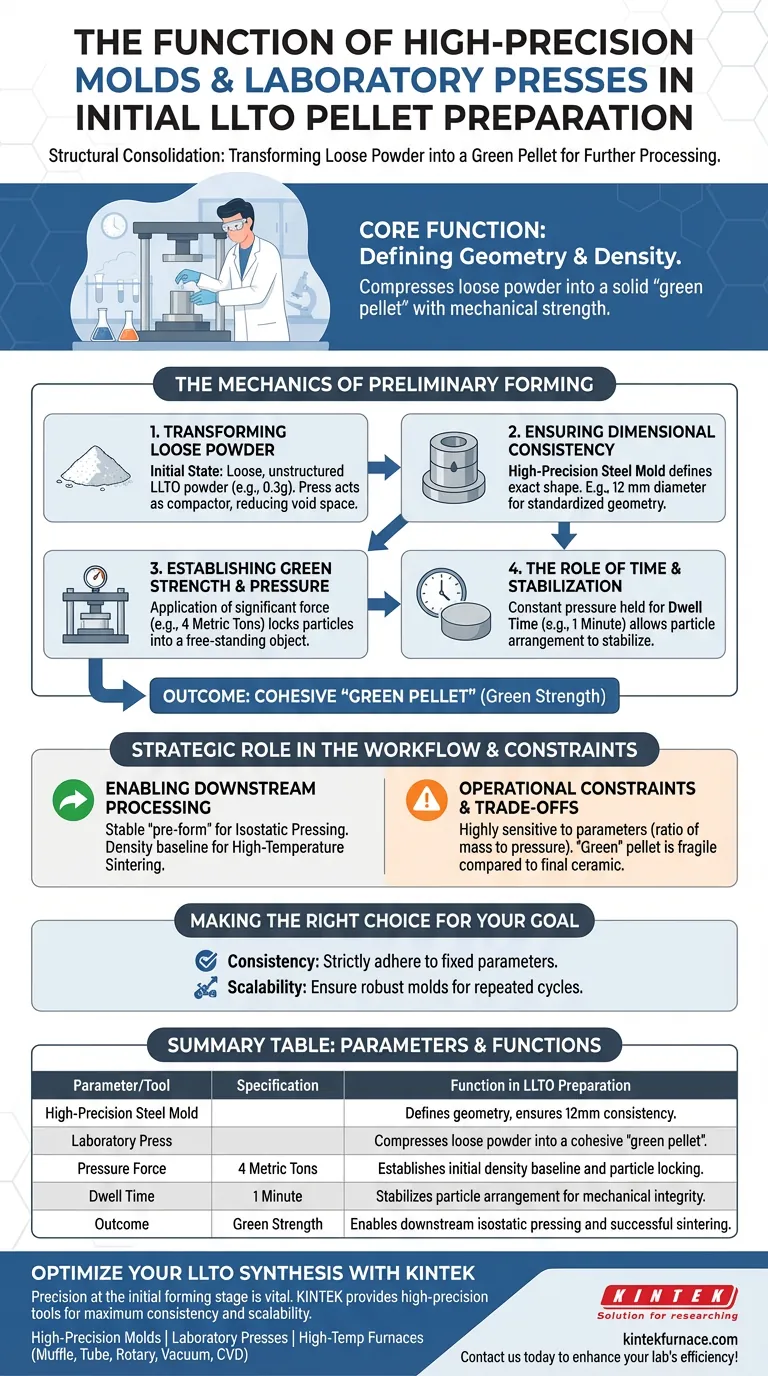
High-precision steel molds and laboratory presses serve the critical function of structural consolidation. In the initial preparation of Lithium Lanthanum Titanate (LLTO), these tools define the geometry and density of the material by compressing loose powder into a solid form. This step transforms volatile powder into a "green pellet" with sufficient mechanical strength to serve as a foundation for further processing.
The primary objective is to convert loose, difficult-to-handle powder into a cohesive, geometric unit. By applying specific, constant pressure, this equipment establishes the initial structural integrity required for subsequent isostatic pressing and high-temperature sintering.
The Mechanics of Preliminary Forming
Transforming Loose Powder into Solids
The initial state of LLTO is a loose powder which lacks structure. The laboratory press functions as a compactor, forcing the discrete particles together to reduce void space.
Ensuring Dimensional Consistency
High-precision steel molds are used to define the exact shape and size of the pellet. For example, a 12 mm diameter mold is often used to ensure the standardized geometry required for consistent experimental results.
Establishing Green Strength
The application of force creates "green strength"—the mechanical integrity of an unsintered ceramic. By subjecting a specific amount of powder (e.g., 0.3 grams) to significant force, the particles lock together to form a free-standing object.
The Role of Time and Pressure
The function of the press is not just to squeeze, but to hold constant pressure. A typical protocol involves applying 4 metric tons of pressure and maintaining it for 1 minute to allow the particle arrangement to stabilize.
Strategic Role in the Workflow
Enabling Downstream Processing
The green pellet is not the final product; it is a prerequisite. The initial pressing provides a stable "pre-form" that allows the material to undergo isostatic pressing without crumbling.
Preparation for Sintering
High-temperature sintering requires a compacted base to be effective. The laboratory press creates the necessary density baseline that allows the ceramic to densify properly during the heating phase.
Operational Constraints and Trade-offs
Dependence on Specific Parameters
The success of this function is highly sensitive to the inputs. Deviating from the established ratio of mass (0.3 g) to pressure (4 metric tons) can result in pellets that are too brittle to handle or too dense to sinter evenly.
The "Green" Limitation
While the press creates mechanical strength, the resulting pellet remains fragile compared to the final ceramic. It provides enough strength for handling and the next process step, but it lacks the chemical bonding of the final sintered product.
Making the Right Choice for Your Goal
To maximize the effectiveness of your preparation stage, consider your specific objective:
- If your primary focus is Consistency: Adhere strictly to the fixed parameters (e.g., 4 metric tons for 1 minute) to ensure every pellet has an identical density profile.
- If your primary focus is Scalability: Ensure your high-precision molds are robust enough to maintain the 12 mm diameter tolerance over repeated high-pressure cycles.
Precision at this initial stage is the single most important factor in securing a stable foundation for the final ceramic electrolyte.
Summary Table:
| Parameter | Specification | Function in LLTO Preparation |
|---|---|---|
| Tooling | High-Precision Steel Mold | Defines geometry and ensures 12mm dimensional consistency. |
| Equipment | Laboratory Press | Compresses loose powder into a cohesive 'green pellet'. |
| Pressure Force | 4 Metric Tons | Establishes the initial density baseline and particle locking. |
| Dwell Time | 1 Minute | Stabilizes particle arrangement for mechanical integrity. |
| Outcome | Green Strength | Enables downstream isostatic pressing and successful sintering. |
Optimize Your LLTO Material Synthesis with KINTEK
Precision at the initial forming stage is vital for high-performance ceramic electrolytes. KINTEK provides the high-precision tools necessary to ensure your research achieves maximum consistency and scalability.
Backed by expert R&D and manufacturing, KINTEK offers a comprehensive range of laboratory equipment including:
- High-Precision Molds: Specifically designed for repeatable ceramic pellet geometry.
- Laboratory Presses: Delivering constant pressure for superior green strength.
- High-Temp Furnaces: Muffle, Tube, Rotary, Vacuum, and CVD systems for expert sintering.
All our systems are customizable to meet your unique laboratory needs. Contact us today to enhance your lab's efficiency and material integrity!
Visual Guide
References
- Pei‐Yin Chen, Sheng‐Heng Chung. A solid-state electrolyte for electrochemical lithium–sulfur cells. DOI: 10.1039/d3ra05937e
This article is also based on technical information from Kintek Furnace Knowledge Base .
Related Products
- High Pressure Laboratory Vacuum Tube Furnace
- Vacuum Hot Press Furnace Machine for Lamination and Heating
- Vacuum Hot Press Furnace Machine Heated Vacuum Press
- Vacuum Hot Press Furnace Machine Heated Vacuum Press Tube Furnace
- 1200℃ Muffle Oven Furnace for Laboratory
People Also Ask
- What role does a high vacuum tube furnace play in Co-Al sintering? Master High-Purity Porous Material Synthesis
- What are the different types of tube furnaces available? Find the Perfect Fit for Your Lab's Needs
- What are the main advantages of vacuum tube furnaces in the market? Achieve Purity and Precision in Material Processing
- What is the role of a vacuum tube furnace during the final thermal treatment stage of Fe3O4@CSAC catalysts?
- What conditions does a tube furnace provide for post-ion-implantation? Achieve Precise Microstructural Repair











