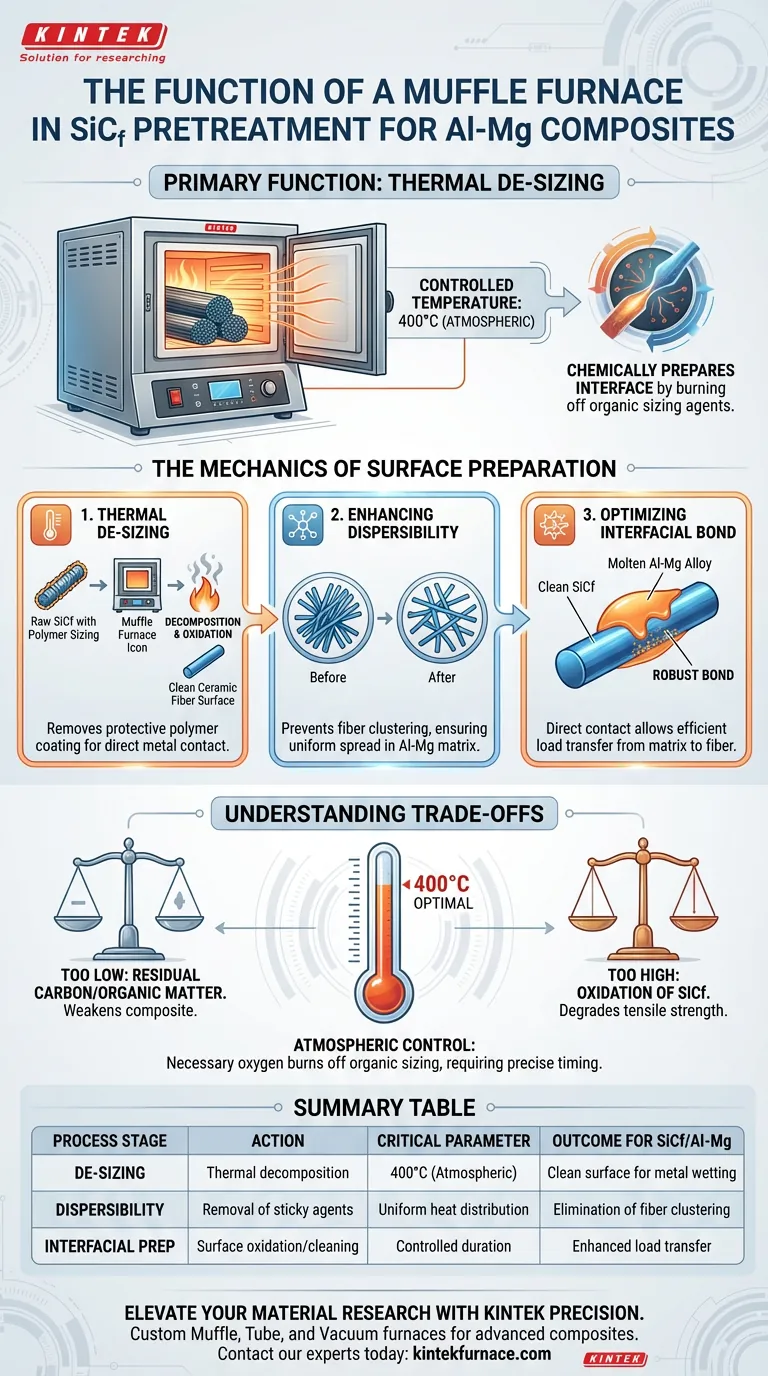
The primary function of a muffle furnace in this context is thermal de-sizing. Specifically, it subjects Silicon Carbide fibers (SiCf) to a controlled temperature of 400°C in an atmospheric environment to essentially burn off organic sizing agents found on the fiber surface.
The muffle furnace does not simply heat the material; it chemically prepares the interface. By eliminating organic coatings through thermal decomposition, it exposes the raw fiber surface, which is a prerequisite for creating a robust bond with the Aluminum-Magnesium matrix.
The Mechanics of Surface Preparation
Thermal De-sizing
Raw Silicon Carbide fibers typically arrive with a protective polymer coating known as "sizing." This coating must be removed before the fibers can be used in a metal matrix.
The muffle furnace provides a stable, atmospheric thermal environment that oxidizes these organic agents. At 400°C, the sizing agents decompose and burn away, leaving the underlying ceramic fiber clean.
Enhancing Dispersibility
Sizing agents often cause fibers to cluster or stick together. By removing these agents, the muffle furnace treatment significantly improves the dispersibility of the fibers.
This ensures that when the fibers are introduced to the Al-Mg matrix, they spread uniformly rather than forming weak, clumped aggregates.
Optimizing the Interfacial Bond
The critical "deep need" addressed by this process is the integrity of the fiber-matrix interface. If sizing agents remain, they act as a contaminant between the ceramic fiber and the metal.
By exposing the clean SiC surface, the molten Aluminum-Magnesium alloy can wet the fiber directly. This direct contact is essential for transferring mechanical loads from the matrix to the strong fibers.
Understanding the Trade-offs
Temperature Sensitivity
While the goal is to remove impurities, the temperature must be strictly controlled at 400°C.
If the temperature is too low, residual carbon or organic matter may remain, weakening the composite. Conversely, if the temperature exceeds the optimal range, you risk oxidizing the Silicon Carbide fiber itself, which degrades its intrinsic tensile strength.
Atmospheric Control
Unlike vacuum furnaces used for other treatments, this process relies on an atmospheric environment to facilitate oxidation. The presence of oxygen is necessary to burn off the organic sizing, but it also necessitates precise timing to prevent damage to the fiber substrate.
Making the Right Choice for Your Goal
To maximize the performance of your Al-Mg composite, apply the pretreatment based on your specific priorities:
- If your primary focus is Mechanical Strength: Ensure the furnace maintains a uniform 400°C to achieve complete de-sizing, as any residue will act as a crack initiation site.
- If your primary focus is Process Consistency: Standardize the duration of the roast to balance the removal of sizing against the risk of fiber surface oxidation.
The muffle furnace is the gatekeeper of composite quality, transforming raw, coated fibers into a reinforcement material capable of bonding with metal.
Summary Table:
| Process Stage | Action | Critical Parameter | Outcome for SiCf/Al-Mg |
|---|---|---|---|
| De-sizing | Thermal decomposition of organic coatings | 400°C (Atmospheric) | Clean fiber surface for direct metal wetting |
| Dispersibility | Removal of sticky polymer agents | Uniform heat distribution | Elimination of fiber clustering and aggregates |
| Interfacial Prep | Surface oxidation/cleaning | Controlled duration | Enhanced load transfer between fiber and matrix |
Elevate Your Material Research with KINTEK Precision
Achieving the perfect 400°C thermal environment for Silicon Carbide fiber pretreatment requires absolute temperature uniformity and reliable atmospheric control. KINTEK provides industry-leading Muffle, Tube, and Vacuum furnaces designed to meet the rigorous demands of advanced composite manufacturing.
Our expert R&D and manufacturing teams specialize in delivering customizable high-temp solutions tailored to your unique laboratory needs. Whether you are optimizing SiCf/Al-Mg interfaces or developing new metal matrix composites, KINTEK ensures your process consistency and mechanical strength.
Ready to refine your thermal processes? Contact our experts today to find your custom solution!
Visual Guide
References
- Guanzhang Lin, Zhaozhao Lv. Strengthening Mechanism and Damping Properties of SiCf/Al-Mg Composites Prepared by Combining Colloidal Dispersion with a Squeeze Melt Infiltration Process. DOI: 10.3390/ma17071600
This article is also based on technical information from Kintek Furnace Knowledge Base .
Related Products
- 1400℃ Muffle Oven Furnace for Laboratory
- High Temperature Muffle Oven Furnace for Laboratory Debinding and Pre Sintering
- Laboratory Muffle Oven Furnace with Bottom Lifting
- 1200℃ Muffle Oven Furnace for Laboratory
- 1700℃ High Temperature Muffle Oven Furnace for Laboratory
People Also Ask
- How does a high-temperature laboratory muffle furnace affect material properties? Transform Anodic Oxide Films Fast
- What is the primary function of a high-temperature laboratory muffle furnace in chemical synthesis? Achieve Precision.
- How does a laboratory high-temperature muffle furnace facilitate the homogenization of borosilicate glass samples? Expert Insights
- How is a laboratory high-temperature muffle furnace used in agloporite preparation? Optimize Material Synthesis
- What role does a laboratory high-temperature muffle furnace play in the treatment of highly contaminated waste glass?