
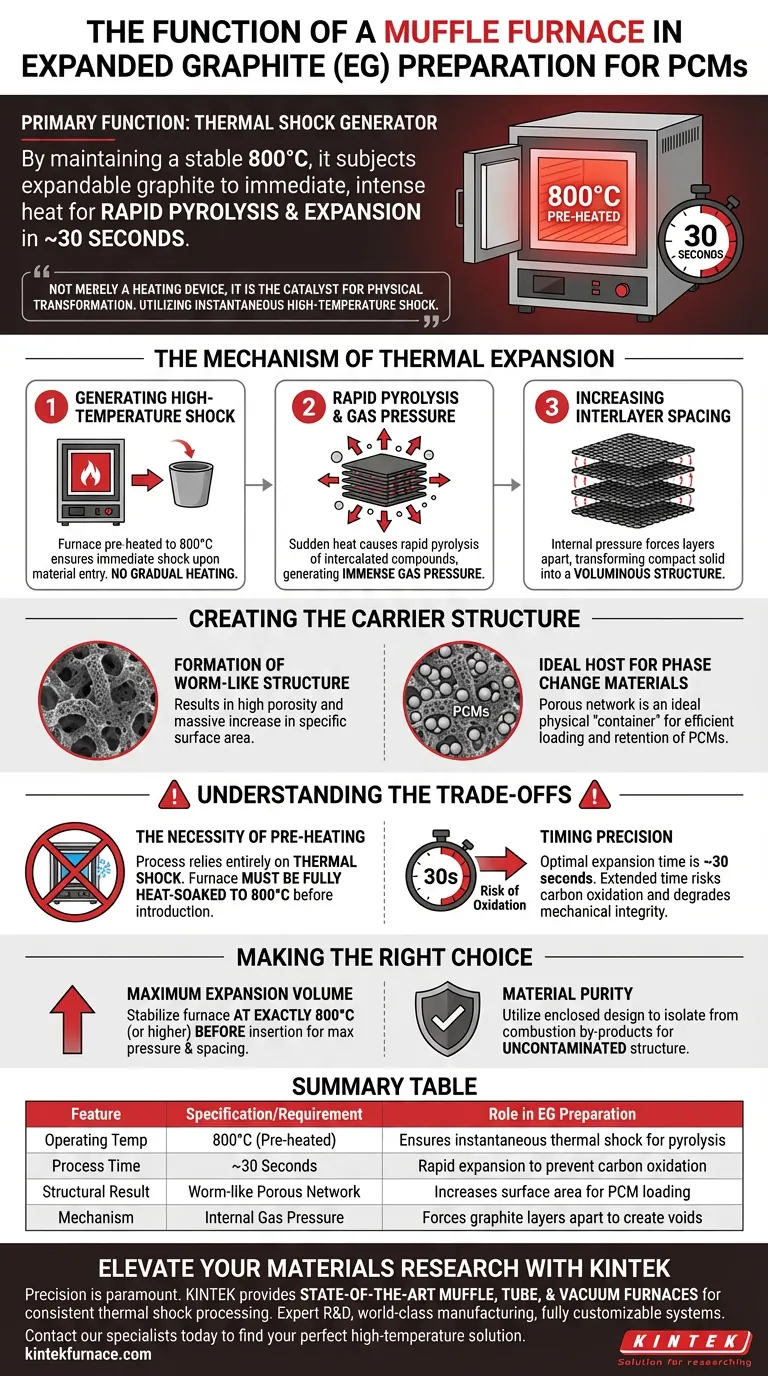
The primary function of a muffle furnace in this context is to act as a thermal shock generator. By maintaining a stable environment at 800°C, it subjects expandable graphite to immediate, intense heat, triggering rapid pyrolysis and expansion within approximately 30 seconds.
The muffle furnace is not merely a heating device; it is the catalyst for a physical transformation. It utilizes instantaneous high-temperature shock to convert dense graphite layers into a highly porous, worm-like structure essential for holding phase change materials.
The Mechanism of Thermal Expansion
The preparation of expanded graphite (EG) relies on a specific sequence of physical reactions that the muffle furnace facilitates.
Generating High-Temperature Shock
Unlike processes that require gradual heating, EG preparation demands an instantaneous high-temperature environment. The muffle furnace is pre-heated to 800°C to ensure that as soon as the material enters, it undergoes immediate thermal shock.
Rapid Pyrolysis and Gas Pressure
This sudden exposure to heat causes the intercalated compounds within the graphite to undergo rapid pyrolysis. This reaction generates immense gas pressure between the graphite layers almost instantly.
Increasing Interlayer Spacing
The internal pressure forces the graphite layers apart. This significantly increases the interlayer spacing, transforming the material from a compact solid into a voluminous structure.
Creating the Carrier Structure
The ultimate goal of using the muffle furnace is to engineer a physical space capable of hosting other substances.
Formation of Worm-like Structure
The expansion process results in a distinct worm-like porous structure. This architecture is characterized by high porosity and a massive increase in specific surface area compared to the raw material.
Ideal Host for Phase Change Materials
This newly created porous network serves as an ideal physical "container." The expanded voids allow for the efficient loading and retention of phase change materials (PCMs), which is the ultimate objective of the preparation process.
Understanding the Trade-offs
While the muffle furnace is effective, understanding its operational constraints is vital for consistent results.
The Necessity of Pre-heating
The process relies entirely on thermal shock, not gradual heating. A common pitfall is placing materials in a cold furnace and ramping the temperature up; this will fail to generate the rapid gas pressure required for proper expansion. The furnace must be fully heat-soaked to 800°C before the material is introduced.
Timing Precision
The primary reference notes an expansion time of roughly 30 seconds. Extended residence time beyond this window yields diminishing returns and may risk oxidation of the carbon structure, potentially degrading the carrier's mechanical integrity.
Making the Right Choice for Your Goal
To ensure optimal expanded graphite preparation, align your furnace usage with your specific project needs.
- If your primary focus is Maximum Expansion Volume: Ensure the furnace is stabilized at exactly 800°C (or slightly higher) before insertion to maximize the pressure differential and interlayer spacing.
- If your primary focus is Material Purity: Utilize the muffle furnace's enclosed design to isolate the graphite from fuel combustion by-products, ensuring the porous structure remains uncontaminated for PCM loading.
The muffle furnace converts thermal energy into structural utility, turning raw graphite into a sophisticated sponge for thermal energy storage.
Summary Table:
| Feature | Specification/Requirement | Role in EG Preparation |
|---|---|---|
| Operating Temp | 800°C (Pre-heated) | Ensures instantaneous thermal shock for pyrolysis |
| Process Time | ~30 Seconds | Rapid expansion to prevent carbon oxidation |
| Structural Result | Worm-like Porous Network | Increases surface area for PCM loading |
| Mechanism | Internal Gas Pressure | Forces graphite layers apart to create voids |
Elevate Your Materials Research with KINTEK
Precision is paramount when preparing expanded graphite carriers. KINTEK provides state-of-the-art muffle, tube, and vacuum furnaces designed to deliver the stable, high-temperature environments essential for consistent thermal shock processing.
Backed by expert R&D and world-class manufacturing, our systems are fully customizable to meet the unique demands of your lab. Whether you are developing phase change materials or advanced carbon structures, KINTEK offers the thermal reliability you need to succeed.
Ready to optimize your thermal expansion process? Contact our specialists today to find the perfect high-temperature solution for your laboratory.
Visual Guide
References
- Jin Tang, Cuiping Wang. Thermal Performance Improvement of Composite Phase-Change Storage Material of Octanoic Acid–Tetradecanol by Modified Expanded Graphite. DOI: 10.3390/en17174311
This article is also based on technical information from Kintek Furnace Knowledge Base .
Related Products
- High Temperature Muffle Oven Furnace for Laboratory Debinding and Pre Sintering
- 1800℃ High Temperature Muffle Oven Furnace for Laboratory
- Laboratory Muffle Oven Furnace with Bottom Lifting
- 1700℃ High Temperature Muffle Oven Furnace for Laboratory
- 1400℃ Muffle Oven Furnace for Laboratory
People Also Ask
- What thermal phenomena occur during polymer binder burnout in ceramic green bodies? Lab Furnace Guide
- Why is controlled heat treatment in a muffle furnace necessary for calcined clay? Achieve Optimal Pozzolanic Activity
- What role does a high-temperature muffle furnace play in STFO synthesis? Achieve Pure Perovskite Results
- How does a high-temperature muffle furnace facilitate the formation of LaNbxAl1−xO3+δ perovskite structures? Key Roles
- What role does a high-temperature muffle furnace play in the formation of biochar catalysts? Master Catalyst Synthesis















