
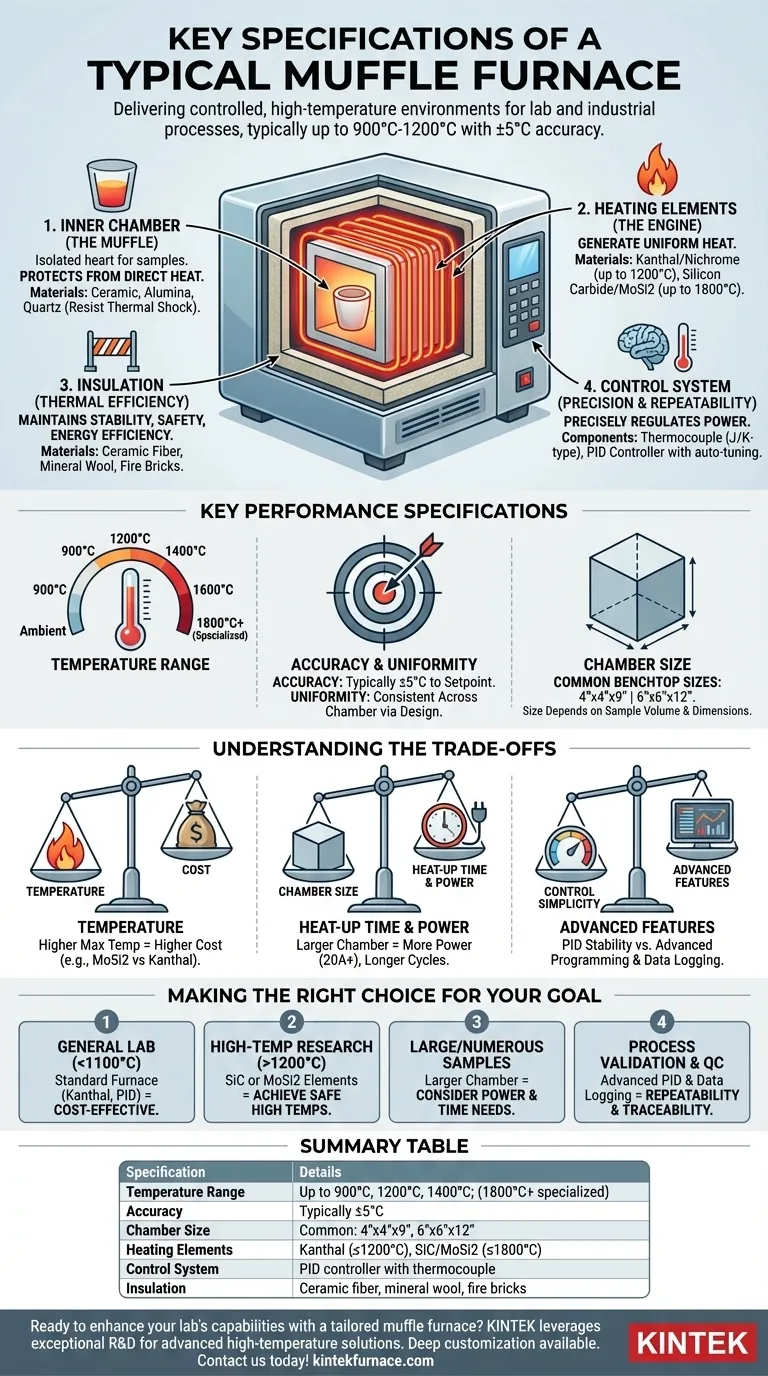
At its core, a typical muffle furnace is defined by its operational temperature range, internal chamber size, method of temperature control, and the materials used in its construction. These specifications work in concert to deliver controlled, high-temperature environments for laboratory and industrial processes, with most standard models operating up to 900°C or 1200°C with an accuracy of ±5°C.
Understanding a muffle furnace isn't just about memorizing specifications. It's about seeing how its core components—the chamber, heating elements, and controller—work together to achieve a specific temperature profile with the required precision and safety for your task.
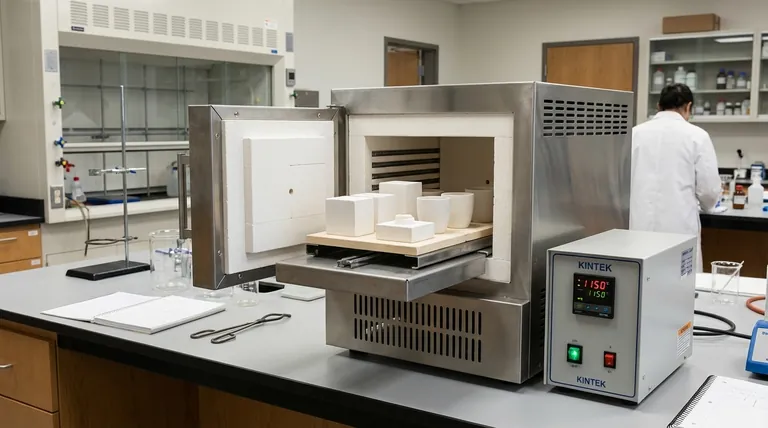
Deconstructing the Muffle Furnace: Core Components
To truly grasp the specifications, you must first understand the function of each major part. The furnace is a system where each component's quality dictates the overall performance.
The Inner Chamber (The Muffle)
The inner chamber, or muffle, is the isolated heart of the furnace where samples are placed. It is responsible for protecting the sample from direct contact with the heating elements.
This chamber is constructed from high-grade, refractory materials like ceramic, alumina, or quartz, chosen for their ability to withstand extreme thermal shock without degrading.
Heating Elements: The Engine of the Furnace
Heating elements are the components that generate heat. They are typically arranged around the outside of the muffle to ensure uniform temperature distribution.
The material used for the element is the primary factor determining the furnace's maximum temperature. Common materials include Kanthal (A1) or nickel-chromium (nichrome) for temperatures up to 1200°C, and Silicon Carbide (SiC) or Molybdenum Disilicide (MoSi2) for higher-temperature applications up to 1800°C.
Insulation: Maximizing Thermal Efficiency
Effective insulation is critical for maintaining temperature stability, ensuring operator safety, and improving energy efficiency. It prevents heat from escaping the chamber.
Materials like ceramic fiber, mineral wool, or high-grade fire bricks are packed between the inner chamber and the outer casing, providing a thermal barrier.
The Control System: Precision and Repeatability
The control system is the brain of the furnace. It consists of a temperature sensor, a controller, and a display.
A thermocouple (J-type or K-type) measures the chamber's temperature and sends this data to the controller.
Modern furnaces use a PID (Proportional-Integral-Derivative) controller, often with auto-tuning features, to precisely regulate power to the heating elements. This system minimizes temperature overshoots and maintains the setpoint with high accuracy.
Key Performance Specifications Explained
These component choices result in a set of measurable performance metrics that define what the furnace can do.
Temperature Range
This is the most critical specification. A standard furnace typically operates from ambient temperature up to 900°C, 1200°C, or 1400°C.
Specialized models designed for advanced materials processing can reach 1800°C or higher, but these require more exotic and expensive heating elements and insulation.
Accuracy and Uniformity
Accuracy refers to how closely the actual chamber temperature matches the setpoint on the controller. For most muffle furnaces, this is specified as ±5°C.
Uniformity describes the temperature consistency across different points within the chamber. While often not given a numeric value, it is a key feature achieved through careful design of the heating elements' placement.
Chamber Size
The internal, usable volume of the furnace is specified by its dimensions (Height x Width x Depth).
Common benchtop sizes include 4" x 4" x 9" and 6" x 6" x 12". The required size depends entirely on the volume and dimensions of the samples you intend to process.
Understanding the Trade-offs
Selecting a furnace involves balancing performance, longevity, and cost. Understanding the inherent trade-offs is essential for making an informed decision.
Temperature vs. Cost: The Heating Element Dilemma
The single biggest factor driving cost is the maximum operating temperature. A furnace rated for 1200°C using Kanthal elements is significantly less expensive than one rated for 1700°C that requires MoSi2 elements.
Do not over-specify your temperature needs. Purchasing a furnace with a much higher temperature range than you require leads to unnecessary capital expense.
Chamber Size vs. Heat-Up Time and Power
A larger chamber provides more capacity but comes with clear downsides. It requires more power to heat (20A or more is common) and will have a longer heat-up and cool-down cycle.
If you process small samples, choosing a smaller chamber will save time, energy, and often lab space.
Control Simplicity vs. Advanced Features
While most modern furnaces use reliable digital PID controllers, some applications may demand more advanced features like programmable multi-step cycles or data logging. These features add complexity and cost.
Conversely, a simple digital indicator may suffice for non-critical processes but lacks the stability and repeatability of a PID system for sensitive work.
Making the Right Choice for Your Goal
Your application dictates the required specifications. Use the following guidelines to select the right tool for the job.
- If your primary focus is general laboratory ashing or heat treating below 1100°C: A standard furnace with Kanthal heating elements and a reliable PID controller is the most cost-effective and appropriate choice.
- If your primary focus is high-temperature materials research (above 1200°C): You must invest in a furnace equipped with Silicon Carbide (SiC) or Molybdenum Disilicide (MoSi2) elements to achieve and sustain these temperatures safely.
- If your primary focus is processing large or numerous samples simultaneously: Prioritize a larger chamber volume, but ensure your facility can meet the higher power requirements and accommodate longer cycle times.
- If your primary focus is process validation and quality control: Emphasize a furnace with an advanced PID controller, over-temperature protection, and potentially data logging capabilities to ensure repeatability and traceability.
By understanding how these specifications relate to the furnace's core function, you can confidently select the precise instrument your work demands.
Summary Table:
| Specification | Details |
|---|---|
| Temperature Range | Up to 900°C, 1200°C, or 1400°C; specialized models up to 1800°C |
| Accuracy | Typically ±5°C |
| Chamber Size | Common sizes: 4" x 4" x 9", 6" x 6" x 12" |
| Heating Elements | Kanthal (up to 1200°C), SiC or MoSi2 (up to 1800°C) |
| Control System | PID controller with thermocouple sensors |
| Insulation | Ceramic fiber, mineral wool, or fire bricks |
Ready to enhance your lab's capabilities with a tailored muffle furnace? KINTEK leverages exceptional R&D and in-house manufacturing to provide advanced high-temperature solutions, including Muffle, Tube, Rotary, Vacuum & Atmosphere Furnaces, and CVD/PECVD Systems. Our deep customization ensures precise fit for your unique experimental needs—contact us today to discuss how we can optimize your processes!
Visual Guide
Related Products
- 1400℃ Muffle Oven Furnace for Laboratory
- 1700℃ High Temperature Muffle Oven Furnace for Laboratory
- 1800℃ High Temperature Muffle Oven Furnace for Laboratory
- 1200℃ Muffle Oven Furnace for Laboratory
- High Temperature Muffle Oven Furnace for Laboratory Debinding and Pre Sintering
People Also Ask
- How does a high-temperature laboratory muffle furnace affect material properties? Transform Anodic Oxide Films Fast
- What is the primary function of a high-temperature laboratory muffle furnace in chemical synthesis? Achieve Precision.
- How is a laboratory high-temperature muffle furnace used in agloporite preparation? Optimize Material Synthesis
- What is the function of a muffle furnace in MOF-derived zirconia conversion? Optimize Phase & Pore Engineering
- What role does a laboratory high-temperature muffle furnace play in the treatment of highly contaminated waste glass?



















