
The primary function of a muffle furnace in the production of Cu–Ce/HZSM-5 adsorbents is to facilitate critical phase transformations through a stable, high-temperature oxidative environment. Specifically, it is responsible for converting precursor chemicals into active metal oxides during the initial calcination and stripping away surface contaminants to restore functionality during the regeneration phase.
Core Takeaway The muffle furnace acts as a precision chemical reactor that uses heat to drive specific oxidation reactions. Its role is twofold: it activates the adsorbent by turning nitrate precursors into essential copper and cerium oxides (CuO and CeO2), and it extends the material's lifespan by burning off phosphide deposits that poison the active sites.
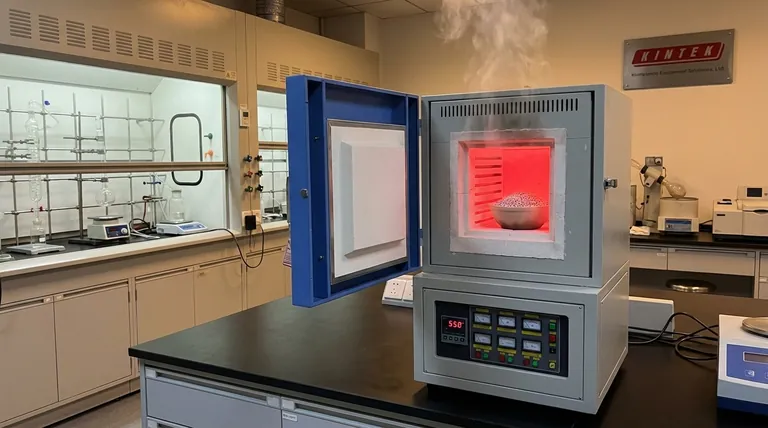
The Calcination Stage: Activation
The first critical application of the muffle furnace occurs immediately after the metal precursors have been impregnated onto the HZSM-5 support.
Thermal Decomposition of Precursors
During the preparation of the adsorbent, copper and cerium are typically introduced as nitrate salts.
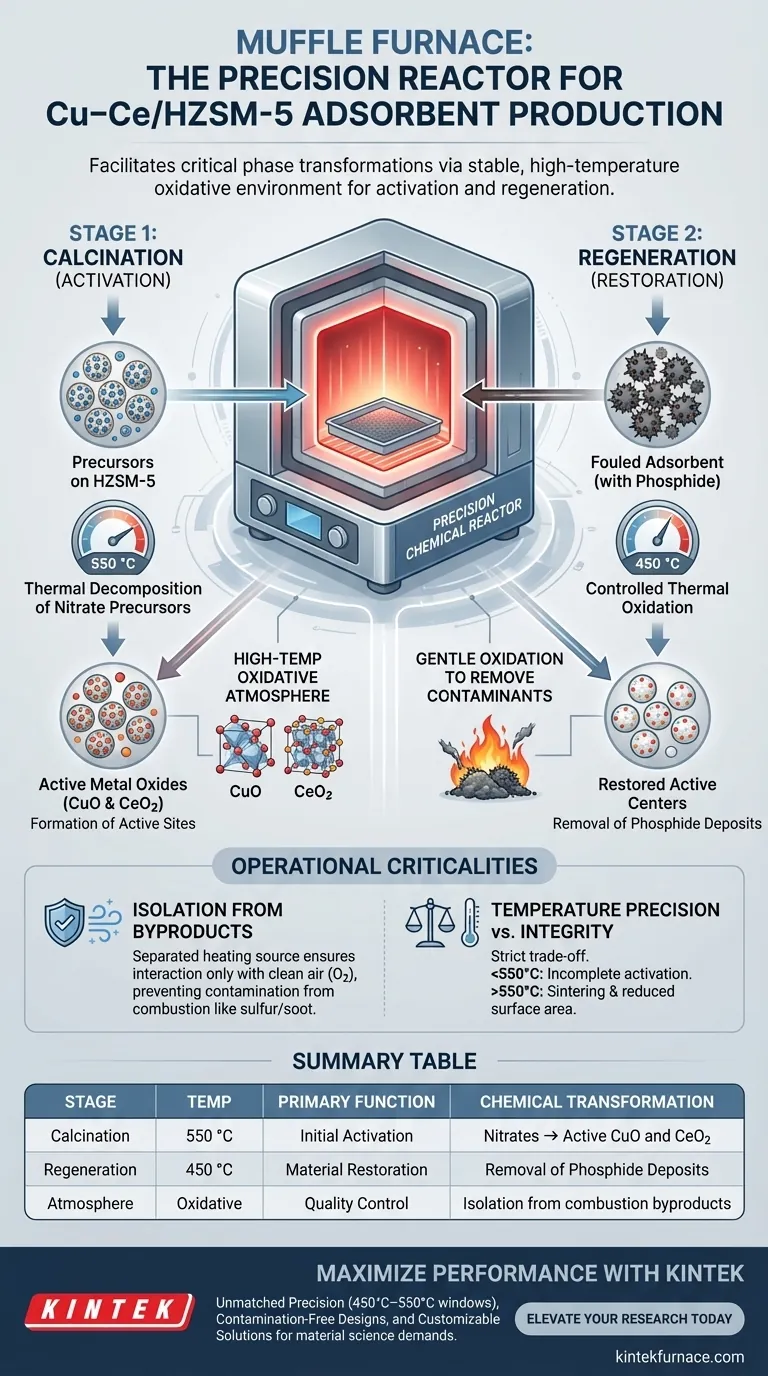
The muffle furnace provides a consistent thermal environment at 550 °C. At this specific temperature, the furnace drives the complete thermal decomposition of these nitrate precursors.
Formation of Active Metal Oxides
The goal of calcination is not just drying; it is a chemical transformation.
The high-temperature oxidative atmosphere converts the decomposed nitrates into stable metal oxides, specifically copper oxide (CuO) and cerium oxide (CeO2). These oxides constitute the active "sites" of the adsorbent that are capable of performing chemical separations.
The Regeneration Stage: Restoration
Adsorbents eventually lose efficiency as their surface becomes fouled with contaminants. The muffle furnace is utilized here to reverse this deactivation.
Removal of Phosphide Deposits
During operation, the Cu–Ce/HZSM-5 adsorbent may accumulate phosphide deposits.
These deposits block the active centers, rendering the material ineffective. The muffle furnace removes these contaminants through thermal oxidation.
Controlled Thermal Oxidation
Regeneration requires a delicate balance between cleaning the material and preserving its structure.
The furnace is set to a lower temperature of 450 °C for this stage. This temperature is sufficient to oxidize and remove the phosphide deposits, restoring the activity centers without subjecting the material to the higher thermal stress used during the initial calcination.
Understanding Operational Criticalities
While the concept of heating is simple, the method of heating provided by a muffle furnace is distinct and critical for material quality.
Isolation from Combustion Byproducts
A defining feature of a muffle furnace is the separation of the heating source from the heating chamber.
This isolation ensures that the Cu–Ce/HZSM-5 material interacts only with air (oxygen) and heat, rather than being contaminated by combustion byproducts (like sulfur or carbon soot) that might occur in a direct-flame furnace.
Temperature Precision vs. Material Integrity
There is a strict trade-off between complete activation and structural damage.
If the calcination temperature drops significantly below 550 °C, the nitrate precursors may not fully decompose, resulting in low activity. Conversely, excessive temperatures can cause sintering, where the dispersed metal oxide particles clump together, reducing the specific surface area and overall efficiency.
Making the Right Choice for Your Goal
To ensure the highest quality Cu–Ce/HZSM-5 adsorbent, you must tailor the thermal treatment to the specific lifecycle stage of the material.
- If your primary focus is Initial Production: Ensure the furnace maintains a stable 550 °C to guarantee the complete conversion of nitrates into active CuO and CeO2 species.
- If your primary focus is Material Longevity: Set the furnace to 450 °C to gently oxidize phosphide contaminants, restoring activity without thermally degrading the zeolite structure.
Precise thermal control is not merely a manufacturing step; it is the mechanism that defines the chemical identity and lifespan of your adsorbent.
Summary Table:
| Stage | Temperature | Primary Function | Chemical Transformation |
|---|---|---|---|
| Calcination | 550 °C | Initial Activation | Nitrates → Active CuO and CeO2 |
| Regeneration | 450 °C | Material Restoration | Removal of Phosphide Deposits |
| Atmosphere | Oxidative | Quality Control | Isolation from combustion byproducts |
Maximize Your Adsorbent Performance with KINTEK
Precise thermal control is the difference between a high-efficiency adsorbent and a failed reaction. KINTEK provides industry-leading muffle, tube, and vacuum furnace systems designed to meet the rigorous demands of material science.
Why choose KINTEK?
- Unmatched Precision: Maintain the exact 450°C–550°C windows required for Cu–Ce/HZSM-5 stability.
- Contamination-Free: Our advanced muffle designs isolate your materials from all combustion byproducts.
- Customizable Solutions: Backed by expert R&D, we offer fully customizable high-temp systems tailored to your unique lab specifications.
Ready to elevate your research and production quality? Contact our technical experts today to find your perfect furnace solution!
Visual Guide
References
- Zhiyuan Liu, Guoqiang Huang. Acid-modified Cu–Ce/HZSM-5 adsorbent removes trace phosphorus impurities from recycled hydrogen during polysilicon production. DOI: 10.1039/d5ra01322d
This article is also based on technical information from Kintek Furnace Knowledge Base .
Related Products
- 1400℃ Muffle Oven Furnace for Laboratory
- 1700℃ High Temperature Muffle Oven Furnace for Laboratory
- 1800℃ High Temperature Muffle Oven Furnace for Laboratory
- 1200℃ Muffle Oven Furnace for Laboratory
- High Temperature Muffle Oven Furnace for Laboratory Debinding and Pre Sintering
People Also Ask
- What is the primary function of a high-temperature laboratory muffle furnace in chemical synthesis? Achieve Precision.
- How does a high-temperature laboratory muffle furnace affect material properties? Transform Anodic Oxide Films Fast
- What role does a muffle furnace play in refractory bricks? Enhance Performance and Durability Testing
- How does a muffle furnace facilitate Ag/ATP catalyst preparation? Optimize Calcination for Superior Performance
- How is a laboratory high-temperature muffle furnace utilized to achieve the specific crystalline structure of LaFeO3 catalysts?



















