
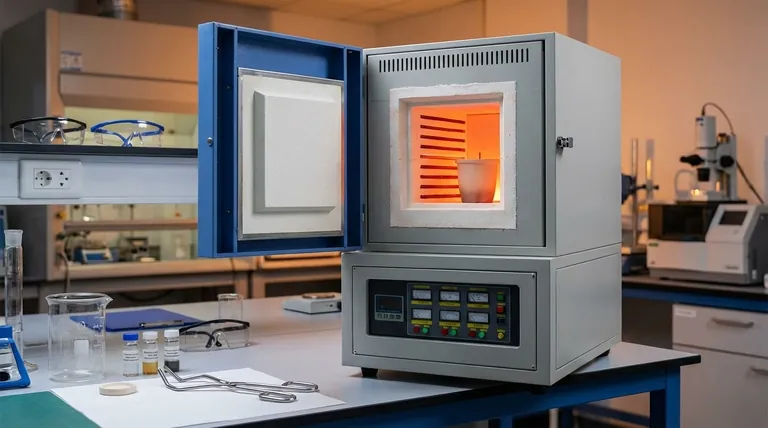
A muffle furnace serves as the precise thermal reactor required to convert raw chemical mixtures into structured crystalline materials during perovskite synthesis. It provides a stable high-temperature environment, typically reaching up to 1100 °C in ambient air, to facilitate the complete decomposition of carbonates and drive solid-state reactions with oxides.
Core Takeaway The muffle furnace is not merely a heating device; it is a phase-control instrument. Its primary role is to ensure the complete elimination of organic precursors and promote the uniform nucleation of the perovskite phase, establishing the crystal structure necessary for high-performance applications.
Driving Critical Chemical Transformations
Facilitating Solid-State Reactions
The most fundamental function of the muffle furnace is enabling the solid-state reaction between oxides and other raw materials.
By maintaining high temperatures (often around 1100 °C), the furnace provides the energy required for atoms to diffuse and rearrange into the perovskite crystal lattice. This process transforms a physical mixture of powders into a chemically bonded single-phase material.
Complete Decomposition of Precursors
Before the final phase can form, volatile components must be removed.
The furnace ensures the full decomposition of carbonates and oxalates found in the raw material mix. Eliminating these residues is essential, as incomplete decomposition leads to impurities and structural defects in the final ceramic product.
Inducing Phase Purity
The stability provided by the furnace is critical for suppressing unwanted secondary phases.
For example, in complex precursors, a step-by-step synthesis strategy at high temperatures prevents the formation of the pyrochlore phase. This ensures the material achieves a pure perovskite phase structure, which is vital for the material's final electronic or magnetic properties.
Controlling Microstructure and Morphology
Regulating Crystallinity and Grain Size
The furnace allows for precise control over the heating curve and dwell time.
By manipulating these variables, manufacturers can dictate the crystallinity and grain size of the synthesized powder. This control is a prerequisite for applications requiring specific physical properties, such as piezoelectric ceramics.
Enabling Combustion Synthesis
In specific synthesis routes, the furnace operates at lower temperatures (e.g., 250 °C to 400 °C) to trigger self-propagating combustion reactions.
The uniform heating triggers a redox reaction between nitrate oxidants and organic fuels. This rapid reaction releases gases, resulting in highly porous, high-surface-area powders rather than dense solids.
Creating Porous Structures
When processing precursor gels, the furnace facilitates the release of large volumes of gas during thermal treatment.
This process prevents the material from collapsing into a dense mass. Instead, it creates a loose precursor powder with high porosity, which significantly increases the available reaction surface area for subsequent processing steps.
Understanding the Trade-offs
Atmosphere Limitations
Standard industrial muffle furnaces typically operate under ambient air conditions.
While this is excellent for oxide formation and removing organics, it is unsuitable for materials that are sensitive to oxidation or require an inert atmosphere (like argon or nitrogen) to prevent degradation during synthesis.
The Risk of Thermal Gradients
Although these furnaces are designed for stability, poor loading configurations can lead to uneven heating.
If the thermal field is not uniform, "cold spots" may result in incomplete nucleation or mixed phases. Conversely, hotspots can lead to over-sintering, where grain growth becomes excessive and reduces the reactivity of the powder.
Making the Right Choice for Your Goal
To optimize your synthesis process, align the furnace parameters with your specific material requirements:
- If your primary focus is Phase Purity and Density: Prioritize high temperatures (approx. 1100 °C) and extended dwell times to ensure complete solid-state reactions and carbonate decomposition.
- If your primary focus is High Surface Area (Porosity): Utilize lower temperature ranges (250–400 °C) to trigger rapid combustion reactions that generate porous, loose powders.
The effectiveness of your preliminary synthesis relies entirely on matching the furnace's thermal profile to the chemical decomposition pathway of your specific precursors.
Summary Table:
| Function | Process Temperature | Primary Objective |
|---|---|---|
| Solid-State Reaction | Up to 1100 °C | Drive atomic diffusion to form perovskite crystal lattice |
| Precursor Decomposition | High Temperature | Complete elimination of carbonates, oxalates, and organics |
| Phase Control | High Temperature | Suppress secondary phases (e.g., pyrochlore) for pure materials |
| Combustion Synthesis | 250 °C – 400 °C | Trigger redox reactions to create high-surface-area powders |
| Morphology Control | Variable | Regulate grain size and crystallinity via heating curves |
Elevate Your Perovskite Synthesis with KINTEK Precision
Achieving phase purity and precise grain morphology requires more than just heat—it requires a controlled thermal environment. KINTEK provides industry-leading muffle, tube, and vacuum furnace systems designed to meet the rigorous demands of advanced material research.
Why choose KINTEK?
- Expert R&D & Manufacturing: Our systems are engineered for superior thermal uniformity and stability.
- Customizable Solutions: Whether you need ambient air processing or inert atmosphere control, we tailor systems to your unique needs.
- Comprehensive Range: From high-temp muffle furnaces to specialized CVD systems, we support every stage of your synthesis workflow.
Ready to optimize your preliminary synthesis stage? Contact KINTEK today to discuss your project requirements!
Visual Guide

References
- Zehua Wang, Zongping Shao. New Understanding and Improvement in Sintering Behavior of Cerium‐Rich Perovskite‐Type Protonic Electrolytes. DOI: 10.1002/adfm.202402716
This article is also based on technical information from Kintek Furnace Knowledge Base .
Related Products
- 1400℃ Muffle Oven Furnace for Laboratory
- 1700℃ High Temperature Muffle Oven Furnace for Laboratory
- 1800℃ High Temperature Muffle Oven Furnace for Laboratory
- 1200℃ Muffle Oven Furnace for Laboratory
- High Temperature Muffle Oven Furnace for Laboratory Debinding and Pre Sintering
People Also Ask
- What is the primary function of a high-temperature laboratory muffle furnace in chemical synthesis? Achieve Precision.
- How does a high-temperature laboratory muffle furnace affect material properties? Transform Anodic Oxide Films Fast
- What function does a muffle furnace perform in perovskite formation? Optimize Your Thermal Synthesis
- What is the role of a laboratory high-temperature muffle furnace in H13 steel treatment? Optimize Tool Performance
- How is a laboratory high-temperature muffle furnace used in agloporite preparation? Optimize Material Synthesis



















