
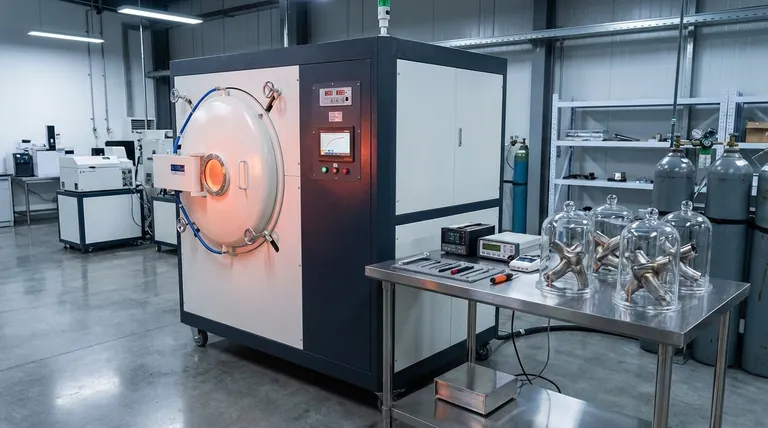
The function of a high-temperature vacuum annealing furnace in this context is to provide a precise, contaminant-free environment that simultaneously eliminates residual welding stresses and regulates critical phase transformations.
Specifically, the furnace utilizes a uniform thermal field to execute complex cycles, such as stepped isothermal annealing at 950°C. This process controls the decomposition of the beta-phase into alpha+beta phases, which is essential for restoring the plasticity and fatigue strength of the welded joints.
Core Takeaway
Welding complex titanium alloys introduces severe residual stresses and unstable microstructures. The high-temperature vacuum furnace acts as a corrective tool, using precise thermal regulation to relieve these stresses while preventing the reactive titanium from absorbing embrittling gases like oxygen and nitrogen.
Managing Thermal Stress and Uniformity
Eliminating Residual Stresses
Welding inherently introduces significant thermal gradients, locking tension into the material.
A high-temperature vacuum furnace addresses this by providing a uniform thermal field. By holding the alloy at high temperatures (e.g., 950°C), the furnace allows the material to relax, effectively erasing the residual stresses caused by the welding process.
Enabling Complex Thermal Cycles
Simple heating is often insufficient for complex alloys.
These furnaces are designed to execute stepped isothermal annealing. This involves holding the material at specific temperatures for set durations before controlled cooling. This precision is required to achieve a consistent internal structure across the entire weldment.
Controlling Microstructural Evolution
Regulating Phase Transformations
The mechanical properties of titanium alloys are dictated by their crystal phases.
During the cooling phase of the heat treatment, the furnace controls the decomposition of the beta-phase. The goal is to facilitate a controlled transition into alpha+beta phases.
Enhancing Mechanical Properties
Uncontrolled cooling leads to undesirable, brittle structures.
By managing the phase transformation described above, the furnace directly improves the plasticity of the joint. Furthermore, this microstructural refinement significantly boosts the fatigue strength, ensuring the part can withstand repeated loading without failure.
Protecting Material Integrity
Preventing Embrittlement
Titanium is highly reactive at high temperatures.
If exposed to air during annealing, titanium will aggressively absorb oxygen, nitrogen, and hydrogen. This leads to embrittlement, where the material becomes glass-like and prone to cracking. The vacuum environment acts as a shield, minimizing the partial pressure of these gases to prevent contamination.
Preserving Surface Quality
Post-processing cleaning can be expensive and damaging.
Because the vacuum environment prevents surface oxidation, the alloy maintains its surface brightness. This ensures that the material does not require aggressive cleaning to remove oxide layers after treatment.
Understanding the Trade-offs
Process Complexity and Time
This is not a rapid process.
The requirement for stepped isothermal annealing (heating, holding, stepping down, cooling) significantly extends cycle times compared to simple stress relief. This requires precise programming and limits the throughput of the equipment.
Sensitivity to Vacuum Integrity
The protection provided is absolute, but fragile.
Because titanium is so reactive, even a minor leak or insufficient vacuum level can lead to interstitial element contamination. If the vacuum fails at 950°C, the mechanical properties (ductility) can degrade sharply, potentially scrapping the entire workpiece.
Making the Right Choice for Your Goal
To maximize the utility of high-temperature vacuum annealing, align your process parameters with your specific mechanical requirements:
- If your primary focus is Fatigue Life: Prioritize the accuracy of the stepped cooling rates to ensure the optimal decomposition of the beta-phase into the alpha+beta structure.
- If your primary focus is Ductility: Ensure the vacuum level is strictly maintained to prevent hydrogen or oxygen uptake, which are the primary causes of material embrittlement.
Precise thermal control in a vacuum is not just about heating; it is about engineering the microstructure to ensure the weld performs as well as the parent metal.
Summary Table:
| Feature | Function in Titanium PWHT | Benefit to Material |
|---|---|---|
| Vacuum Environment | Prevents O2, N2, and H2 absorption | Eliminates embrittlement and preserves surface brightness |
| Uniform Thermal Field | Relaxes internal tension at 950°C | Erases residual welding stresses and prevents distortion |
| Stepped Isothermal Cycles | Controls beta-to-alpha+beta transformation | Enhances plasticity and fatigue life of welded joints |
| Precise Cooling Rates | Manages microstructural evolution | Ensures consistent mechanical properties across the weldment |
Elevate Your Aerospace and Medical Manufacturing Standards
Don't let residual stress or embrittlement compromise your critical titanium components. Backed by expert R&D and manufacturing, KINTEK offers high-performance Vacuum, Muffle, and Tube systems tailored for advanced metallurgy. Whether you require precise stepped isothermal annealing or rapid thermal processing, our customizable high-temperature furnaces provide the contamination-free environment your complex alloys demand.
Ready to optimize your heat treatment cycle? Contact KINTEK today for a customized solution.
Visual Guide

References
- Oleksiі Fedosov, Ivan Karpovych. Дослідження технології зварювання плавленням складнолегованих титанових сплавів. DOI: 10.32620/aktt.2024.2.07
This article is also based on technical information from Kintek Furnace Knowledge Base .
Related Products
- Molybdenum Vacuum Heat Treat Furnace
- 2200 ℃ Tungsten Vacuum Heat Treat and Sintering Furnace
- 1700℃ High Temperature Laboratory Tube Furnace with Alumina Tube
- 2200 ℃ Graphite Vacuum Heat Treat Furnace
- 1400℃ Controlled Inert Nitrogen Atmosphere Furnace
People Also Ask
- How does vacuum heat treating work in terms of temperature and time control? Master Precise Material Transformations
- What is the primary application of vacuum heat treating furnaces in aerospace? Enhance Component Performance with Precision
- How does a vacuum heat treating furnace improve the condition of metal alloys? Achieve Superior Metal Performance
- What is the process of vacuum heat treating? Achieve Superior Metallurgical Properties
- Why are vacuum heat treating furnaces essential for aerospace? Ensure Superior Material Integrity for High-Stakes Applications



















