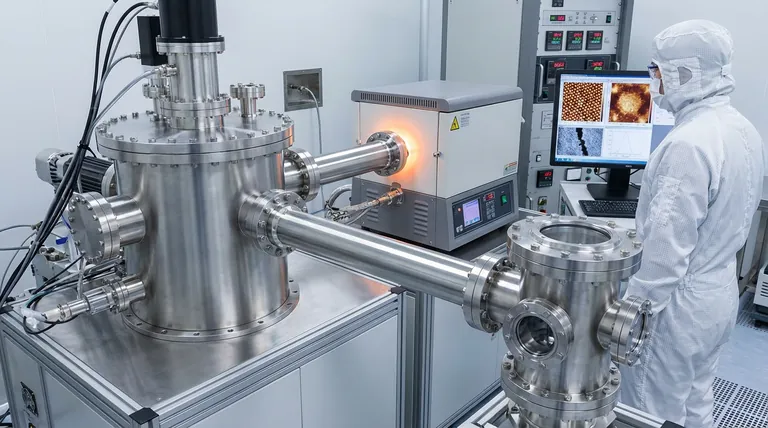
The critical advantage is the preservation of surface integrity. An integrated Ultra-High Vacuum (UHV) preparation chamber allows you to transfer Indium Selenide (In2Se3) samples directly from a synthesis environment—such as a Chemical Vapor Deposition (CVD) system or an annealing furnace—to an observation chamber without ever exposing them to the ambient atmosphere. This seamless workflow eliminates the risk of surface degradation caused by air.
An integrated UHV workflow acts as a protective shield between synthesis and analysis. By maintaining a continuous vacuum, it prevents surface oxidation and moisture contamination, ensuring that the atomic structures you characterize are intrinsic to the material and not artifacts of environmental exposure.
The Challenge of Environmental Exposure
The Threat of Oxidation
In2Se3 is sensitive to the reactive elements found in a standard laboratory atmosphere. When these samples are moved between equipment without protection, oxygen immediately interacts with the surface.
The Impact of Moisture
Beyond oxygen, atmospheric moisture is a significant contaminant. Exposure to humidity can alter the chemical composition of the surface layer, obscuring the true properties of the material.
Compromised Data Integrity
If a sample is exposed to air even briefly, any subsequent analysis—particularly surface-sensitive techniques—will detect these contaminants. This leads to data that represents the oxidized layer rather than the pure In2Se3 structure.
Operational Benefits of Integration
Seamless Sample Transfer
The integrated chamber mechanically links the processing stage (CVD or annealing) with the observation stage. This allows for physical transport of the sample in a controlled environment where the vacuum is never broken.
Enabling Atomic-Level Manipulation
High-precision experiments, such as moving individual atoms, require an absolutely pristine surface. The UHV environment ensures the surface remains chemically clean, making atomic-level manipulation possible.
Ensuring Well-Defined Structures
For accurate characterization, the atomic lattice must be clearly visible and free of debris. An integrated system preserves the well-defined structures created during synthesis, allowing for high-fidelity observation.
Understanding the Trade-offs
System Complexity and Maintenance
While an integrated UHV system offers superior sample quality, it introduces significant operational complexity. The entire transfer path must be maintained at ultra-high vacuum levels; a failure in any seal or pump along the chain compromises the entire experiment.
Restricted Workflow
The integration rigidly couples your synthesis and analysis tools. Unlike modular ex-situ setups, where samples can be easily moved to various independent instruments, an integrated system limits you to the specific tools connected to the vacuum chamber.
Making the Right Choice for Your Goal
To determine if an integrated UHV setup is required for your specific In2Se3 research, consider your primary objectives:
- If your primary focus is Atomic-Level Manipulation: You must use an integrated UHV system, as even minor surface contamination will prevent successful manipulation of surface atoms.
- If your primary focus is Intrinsic Surface Characterization: An integrated system is essential to ensure you are measuring the true chemical and structural properties of In2Se3, rather than an oxide layer.
By eliminating atmospheric variables, integrated UHV systems transform In2Se3 processing from a race against oxidation into a controlled, precise science.
Summary Table:
| Feature | Integrated UHV Workflow | Standard Atmospheric Transfer |
|---|---|---|
| Surface Protection | Prevents oxidation & moisture | High risk of atmospheric degradation |
| Data Accuracy | Reflects intrinsic material properties | Measures contamination/oxide layers |
| Capability | Enables atomic-level manipulation | Limited by surface debris |
| Workflow | Seamless, vacuum-sealed transfer | Manual, breaks vacuum between steps |
| Complexity | High (requires maintenance of vacuum) | Low (portable samples) |
Elevate Your Research with KINTEK’s Integrated Vacuum Solutions
Don’t let atmospheric contamination compromise your research data. KINTEK provides high-performance laboratory equipment tailored for sensitive materials like In2Se3. Backed by expert R&D and precision manufacturing, we offer high-temperature CVD systems, annealing furnaces, and customized vacuum chambers designed to preserve the atomic integrity of your samples.
Whether you need a standalone furnace or a fully integrated UHV-ready system, our engineers can customize a solution for your unique laboratory needs. Contact KINTEK today to discuss how our vacuum processing technology can ensure the success of your next experiment.
References
- Fan Zhang, Chenggang Tao. Atomic-scale manipulation of polar domain boundaries in monolayer ferroelectric In2Se3. DOI: 10.1038/s41467-023-44642-9
This article is also based on technical information from Kintek Furnace Knowledge Base .
Related Products
- Multi Heating Zones CVD Tube Furnace Machine for Chemical Vapor Deposition Equipment
- Vertical Laboratory Quartz Tube Furnace Tubular Furnace
- Split Chamber CVD Tube Furnace with Vacuum Station CVD Machine
- Slide PECVD Tube Furnace with Liquid Gasifier PECVD Machine
- High Temperature Muffle Oven Furnace for Laboratory Debinding and Pre Sintering
People Also Ask
- What is the function of a multi-zone tube furnace in CVD synthesis? Master 2D In2Se3 Nanosheet Precision
- Why are multi zone tube furnaces particularly useful for nanomaterial research? Unlock Precise Thermal Control for Advanced Synthesis
- What temperature-related capabilities make multi zone tube furnaces valuable for research? Unlock Precision Thermal Control
- What environmental protection applications utilize multi zone tube furnaces? Unlock Precision in Waste Treatment and Green Tech
- What role do multi zone tube furnaces play in new energy research? Unlock Precise Thermal Control for Innovation