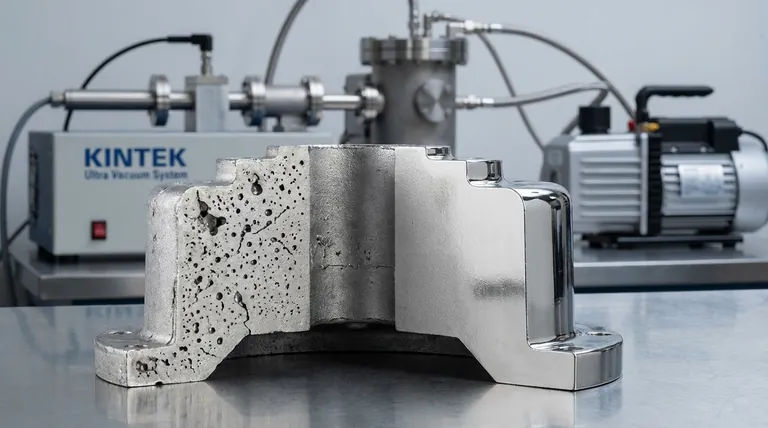
The integration of a vacuum system enhances die casting quality by extracting air from the mold cavity immediately before the molten metal is injected. This extraction minimizes the entrapment of gas, directly resolving the issue of porosity and resulting in a component that is denser, structurally stronger, and compatible with advanced finishing processes.
By eliminating air pockets that lead to gas holes, vacuum systems transform die casting from a simple shaping process into a method capable of producing high-density, structural-grade components suitable for demanding surface finishes.
The Mechanism of Defect Reduction
To understand the value of a vacuum system, you must first understand the primary enemy of die casting quality: porosity.
Evacuating the Mold Cavity
In standard die casting, air naturally fills the mold. When metal is injected at high speeds, this air can become trapped.
A vacuum system intervenes by sucking this air out of the cavity just prior to injection. This creates a void that the molten metal can fill completely without competing with atmospheric pressure.
Minimizing Gas Holes
The immediate result of air extraction is a significant reduction in gas holes.
These are microscopic or macroscopic bubbles that form within the metal as it solidifies. By removing the air beforehand, the vacuum system ensures the metal matrix remains solid and continuous.
Impact on Physical Properties
The removal of gas does more than just clean up the interior of the part; it fundamentally changes the physical characteristics of the metal.
Achieving Higher Internal Density
With the absence of gas pockets, the molten metal packs together more tightly.
This results in higher internal density. The part is no longer a honeycomb of microscopic voids but a solid, cohesive unit.
Improving Mechanical Integrity
Density correlates directly with strength. A part with fewer internal defects possesses superior mechanical integrity.
These components are better equipped to handle stress and load without failure, making them suitable for critical structural applications where standard castings might fail.
Unlocking Surface Finish Potential
For many manufacturers, the most critical advantage of vacuum die casting is not just strength, but the ability to apply high-end finishes.
Enabling Electroplating
Secondary processes like electroplating are notoriously sensitive to surface defects.
If a part has internal porosity, chemicals can become trapped or gas can expand, causing surface blisters. Vacuum casting provides the dense, defect-free surface required for a flawless plated finish.
Facilitating High-Quality Painting
Similar to plating, high-quality painting often involves heat curing.
trapped gas in a porous part can expand under heat, ruining the paint job. The vacuum process ensures the surface is stable and suitable for premium cosmetic applications.
Understanding the Contextual Trade-offs
While vacuum systems offer clear quality benefits, it is important to view them as a specific tool for specific requirements.
Process Complexity
Integrating a vacuum system adds a layer of sophistication to the casting cycle.
It is a specialized step intended for parts where structural integrity or surface finish is non-negotiable. It transforms the process from a general forming method into a precision engineering solution.
Making the Right Choice for Your Goal
Deciding to utilize vacuum die casting depends entirely on the end-use requirements of your component.
- If your primary focus is mechanical durability: The vacuum system is essential for creating high-density parts that maintain structural integrity under stress.
- If your primary focus is cosmetic excellence: The system is required to produce the defect-free substrates necessary for successful electroplating or high-quality painting.
Vacuum integration is the definitive solution for bridging the gap between standard die casting and high-performance, precision manufacturing.
Summary Table:
| Feature | Standard Die Casting | Vacuum-Integrated Die Casting |
|---|---|---|
| Gas Porosity | High risk of air entrapment | Minimized via cavity evacuation |
| Internal Density | Lower (honeycomb potential) | Higher (solid cohesive matrix) |
| Mechanical Strength | Standard structural integrity | Superior load-bearing integrity |
| Surface Finishing | Limited by gas blisters | Ideal for electroplating & painting |
| Best For | General shaping | Precision & high-performance parts |
Elevate Your Manufacturing Precision with KINTEK
Is porosity compromising your component quality? KINTEK provides the advanced thermal and vacuum solutions needed to achieve structural-grade excellence. Backed by expert R&D and manufacturing, we offer Muffle, Tube, Rotary, Vacuum, and CVD systems, as well as other lab high-temperature furnaces—all fully customizable to meet your unique precision die casting and heat treatment needs.
Take the next step in precision engineering. Contact our specialists today to discuss how our customizable vacuum systems can enhance your material integrity and surface finish potential.
References
- S. B. Pulate, V.R. Lawande. A Comprehensive Study on Pressure Die Casting: Process Mechanisms, Material Science, Challenges, and Future Trends. DOI: 10.32628/ijsrset251256
This article is also based on technical information from Kintek Furnace Knowledge Base .
Related Products
- HFCVD Machine System Equipment for Drawing Die Nano Diamond Coating
- Vacuum Induction Melting Furnace
- CF KF Flange Vacuum Electrode Feedthrough Lead Sealing Assembly for Vacuum Systems
- Vacuum Dental Porcelain Sintering Furnace for Dental Laboratories
- Vacuum Hot Press Furnace Machine for Lamination and Heating
People Also Ask
- What is Hot-filament Chemical Vapor Deposition (HFCVD)? Achieve High-Quality Thin Films with Precision Control
- What are the equipment for chemical vapor deposition? A Guide to the 5 Essential Components
- What is the significance of the vacuum pressure control system in the CVD coating process for powders?
- What is the function of high-purity Argon (Ar) gas during CVD? Optimize Your Thin Film Uniformity and Purity
- What are the advantages of using Chemical Vapor Deposition (CVD) for coating turbine blades? Enhance Life & Performance