
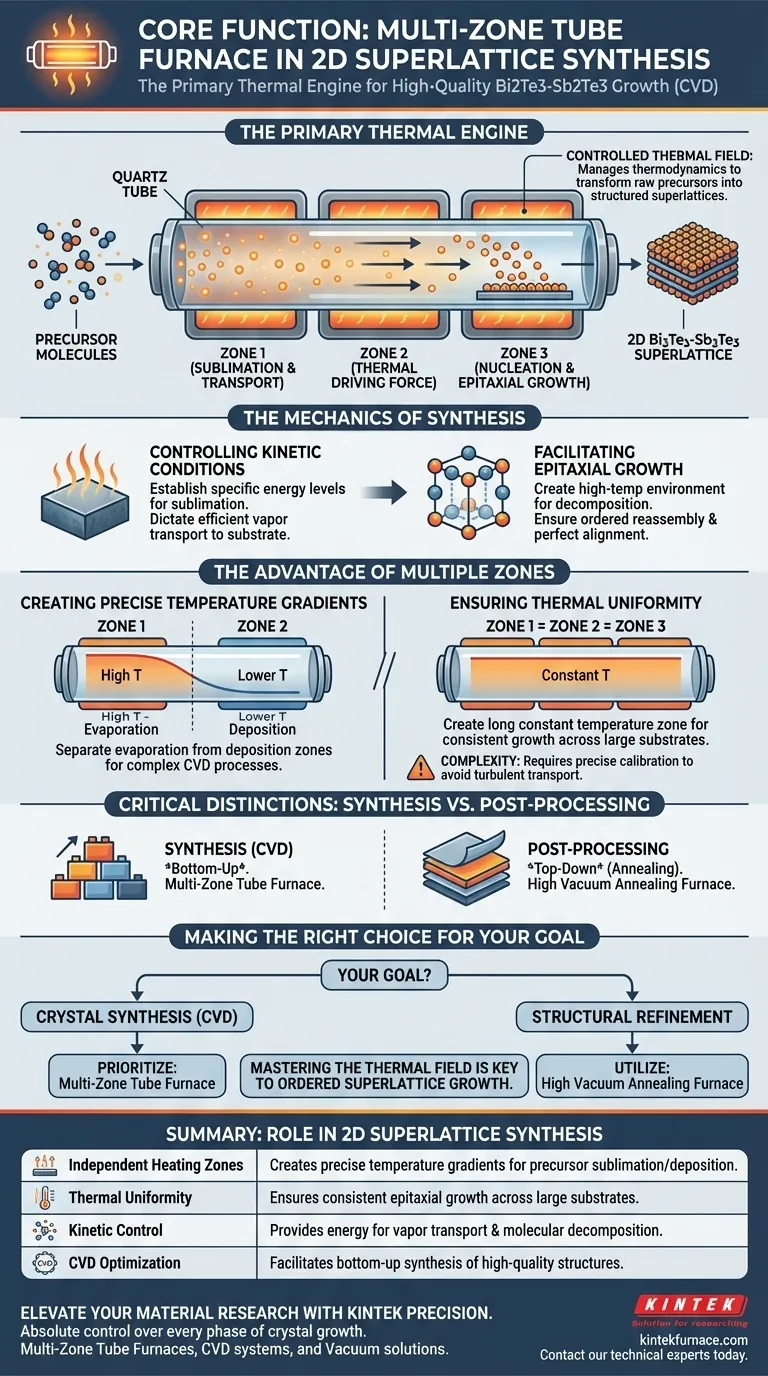
The multi-zone tube furnace functions as the primary thermal engine in the synthesis of 2D Bi2Te3-Sb2Te3 van der Waals superlattices. It provides the essential kinetic conditions required for the sublimation, transport, and nucleation of precursor molecules during Chemical Vapor Deposition (CVD). By maintaining precise high-temperature environments, the furnace facilitates the decomposition of precursors and their subsequent epitaxial growth onto the substrate.
The core value of this equipment lies in its ability to generate a controlled thermal field. It manages the complex thermodynamics of crystal growth, transforming raw precursor molecules into high-quality, structured superlattices.

The Mechanics of Synthesis
Controlling Kinetic Conditions
The synthesis of van der Waals superlattices requires more than just heat; it requires movement. The multi-zone furnace establishes the specific kinetic energy levels needed to sublimate solid precursors into vapor.
Once vaporized, these molecules must travel to the substrate. The furnace controls the thermal driving force that dictates this transport, ensuring the material moves efficiently through the reaction chamber.
Facilitating Epitaxial Growth
At the substrate level, the furnace creates a high-temperature environment that triggers the decomposition of the transported molecules.
This decomposition allows the atoms to reassemble in an ordered fashion. The precise thermal control ensures high-quality epitaxial growth, where the new crystal layers align perfectly with the underlying structure.
The Advantage of Multiple Zones
Creating Precise Temperature Gradients
Unlike single-zone heaters, a multi-zone furnace possesses independent temperature control capabilities for different sections of the tube.
This allows for the creation of specific temperature gradients. These gradients are often critical in CVD processes to separate the evaporation zone (where precursors turn to gas) from the deposition zone (where crystals grow).
Ensuring Thermal Uniformity
Alternatively, when a large growth area is required, multiple zones can be set to the same temperature.
This configuration creates a longer constant temperature zone than a standard single-zone furnace could achieve. This extended uniformity is vital for consistent film growth across larger substrates.
Critical Distinctions and Trade-offs
Synthesis vs. Post-Processing
It is crucial to distinguish the role of the multi-zone tube furnace from that of a high vacuum annealing furnace.
The tube furnace is used for the bottom-up synthesis (CVD) of the material. In contrast, high vacuum annealing is a top-down post-processing technique used to induce layer-by-layer thermal decomposition to fine-tune thickness.
Complexity of Parameter Control
The flexibility of multiple zones introduces complexity. Users must precisely calibrate the interaction between zones to prevent turbulent transport or premature nucleation.
Making the Right Choice for Your Goal
To maximize the effectiveness of your equipment in generating 2D Bi2Te3-Sb2Te3 structures, consider the following:
- If your primary focus is Crystal Synthesis (CVD): Prioritize the multi-zone tube furnace to establish the precise temperature gradients necessary for precursor transport and epitaxial growth.
- If your primary focus is Structural Refinement: Utilize a high vacuum annealing furnace to perform controlled thinning and layer engineering on pre-synthesized structures.
Mastering the thermal field is the single most important factor in transitioning from random deposition to ordered superlattice growth.
Summary Table:
| Feature | Role in 2D Superlattice Synthesis |
|---|---|
| Independent Heating Zones | Creates precise temperature gradients for precursor sublimation and deposition. |
| Thermal Uniformity | Ensures consistent epitaxial growth across large substrates in the constant temperature zone. |
| Kinetic Control | Provides the energy required for vapor transport and molecular decomposition. |
| CVD Optimization | Facilitates bottom-up synthesis of high-quality Bi2Te3-Sb2Te3 van der Waals structures. |
Elevate Your Material Research with KINTEK Precision
Achieving the perfect van der Waals superlattice requires more than just heat; it requires mastery over the thermal field. KINTEK provides industry-leading Multi-Zone Tube Furnaces, CVD systems, and Vacuum solutions designed to give you absolute control over every phase of crystal growth.
Backed by expert R&D and world-class manufacturing, our systems are fully customizable to meet the unique requirements of your advanced material synthesis. Whether you are performing bottom-up CVD growth or top-down vacuum annealing, KINTEK offers the reliability and precision your lab demands.
Ready to refine your synthesis process? Contact our technical experts today to find the ideal high-temperature furnace solution for your research.
Visual Guide
References
- Han Wang, Wen Lei. Superlattice Engineering on 2D Bi<sub>2</sub>Te<sub>3</sub>‐Sb<sub>2</sub>Te<sub>3</sub> Chalcogenides. DOI: 10.1002/advs.202503492
This article is also based on technical information from Kintek Furnace Knowledge Base .
Related Products
- Multi Heating Zones CVD Tube Furnace Machine for Chemical Vapor Deposition Equipment
- Split Multi Heating Zone Rotary Tube Furnace Rotating Tube Furnace
- Multi Zone Laboratory Quartz Tube Furnace Tubular Furnace
- Magnesium Extraction and Purification Condensing Tube Furnace
- Vacuum Sealed Continuous Working Rotary Tube Furnace Rotating Tube Furnace
People Also Ask
- What is the function of a multi-zone tube furnace in CVD synthesis? Master 2D In2Se3 Nanosheet Precision
- What temperature-related capabilities make multi zone tube furnaces valuable for research? Unlock Precision Thermal Control
- What environmental protection applications utilize multi zone tube furnaces? Unlock Precision in Waste Treatment and Green Tech
- Why are multi zone tube furnaces particularly useful for nanomaterial research? Unlock Precise Thermal Control for Advanced Synthesis
- What role do multi zone tube furnaces play in new energy research? Unlock Precise Thermal Control for Innovation



















