
The short answer is that incorrect timing in a dental furnace will ruin the restoration by causing either under-sintering or over-sintering. If the duration is too short, the material won't fully fuse, compromising its durability. If it's too long, the material can deform, develop cracks, or become brittle. This is prevented by strictly adhering to the manufacturer's guidelines for the specific dental material being used.
While precise timing is a critical pillar of successful sintering, it is not the only one. Achieving a perfect restoration depends on the precise interplay between time, temperature, and furnace maintenance, as a failure in one area will compromise the others.
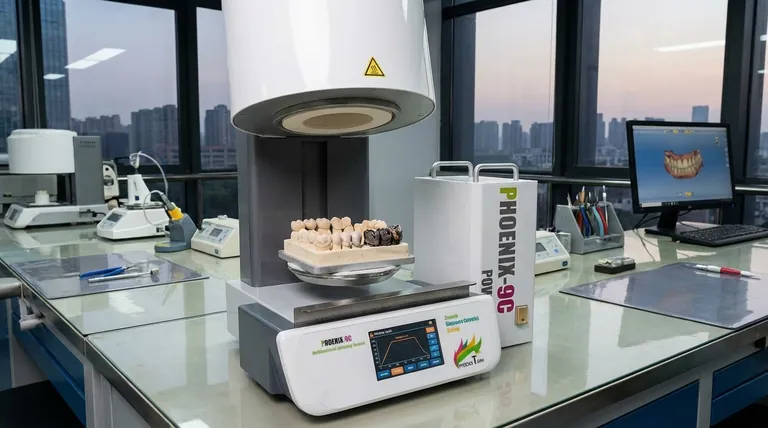
The Consequences of Incorrect Timing
Sintering is a precise thermal process that transforms a porous, chalk-like material into a dense, strong ceramic restoration. Time is the variable that dictates how long this transformation is allowed to proceed.
The Impact of Insufficient Time: Under-Sintering
When the furnace cycle is too short, the material does not receive enough thermal energy to complete the sintering process.
This results in an incomplete fusion of ceramic particles, leaving the final restoration porous and weak. An under-sintered crown or bridge will lack the required durability and is highly susceptible to fracture under normal use.
The Impact of Excessive Time: Over-Sintering
Conversely, keeping the material in the furnace for too long can be equally damaging.
Extended exposure to high heat can cause the material to over-sinter, which can lead to deformation, melting, or the development of internal cracks. This compromises the structural integrity and fit of the final restoration.
Beyond Timing: Other Critical Process Variables
A perfect time setting is useless if other critical factors are incorrect. The success of your furnace operation depends on a holistic view of the entire process.
The Critical Role of Temperature
Setting the wrong temperature is one of the most common and severe errors.
A temperature that is too high can cause materials to melt or deform. A temperature that is too low will lead to incomplete sintering, much like insufficient time.
The Necessity of Proper Ventilation
Proper airflow is crucial for consistent results and operator safety.
Inadequate ventilation can trap fumes, which not only affects the quality of the sintering process but can also pose a health risk. Regular inspection and cleaning of ventilation filters are essential.
The Reliability of Furnace Software
Modern furnaces rely on software to execute precise heating cycles.
Software glitches can cause the furnace to deviate from its programmed settings, leading to unpredictable and poor outcomes. Keeping the software updated and backing up custom settings is a key preventative measure.
Common Pitfalls to Avoid
Trust and reliability are built by avoiding common, preventable mistakes that lead to inconsistent outcomes.
Neglecting Routine Calibration
An uncalibrated furnace will not deliver the temperature it displays. You might follow the manufacturer's guidelines perfectly, but if the furnace is off by 20 degrees, the timing protocol becomes irrelevant.
Regularly calibrating your furnace ensures its temperature readings are accurate, making your settings meaningful.
Using "One-Size-Fits-All" Settings
Different dental materials have unique chemical and physical properties that require specific sintering protocols.
Using a generic setting for a specialized zirconia or ceramic is a recipe for failure. Always consult the material-specific guidelines for both time and temperature.
Ignoring Environmental Factors
Even a perfectly calibrated furnace can be affected by its environment. A poorly ventilated room can impact heat dissipation and airflow.
Ensure your furnace is installed in a well-ventilated area according to the manufacturer's specifications to maintain optimal performance.
A Checklist for Reliable Furnace Operation
To ensure every restoration meets the highest standard, adopt a systematic approach to your furnace operations.
- If your primary focus is quality and consistency: Always begin by verifying the material manufacturer's specific guidelines for both time and temperature before starting any cycle.
- If your primary focus is long-term reliability: Implement and follow a strict routine schedule for furnace calibration and ventilation system maintenance.
- If your primary focus is error prevention: Keep your furnace's software updated and maintain backups of any custom settings to safeguard against digital failures.
Mastering these operational details transforms your dental furnace from a simple tool into a predictable engine for excellence.
Summary Table:
| Timing Error | Consequence | Prevention |
|---|---|---|
| Too Short (Under-Sintering) | Porous, weak restoration prone to fracture. | Strictly adhere to material-specific manufacturer guidelines. |
| Too Long (Over-Sintering) | Deformation, internal cracks, or melting. | Use precise, programmed cycles and avoid manual overrides. |
Achieve Flawless, Predictable Results with Every Sintering Cycle
Don't let incorrect timing compromise the quality of your dental restorations. Consistent, reliable performance is built on precision engineering and expert support.
Backed by expert R&D and manufacturing, KINTEK offers a range of high-performance dental furnaces, including Muffle, Tube, and Vacuum systems, all customizable for your lab's unique workflow and materials.
Contact our experts today to find the perfect furnace solution that ensures precise timing, temperature control, and unparalleled reliability for your practice.
Visual Guide

Related Products
- Dental Porcelain Zirconia Sintering Ceramic Vacuum Press Furnace
- Vacuum Dental Porcelain Sintering Furnace for Dental Laboratories
- Chairside Dental Porcelain Zirconia Sintering Furnace with Transformer for Ceramic Restorations
- High Temperature Muffle Oven Furnace for Laboratory Debinding and Pre Sintering
- 1200℃ Muffle Oven Furnace for Laboratory
People Also Ask
- What factors determine the quality of sintered zirconia restorations? Master Material, Equipment, and Technique
- How do conventional vs rapid sintering in dental furnaces affect zirconia? Optimize Efficiency Without Sacrificing Strength
- What is the purpose of dental sintering furnaces? Transform Zirconia into Durable, High-Quality Dental Restorations
- What precautions should be taken when sintering zirconia in the Fast Slow Dental Sintering Furnace? Master Key Steps for Perfect Results
- What temperature range is used for sintering zirconia ceramics? Achieve Optimal Strength and Translucency



















