High-purity argon gas serves as the critical transport medium and protective shield during the physical vapor transport (PVT) preparation of 9,10-bis(phenylethynyl)anthracene (BPEA). Its primary function is to act as an inert carrier that physically moves sublimated BPEA molecules from the high-temperature source to the cooler substrate where crystallization occurs. Additionally, it establishes a controlled environment that prevents chemical degradation.
Core Takeaway: Argon plays a dual role in BPEA crystal growth: it is the vehicle that drives the migration of vapor across the temperature gradient, and it is the barrier that enforces an inert atmosphere to prevent oxidation and ensure high molecular purity.
Facilitating the Transport Mechanism
To understand the role of argon, one must look at the mechanics of the Physical Vapor Transport (PVT) system. The process relies on moving material from a source zone to a growth zone.
Bridging the Temperature Zones
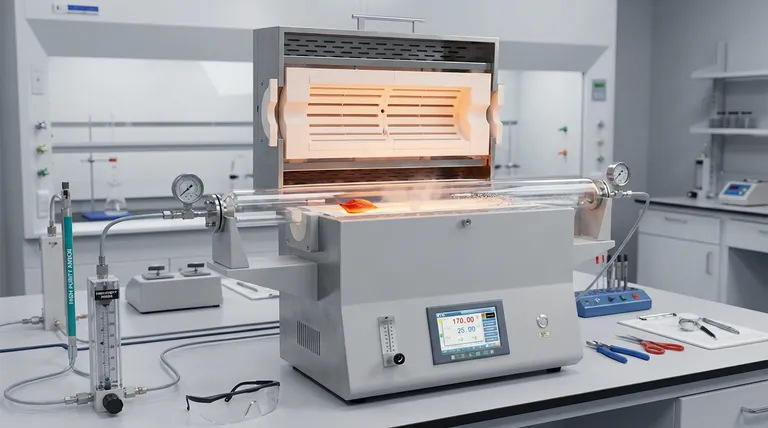
In the horizontal tube furnace, the BPEA powder is heated (typically around 195 °C) until it sublimates.
Argon gas flows continuously through the tube, picking up these vaporized BPEA molecules. It carries them from this high-temperature zone to a lower-temperature zone downstream.
Controlling Crystallization Location
Without this carrier gas, the vapor might simply re-deposit locally or diffuse randomly.
The directed flow of argon ensures the vapor reaches the specific substrate area where the temperature is optimized for crystallization. This precise transport is essential for growing high-quality, grain-boundary-free single crystals.
Preserving Chemical Integrity
Beyond simple transport, the "deep need" of the system is chemical stability. Organic semiconductors like BPEA are vulnerable at high temperatures.
Creating an Inert Atmosphere
The argon used must be of high purity. Its most vital chemical characteristic is its inertness.
By filling the tube furnace, argon displaces reactive atmospheric gases. This prevents the oxidation of the organic BPEA molecules, which would otherwise degrade rapidly at sublimation temperatures.
Maintaining Positive Pressure
The primary reference notes that the continuous flow of argon maintains a positive pressure within the system.
This internal pressure acts as a shield. It ensures that if there are any minute leaks or imperfections in the seal, gas flows out rather than allowing oxygen-rich outside air to flow in.
Active Removal of Impurities
Argon does not just protect the BPEA; it actively cleans the environment.
The continuous flow assists in sweeping away unstable impurities present in the system. By flushing these contaminants out, the argon ensures that the crystal growth environment remains stable and the resulting crystal retains high purity.
Understanding the Operational Requirements
While argon is essential, its effectiveness relies on precise implementation.
The Necessity of Continuous Flow
The flow of argon cannot be static. It must be continuous to maintain the pressure differential required to exclude contaminants.
If the flow is interrupted, the positive pressure drops, and the protective "inert bubble" collapses, leading to immediate oxidation risks.
The Requirement for High Purity
Standard industrial argon is often insufficient.
The process explicitly requires high-purity argon. Any trace contaminants within the carrier gas itself (such as moisture or oxygen) will react with the hot BPEA, negating the purpose of the inert atmosphere.
Making the Right Choice for Your Goal
When setting up your PVT system for BPEA, consider how the gas flow aligns with your specific objectives.
- If your primary focus is Crystal Purity: Prioritize the maintenance of positive pressure and use the highest grade of argon available to prevent oxidation and flush unstable impurities.
- If your primary focus is Growth Location: Calibrate the argon flow rate to optimize the transport of vapor from the 195 °C sublimation zone to the precise temperature band required for crystallization.
The stability of your growth environment is directly proportional to the integrity of your argon flow.
Summary Table:
| Function of Argon Gas | Detailed Role in PVT Process |
|---|---|
| Transport Medium | Carries sublimated BPEA molecules from the high-temp source to the cooler growth zone. |
| Inert Atmosphere | Displaces oxygen and moisture to prevent chemical degradation and oxidation of organic molecules. |
| Positive Pressure | Maintains a shield that prevents external air from entering the furnace through leaks. |
| Impurity Removal | Actively sweeps away unstable contaminants to maintain a clean crystallization environment. |
Elevate Your Crystal Growth Precision with KINTEK
High-quality BPEA single crystals require the perfect synergy between inert gas flow and temperature control. Backed by expert R&D and manufacturing, KINTEK offers specialized Tube, Vacuum, and CVD systems, along with other lab high-temperature furnaces—all fully customizable to meet your unique PVT requirements.
Ready to achieve superior chemical integrity and grain-boundary-free results? Contact us today to find your tailored laboratory solution!
References
- Yanan Sun, Lang Jiang. Low Contact Resistance Organic Single‐Crystal Transistors with Band‐Like Transport Based on 2,6‐Bis‐Phenylethynyl‐Anthracene. DOI: 10.1002/advs.202400112
This article is also based on technical information from Kintek Furnace Knowledge Base .
Related Products
- RF PECVD System Radio Frequency Plasma Enhanced Chemical Vapor Deposition
- Slide PECVD Tube Furnace with Liquid Gasifier PECVD Machine
- HFCVD Machine System Equipment for Drawing Die Nano Diamond Coating
- Custom Made Versatile CVD Tube Furnace Chemical Vapor Deposition CVD Equipment Machine
- 915MHz MPCVD Diamond Machine Microwave Plasma Chemical Vapor Deposition System Reactor
People Also Ask
- What is RF in PECVD? A Critical Control for Plasma Deposition
- What is the role of RF power in PECVD and how does the RF-PECVD process work? Master Thin Film Deposition Control
- What are the applications of plasma enhanced chemical vapor deposition? Key Uses in Electronics, Optics & Materials
- What are the key advantages of PECVD technology? Achieve Low-Temperature, High-Quality Thin Film Deposition
- How are deposition rates and film properties controlled in PECVD? Master Key Parameters for Optimal Thin Films