
A vacuum ceramic furnace performs the critical function of transforming raw glaze materials into a dense, non-porous protective layer on lithium disilicate restorations. By heating the material to specific temperatures (typically 770°C) under a vacuum, the furnace actively extracts air bubbles from the molten glaze, creating a hermetic seal that improves both the visual clarity and the structural longevity of the material.
Core Takeaway The vacuum environment is not merely for heating; its primary purpose is the active exclusion of trapped air during the sintering phase. This ensures the final glaze is a dense, flawless barrier that prevents moisture penetration and chemical decomposition, rather than a porous coating that could compromise the restoration over time.
The Mechanics of Vacuum Glazing
Thermal Transformation
The furnace utilizes specific heating programs to raise the temperature of the lithium disilicate and the applied glaze paste.
At approximately 770 degrees Celsius, the furnace triggers a sintering process. This heat transforms the glaze powder and liquid mixture, melting them down into a uniform, viscous glassy state.
Active Bubble Exclusion
The defining feature of this process is the application of a vacuum during the heating cycle.
As the glaze melts, air trapped within the powder/liquid mixture attempts to escape. The vacuum environment facilitates this degassing process, effectively pulling air bubbles out of the molten layer before it solidifies.
Formation of a Flawless Surface
By removing these microscopic voids, the furnace produces a dense and flawless barrier.
Without the vacuum, the glaze layer would likely contain trapped porosity, which results in a cloudy appearance and a rougher surface texture. The vacuum ensures the final finish is smooth and optically clear.
Enhancing Material Longevity
Inhibiting Moisture Penetration
The glazed layer acts as a functional shield for the underlying lithium disilicate.
The dense glass barrier created by the vacuum furnace inhibits moisture penetration. This is critical because water absorption can degrade the ceramic structure over prolonged exposure in the oral environment.
Preventing Chemical Decomposition
Beyond moisture, the glaze protects the chemical integrity of the material.
The barrier prevents the decomposition of the silica network. By stabilizing the surface chemistry, the glazing process significantly improves the color stability of the restoration, ensuring it does not degrade or shift in shade over time.
Understanding the Trade-offs
The Necessity of Precise Control
While the vacuum is essential for density, the process relies heavily on the precision of the thermal field.
Just as high-temperature furnaces used in material synthesis require strict execution of heating curves to prevent local overheating, the glazing furnace must maintain uniform temperature distribution.
Risks of Process Deviation
If the temperature fluctuates or the vacuum level is insufficient, the glaze may fail to seal completely.
Inadequate vacuum levels can lead to residual porosity, compromising the hermetic seal. Conversely, incorrect thermal application can cause compositional deviations, negating the benefits of the glaze layer.
Making the Right Choice for Your Goal
To maximize the quality of lithium disilicate restorations, consider how the furnace functions relative to your specific objectives:
- If your primary focus is Aesthetic Quality: Ensure the vacuum cycle is fully synchronized with the melt phase to eliminate all micro-bubbles, guaranteeing high translucency and color fidelity.
- If your primary focus is Long-Term Durability: Prioritize the integrity of the sintered barrier (holding at 770°C) to create a maximum-density shield against moisture and silica degradation.
Ultimately, the vacuum ceramic furnace converts a cosmetic coating into a functional, structural defense system for the restoration.
Summary Table:
| Feature | Function in Glazing Process | Impact on Lithium Disilicate |
|---|---|---|
| Vacuum Environment | Active degassing/bubble exclusion | Removes porosity for a clear, dense finish |
| Thermal Control | Sintering at ~770°C | Melts glaze into a uniform, viscous glassy state |
| Dense Barrier | Hermetic sealing | Inhibits moisture penetration & chemical decay |
| Surface Smoothing | Formation of flawless surface | Enhances aesthetics and prevents plaque buildup |
Elevate Your Restoration Quality with KINTEK Precision
Don't let residual porosity compromise your lab's output. KINTEK provides industry-leading vacuum and high-temperature furnace systems—including Muffle, Tube, Rotary, and CVD systems—specifically engineered for the precise thermal control and vacuum integrity required for lithium disilicate glazing. Backed by expert R&D and manufacturing, our customizable furnaces ensure every restoration achieves a flawless, moisture-resistant finish.
Ready to optimize your dental laboratory workflow? Contact our specialists today to find the perfect high-temp solution for your unique needs!
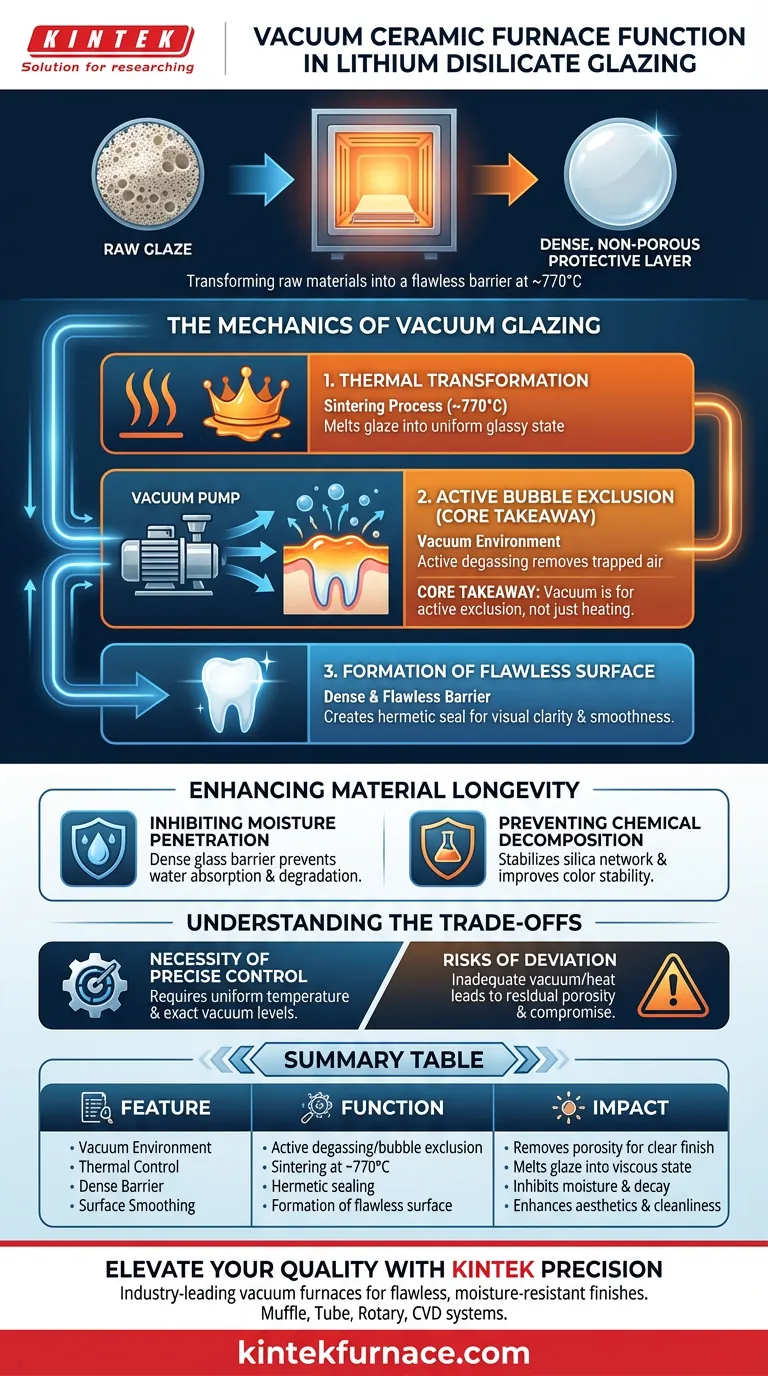
Visual Guide
References
- K. Saleh, Yasser Aly. COLOR STABILITY OF GLAZED AND POLISHED LITHIUM DISILICATE PRESSABLE GLASS CERAMIC AFTER IMMERSION IN MOUTH RINSES: AN IN VITRO STUDY.. DOI: 10.21608/adjalexu.2023.212029.1387
This article is also based on technical information from Kintek Furnace Knowledge Base .
Related Products
- Vacuum Heat Treat Furnace with Ceramic Fiber Liner
- Dental Porcelain Zirconia Sintering Ceramic Vacuum Press Furnace
- Vacuum Dental Porcelain Sintering Furnace for Dental Laboratories
- Molybdenum Vacuum Heat Treat Furnace
- Vacuum Heat Treat Sintering and Brazing Furnace
People Also Ask
- How does vacuum heat treating affect the grain structure of metal alloys? Achieve Precise Microstructure Control
- What are the benefits of using vacuum heat treating furnaces for metal alloys? Achieve Superior Metal Properties and Performance
- What is one of the most important uses of vacuum heat treating furnaces in aerospace? Achieve Superior Strength in Aircraft Alloys
- How does a vacuum heat treat furnace work? Achieve Pristine, High-Performance Results
- What is the difference between heat treat and vacuum heat treat? Achieve Superior Metal Properties with Pristine Finishes



















