
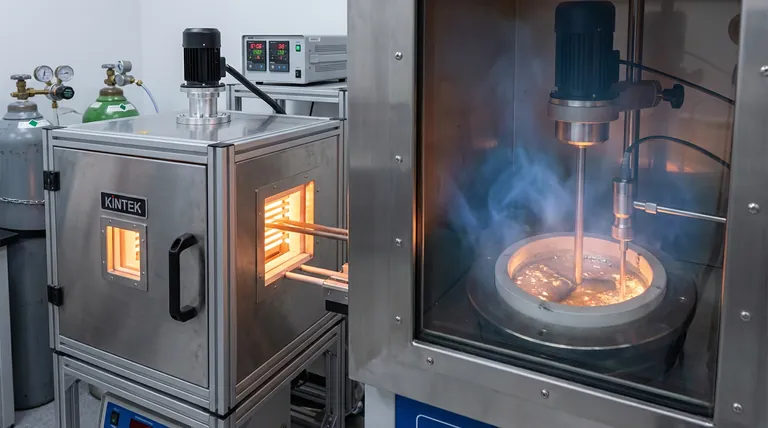
A high-purity argon gas environment serves as a critical isolation barrier that separates the molten AA7150-Al2O3 composite from the surrounding atmosphere. This inert shield is essential during high-temperature stirring and ultrasonic processing to prevent the chemical degradation of the alloy. Specifically, it stops the formation of oxide skins and minimizes the absorption of hydrogen, directly preserving the material's integrity.
Core Insight: The atmosphere surrounding the melt determines the structural viability of the final casting. Without argon protection, the composite is vulnerable to oxidation and gas porosity, which compromise both density and purity regardless of the base material quality.
preventing Chemical Degradation
To achieve a high-performance composite, you must neutralize the aluminum alloy's natural reactivity at high temperatures.
Isolating the Melt from Air
During processing, particularly when the material is agitated by stirring or ultrasonic waves, the surface area exposed to air increases. Argon creates a non-reactive envelope around the melt, effectively blocking contact with oxygen.
Eliminating Oxide Skins
Without this protective atmosphere, oxygen reacts rapidly with the aluminum to form oxide skins (dross) on the surface of the melt. Argon prevents these oxidation reactions, keeping the inclusions out of the final casting and ensuring the composite remains pure.
Ensuring Structural Integrity and Density
Beyond surface purity, the internal structure of the casting relies heavily on minimizing dissolved gases.
Mitigating Hydrogen Absorption
Molten aluminum is highly susceptible to absorbing hydrogen from moisture in the air. The inert argon environment significantly reduces this risk by displacing the air and lowering the partial pressure of hydrogen available for absorption.
Reducing Gas Porosity
By limiting hydrogen uptake, the risk of gas porosity—bubbles trapped inside the metal as it solidifies—is drastically lowered. This leads to a denser casting with fewer internal defects, which is critical for the mechanical performance of the AA7150-Al2O3 composite.
Understanding the Process Constraints
While argon is effective, its implementation requires precision to ensure the "protective roles" are actually fulfilled.
The Necessity of Continuous Coverage
The protection provided by argon is active, not passive; it requires a maintained environment. If the gas flow is interrupted or the containment is breached during aggressive stirring, the melt instantly becomes vulnerable to oxidation and hydrogen pickup again.
Complexity in Ultrasonic Processing
Ultrasonic processing introduces cavitation and turbulence. This dynamic movement demands a robust argon supply to ensure that fresh metal surfaces exposed by the agitation are not immediately oxidized by leaks in the atmosphere.
Optimizing Composite Quality
To maximize the benefits of an argon environment, tailor your process control to your specific quality metrics.
- If your primary focus is material purity: Maintain the argon flow from the initial melting phase through to pouring to prevent even the slightest formation of oxide skins.
- If your primary focus is mechanical density: Ensure the argon environment is most robust during high-temperature stirring and ultrasonic treatment, as this is when hydrogen absorption is most likely to cause porosity.
Strict adherence to atmospheric control is the baseline requirement for producing defect-free AA7150-Al2O3 composites.
Summary Table:
| Protective Role | Mechanism of Action | Impact on Material Quality |
|---|---|---|
| Oxidation Prevention | Creates an inert barrier against oxygen | Eliminates oxide skins (dross) and inclusions |
| Hydrogen Mitigation | Displaces moisture-laden air | Prevents gas porosity and internal bubbles |
| Atmospheric Isolation | Neutralizes surface reactivity during stirring | Maintains chemical purity and alloy integrity |
| Structural Density | Lowers partial pressure of hydrogen | Produces denser, defect-free final castings |
Optimize Your Composite Processing with KINTEK
Producing defect-free AA7150-Al2O3 composites requires more than just high-purity gas—it demands the precision of high-temperature atmospheric control. Backed by expert R&D and manufacturing, KINTEK offers a comprehensive range of Muffle, Tube, Rotary, Vacuum, and CVD systems, all fully customizable to meet your unique lab and production needs.
Whether you are mitigating hydrogen absorption or preventing oxidation, our advanced furnaces provide the stable, inert environment your materials require for peak mechanical performance.
Ready to elevate your material integrity? Contact our experts today to find the perfect furnace solution for your application.
References
- K. Chinna Maddaiah, R. Pramod. Studies on the Mechanical, Strengthening Mechanisms and Tribological Characteristics of AA7150-Al2O3 Nano-Metal Matrix Composites. DOI: 10.3390/jcs8030097
This article is also based on technical information from Kintek Furnace Knowledge Base .
Related Products
- Vacuum Induction Melting Furnace
- Controlled Inert Nitrogen Hydrogen Atmosphere Furnace
- Small Vacuum Heat Treat and Tungsten Wire Sintering Furnace
- 1400℃ High Temperature Laboratory Tube Furnace with Alumina Tube
- Vacuum Heat Treat Sintering Furnace Molybdenum Wire Vacuum Sintering Furnace
People Also Ask
- What are the core functions of the High Vacuum Induction Melting (VIM) furnace? Optimize DD5 Superalloy Purification
- What role does a Vacuum Induction Melting furnace play in the production of high-aluminum nickel-based superalloys?
- What is the role of VIM and directional solidification in aero-engine blade substrates? Engineering Extreme Durability
- What are the advantages of using a VIM furnace to control residual oxygen pressure? Achieve Superior Metal Uniformity
- Why is a Vacuum Induction Melting furnace (VIM) used for Cu-Zn-Al-Sn alloys? Achieve Precision Composition Control
















