
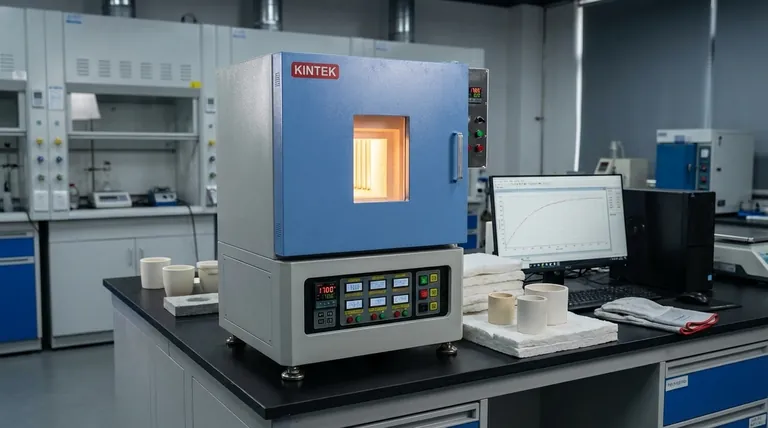
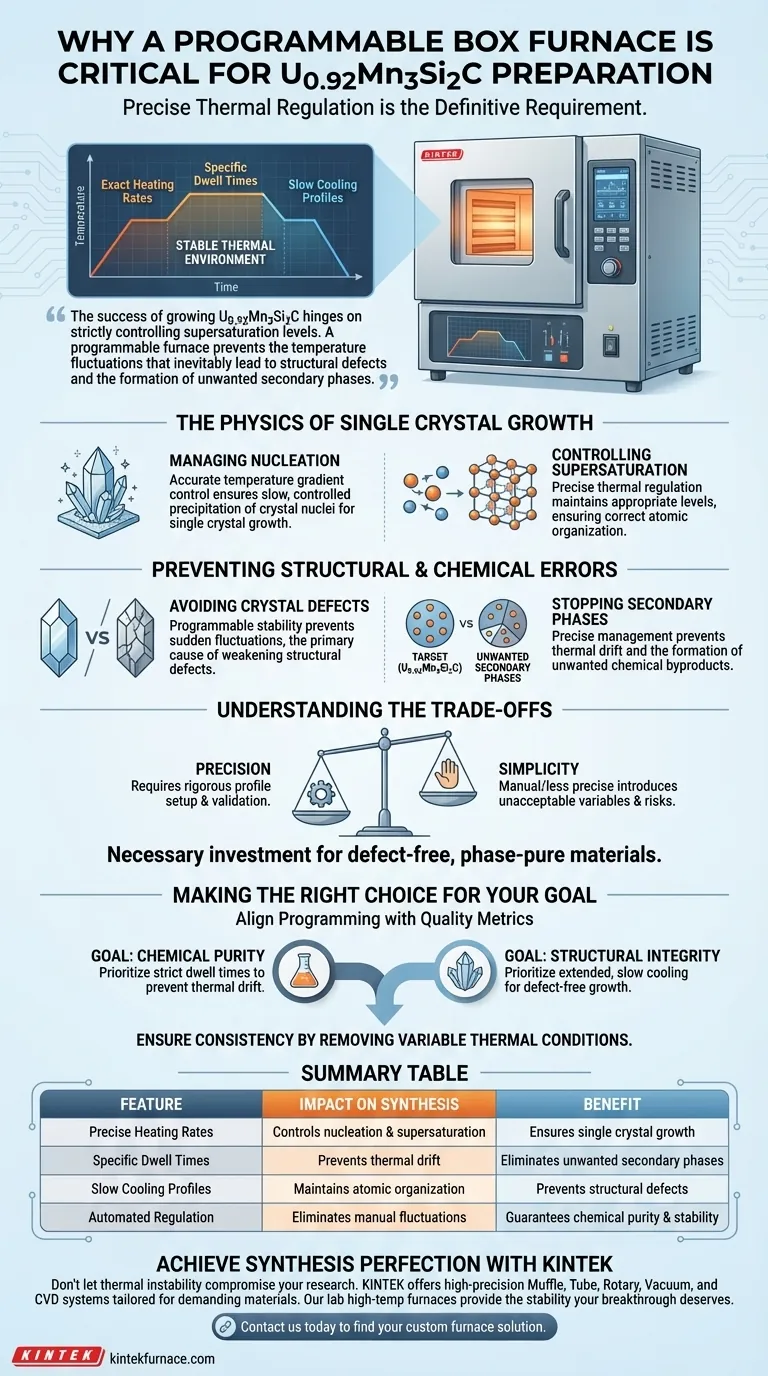
Precise thermal regulation is the definitive requirement. A programmable box furnace is critical for the preparation of U0.92Mn3Si2C because it enables the exact management of heating rates, specific dwell times, and slow cooling profiles. Without this automated precision, it is virtually impossible to maintain the stable thermal environment required for high-quality synthesis.
The success of growing U0.92Mn3Si2C hinges on strictly controlling supersaturation levels. A programmable furnace prevents the temperature fluctuations that inevitably lead to structural defects and the formation of unwanted secondary phases.
The Physics of Single Crystal Growth
Managing Nucleation
Accurate temperature gradient control is vital for this specific material. It ensures that crystal nuclei precipitate slowly rather than rapidly or chaotically. This controlled precipitation is the foundational step for achieving single crystal growth.
Controlling Supersaturation
The furnace allows you to maintain appropriate supersaturation levels throughout the process. By regulating the thermal environment precisely, the programmable system ensures the material organizes correctly at the atomic level, rather than freezing into a disordered state.
Preventing Structural and Chemical Errors
Avoiding Crystal Defects
Thermal stability is non-negotiable for structural integrity. The programmable nature of the furnace prevents sudden temperature fluctuations. These fluctuations are the primary cause of crystal defects, which weaken the material and alter its physical properties.
Stopping Secondary Phases
Inconsistent heating does more than just damage the crystal structure; it alters the chemistry. Precise thermal management prevents the formation of secondary phases. These are unwanted chemical byproducts that occur when the temperature drifts outside the optimal growth window.
Understanding the Trade-offs
Precision vs. Simplicity
The use of a programmable furnace introduces a requirement for rigorous profile setup and validation. However, the trade-off is clear: attempting this synthesis with manual or less precise equipment introduces unacceptable variables. The risk of defects and phase impurities makes the complexity of programmable control a necessary investment for this specific material.
Making the Right Choice for Your Goal
To maximize the quality of your U0.92Mn3Si2C preparation, align your furnace programming with your specific quality metrics:
- If your primary focus is Chemical Purity: Ensure your profile prioritizes strict dwell times to prevent the thermal drift that creates secondary phases.
- If your primary focus is Structural Integrity: Prioritize extended, slow cooling profiles to maintain the supersaturation levels needed for defect-free single crystal growth.
By removing variable thermal conditions from the equation, you ensure both the structural and chemical consistency of the final product.
Summary Table:
| Feature | Impact on U0.92Mn3Si2C Synthesis | Benefit |
|---|---|---|
| Precise Heating Rates | Controls nucleation & supersaturation | Ensures single crystal growth |
| Specific Dwell Times | Prevents thermal drift | Eliminates unwanted secondary phases |
| Slow Cooling Profiles | Maintains atomic organization | Prevents structural defects |
| Automated Regulation | Eliminates manual fluctuations | Guarantees chemical purity & stability |
Achieve Synthesis Perfection with KINTEK
Don't let thermal instability compromise your high-purity research. Backed by expert R&D and world-class manufacturing, KINTEK offers high-precision Muffle, Tube, Rotary, Vacuum, and CVD systems tailored for the most demanding materials like U0.92Mn3Si2C.
Whether you require exact supersaturation control or customizable cooling profiles, our lab high-temp furnaces provide the stability your breakthrough deserves. Contact us today to find your custom furnace solution and elevate your material integrity.
Visual Guide
References
- Hope A. Long, Vladislav V. Klepov. Synthesis of U<sub>0.92</sub>Mn<sub>3</sub>Si<sub>2</sub>C Using Organic Carbon Source. DOI: 10.1002/zaac.202500047
This article is also based on technical information from Kintek Furnace Knowledge Base .
Related Products
- Custom Made Versatile CVD Tube Furnace Chemical Vapor Deposition CVD Equipment Machine
- Multi Heating Zones CVD Tube Furnace Machine for Chemical Vapor Deposition Equipment
- 1200℃ Controlled Inert Nitrogen Atmosphere Furnace
- Mesh Belt Controlled Atmosphere Furnace Inert Nitrogen Atmosphere Furnace
- Split Multi Heating Zone Rotary Tube Furnace Rotating Tube Furnace
People Also Ask
- Why are CVD tube furnace sintering systems indispensable for 2D material research and production? Unlock Atomic-Scale Precision
- What is a CVD tube furnace and what is its primary function? Discover Precision Thin-Film Deposition
- How does CVD tube furnace sintering enhance graphene growth? Achieve Superior Crystallinity and High Electron Mobility
- Which industries and research fields benefit from CVD tube furnace sintering systems for 2D materials? Unlock Next-Gen Tech Innovations
- What temperature range do standard CVD tube furnaces operate at? Unlock Precision for Your Material Deposition



















