
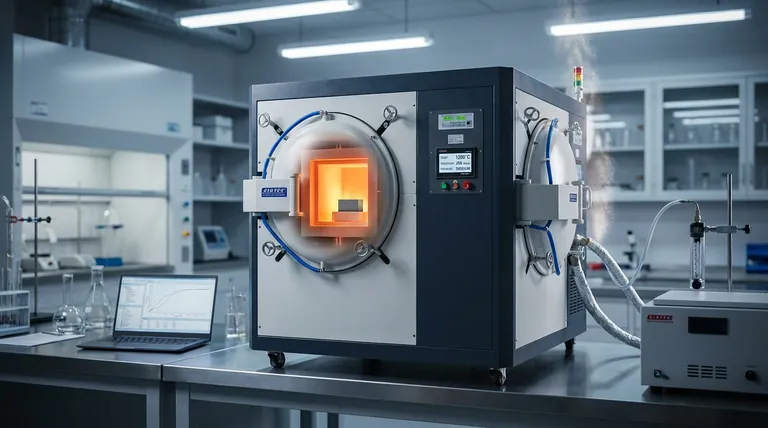
A high-temperature vacuum furnace is the critical enabler for synthesizing the Mn2AlB2 MAB phase because it simultaneously manages extreme heat and atmospheric purity. Specifically, it maintains a precise sintering temperature of 1200 °C while establishing a protected environment using a 200 sccm argon flow to prevent material degradation.
Synthesizing high-quality Mn2AlB2 requires a delicate balance of thermal energy and chemical isolation. The furnace's ability to sustain 1200 °C under a controlled inert gas flow ensures that precursors react completely to form the correct crystal structure without succumbing to oxidation.
Precise Thermal Regulation
Reaching the Reaction Threshold
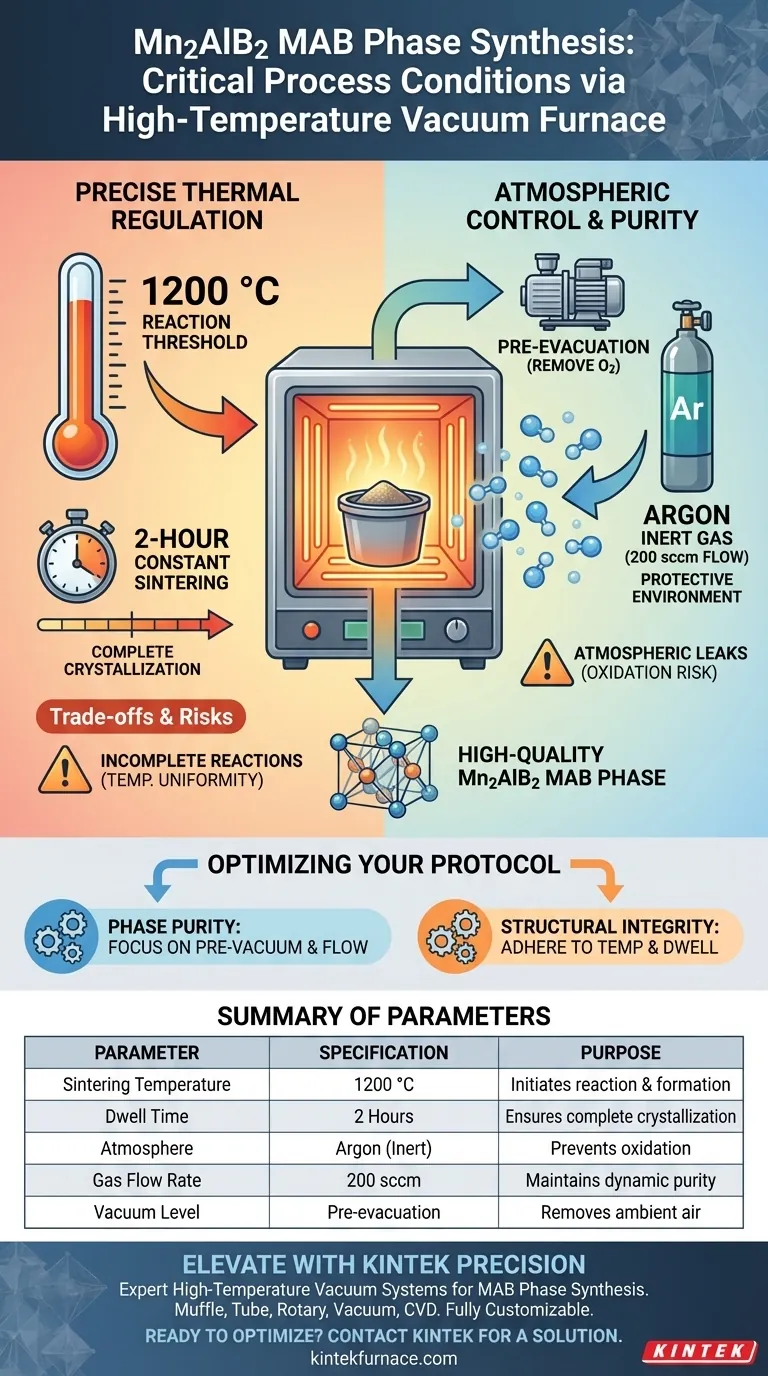
To synthesize Mn2AlB2, the furnace must provide rigorous temperature control centered at 1200 °C. This specific thermal energy level is required to initiate the solid-state reactions between the precursor materials.
Ensuring Complete Crystallization
Reaching peak temperature is insufficient on its own; the duration of heat exposure is equally critical. The process requires a 2-hour constant temperature sintering period.
This dwell time allows the chemical reactions to reach completion. It ensures the material fully crystallizes into the characteristic layered structure that defines the MAB phase.
Atmospheric Control and Purity
Eliminating Oxygen
At 1200 °C, metal components are highly susceptible to rapid oxidation. The vacuum furnace mitigates this by pre-evacuating the chamber to remove ambient air before heating begins.
Maintaining an Inert Environment
Once evacuated, the system introduces an inert gas, specifically argon, to create a protective atmosphere. This prevents oxygen from interacting with the metal, effectively blocking the formation of unwanted oxides and impurities.
Managing Gas Flow
The process relies on a dynamic atmosphere rather than a static one. A continuous argon flow of 200 sccm (standard cubic centimeters per minute) is maintained throughout the process.
This flow helps stabilize the environment. It ensures that the atmosphere remains consistently inert surrounding the sample during the critical reaction window.
Understanding the Trade-offs
The Risk of Incomplete Reactions
While the 2-hour window is standard, deviation in temperature uniformity can lead to issues. If the furnace fails to hold 1200 °C consistently across the entire sample, you risk incomplete chemical reactions and poor structural formation.
Sensitivity to Atmospheric Leaks
The reliance on a vacuum-purge and argon-fill cycle creates a single point of failure. Even a minor breach in the chamber's integrity will allow oxygen ingress, instantly compromising the purity of the Mn2AlB2 phase despite correct temperature settings.
Optimizing Your Synthesis Protocol
To ensure successful synthesis of Mn2AlB2, align your process parameters with your specific quality goals:
- If your primary focus is phase purity: Prioritize the pre-evacuation step and verify the 200 sccm argon flow to guarantee a strictly oxygen-free environment.
- If your primary focus is structural integrity: strictly adhere to the 1200 °C setpoint and the full 2-hour dwell time to maximize crystallization.
Precision in these environmental variables is the defining factor between a failed experiment and a high-quality MAB phase material.
Summary Table:
| Parameter | Specification | Purpose in Mn2AlB2 Synthesis |
|---|---|---|
| Sintering Temperature | 1200 °C | Initiates solid-state reaction and crystal formation |
| Dwell Time | 2 Hours | Ensures complete chemical reaction and crystallization |
| Atmosphere | Argon (Inert) | Prevents oxidation of metallic precursors |
| Gas Flow Rate | 200 sccm | Maintains dynamic purity and stabilizes the environment |
| Vacuum Level | Pre-evacuation | Removes oxygen and ambient air before heating |
Elevate Your MAB Phase Synthesis with KINTEK Precision
Achieving the delicate balance of 1200°C thermal stability and atmospheric purity is critical for high-quality Mn2AlB2 production. KINTEK provides industry-leading high-temperature vacuum and atmosphere-controlled systems designed to eliminate oxidation and ensure structural integrity.
Backed by expert R&D and manufacturing, KINTEK offers Muffle, Tube, Rotary, Vacuum, and CVD systems, all fully customizable to meet your unique lab requirements. Don't compromise on phase purity—partner with the experts in thermal processing.
Ready to optimize your synthesis protocol? Contact KINTEK today for a customized solution.
Visual Guide
References
- Fatma Nur Tuzluca Yesilbag, Ahmad Hüseyin. The effect of Aluminum (Al) ratio on the synthesis of the laminated Mn2AlB2 MAB Phase. DOI: 10.18185/erzifbed.1514470
This article is also based on technical information from Kintek Furnace Knowledge Base .
Related Products
- 2200 ℃ Tungsten Vacuum Heat Treat and Sintering Furnace
- 2200 ℃ Graphite Vacuum Heat Treat Furnace
- Molybdenum Vacuum Heat Treat Furnace
- 1400℃ Controlled Inert Nitrogen Atmosphere Furnace
- Vacuum Heat Treat Sintering Furnace Molybdenum Wire Vacuum Sintering Furnace
People Also Ask
- How does a tungsten-heated vacuum sintering furnace prepare (TbxY1-x)2O3 ceramics? Achieve 99%+ Density & Purity
- How do compaction pressure and vacuum sintering optimize porous ceramics? Maximize Density & Toughness
- What wear-resistance enhancements are achieved by powder coating? The Role of Vacuum Sintering Furnaces
- What role does a high-temperature vacuum sintering furnace play in the densification of WC-10(Ni, Ni/Co) alloys?
- What core role does a high-temperature vacuum sintering furnace play in Sm:YAG ceramics? Mastering Optical Clarity



















