
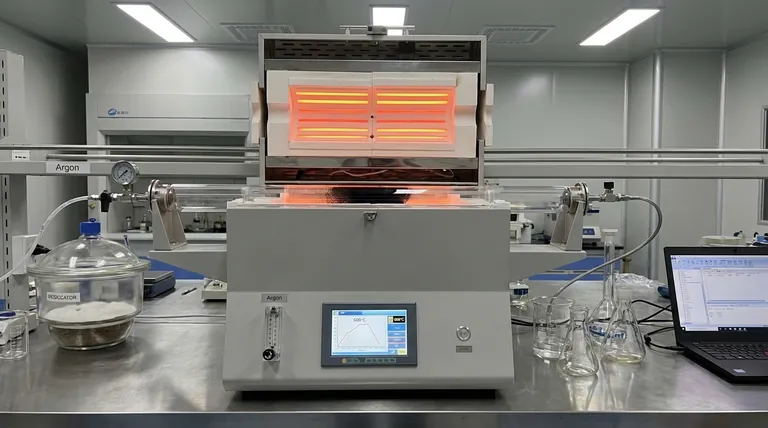
A tube furnace provides two non-negotiable conditions for carbonizing PI-COFs: a strictly inert atmosphere and precise thermal regulation. To successfully convert Polyimide Covalent Organic Frameworks (PI-COFs) into nitrogen-doped mesoporous carbons, the furnace must maintain an oxygen-free environment (typically argon) and execute specific heating protocols, such as ramping at 10°C per minute up to 600°C.
The tube furnace acts as a precision reactor that facilitates the thermal decomposition and reorganization of the organic framework, ensuring the material evolves into a stable graphitic structure rather than oxidizing into ash.
The Necessity of Inert Atmosphere Control
Preventing Material Oxidation
The most critical condition provided by the tube furnace is strict atmosphere protection, utilizing inert gases like argon.
Without this protection, the high processing temperatures would cause the organic framework to react with oxygen.
Instead of carbonizing, the material would simply burn away, destroying the desired graphitic structure.
Facilitating Nitrogen Doping
By excluding oxygen, the furnace creates the ideal environment for the chemical structure to rearrange.
This environment preserves the nitrogen inherent in the PI-COF precursor.
This retention allows for the successful formation of nitrogen-doped mesoporous carbons, which are highly valued for their electronic and catalytic properties.
Thermal Precision and Stability
Controlled Heating Rates
The tube furnace allows for programmable heating ramps, specifically referenced as 10°C per minute.
A controlled ramp is vital to prevent thermal shock to the material.
Gradual heating ensures that volatile components are released systematically, preventing the structural collapse of the framework.
Sustained High Temperatures
The equipment must be capable of reaching and strictly maintaining high temperatures, typically 600°C.
This temperature is the threshold required to drive the thermal decomposition of the PI-COF.
Holding this temperature for a specific duration ensures the complete conversion of the organic polymer into a carbonized state.
Understanding the Trade-offs
Process Speed vs. Structural Integrity
There is a distinct trade-off between the speed of the heating ramp and the quality of the final carbon structure.
While the furnace can heat rapidly, adhering to a moderate rate (like 10°C/min) lengthens the experiment time significantly.
However, rushing this process risks creating a chaotic, non-uniform carbon structure with poor porosity.
Atmosphere Sensitivity
The reliance on a strict inert atmosphere introduces a point of failure: system leaks.
Even a microscopic leak in the tube furnace setup can introduce trace oxygen.
This slight contamination can compromise the purity of the nitrogen-doped carbon, leading to inconsistent experimental results.
Making the Right Choice for Your Experiment
To ensure high-quality carbonization of PI-COFs, you must align your furnace parameters with your material goals.
- If your primary focus is graphitic quality: Prioritize a slower ramp rate and ensure the 600°C hold time is sufficient to allow complete structural reorganization.
- If your primary focus is chemical purity: Double-check the integrity of the argon flow and seals, as the inert atmosphere is the single biggest factor in preventing sample loss to oxidation.
Success in carbonizing PI-COFs relies not just on reaching 600°C, but on how precisely you control the journey there in the absence of oxygen.
Summary Table:
| Parameter | Critical Requirement | Role in PI-COF Carbonization |
|---|---|---|
| Atmosphere Control | Inert Gas (Argon) | Prevents oxidation/ash and facilitates nitrogen doping |
| Heating Rate | 10°C per minute | Prevents thermal shock and structural collapse |
| Max Temperature | 600°C | Drives thermal decomposition and graphitic reorganization |
| Environment | Oxygen-free | Preserves chemical purity and electronic properties |
Elevate Your Advanced Material Synthesis with KINTEK
Precision is the difference between a high-performance graphitic structure and a failed experiment. KINTEK provides the high-performance Tube, Muffle, Vacuum, and CVD systems necessary for sensitive processes like PI-COF carbonization.
Backed by expert R&D and manufacturing, our systems offer the strict inert atmosphere protection and programmable thermal regulation required to ensure consistent, high-purity results. Whether you need standard lab equipment or a custom high-temperature solution, our team is ready to support your unique research goals.
Ready to optimize your carbonization protocols? Contact our experts today to find the perfect furnace for your lab.
Visual Guide

References
- Atsushi Nagai, Atsunori Matsuda. Synthesis and Electrical Property of Graphite Oxide-like Mesoporous <i>N</i>-Carbon Derived from Polyimide-Covalent Organic Framework Templates. DOI: 10.1021/acsomega.5c03968
This article is also based on technical information from Kintek Furnace Knowledge Base .
Related Products
- 1200℃ Controlled Inert Nitrogen Atmosphere Furnace
- Split Chamber CVD Tube Furnace with Vacuum Station CVD Machine
- Multi Zone Laboratory Quartz Tube Furnace Tubular Furnace
- Electric Rotary Kiln Small Rotary Furnace for Activated Carbon Regeneration
- Split Multi Heating Zone Rotary Tube Furnace Rotating Tube Furnace
People Also Ask
- What controlled-atmosphere furnace conditions are required for sintering powder metallurgy copper alloy compacts? Ideal Setup
- How do surface oxide layers on ceramic powders like silicon nitride affect sintering? Master Atmosphere Control
- Why is a controlled atmosphere furnace required for 316L debinding? Ensure Structural Integrity & Zero Cracks
- What Roles Do a Controlled Atmosphere Furnace and Oil Quenching Tank Play in AISI 5140 Steel Heat Treatment?
- How does a vacuum or controlled atmosphere furnace facilitate sessile-drop experiments? Optimize Alloy Wetting Analysis



















