
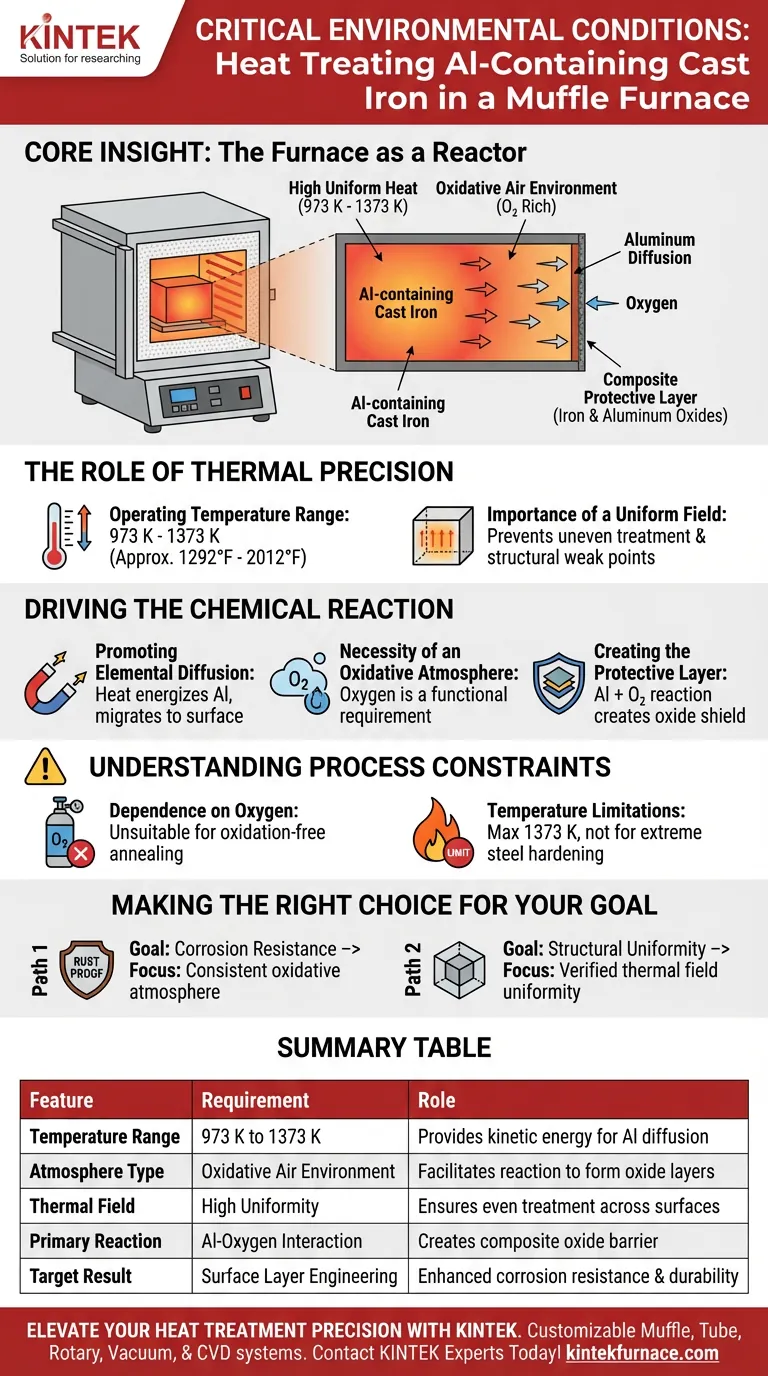
A box-type resistance furnace, often called a muffle furnace, establishes a stable oxidative air environment within a critical temperature range. Specifically, it maintains a precise and uniform thermal field between 973 K and 1373 K, which is required to facilitate necessary chemical changes on the surface of the metal.
Core Insight: The furnace does not simply heat the metal; it acts as a reactor. By combining high uniform heat with an oxygen-rich atmosphere, it drives the diffusion of aluminum to the surface to form a composite protective barrier of iron and aluminum oxides.
The Role of Thermal Precision
Operating Temperature Range
For effective treatment of aluminum-containing cast iron, specific thermal energy is required. The furnace must reliably operate between 973 K and 1373 K.
Importance of a Uniform Field
The "box-type" design is engineered to create a uniform temperature field throughout the chamber. This ensures that the entire workpiece receives the same thermal exposure, preventing uneven treatment or structural weak points.
Driving the Chemical Reaction
Promoting Elemental Diffusion
The high heat provided by the furnace serves a kinetic purpose. It energizes the aluminum elements within the cast iron, causing them to diffuse (migrate) from the interior of the material to the exterior surface.
The Necessity of an Oxidative Atmosphere
Unlike heat treatments that require a vacuum or inert gas to prevent oxidation, this process specifically requires an oxidative air environment. The presence of oxygen is a functional requirement, not a byproduct.
Creating the Protective Layer
When the diffusing aluminum reaches the surface, it reacts with the oxygen in the furnace chamber. This reaction results in the formation of a composite protective layer consisting of both iron oxides and aluminum oxides, which shields the underlying material.
Understanding Process Constraints
Dependence on Oxygen
This specific method relies entirely on the availability of oxygen to interact with the aluminum. Consequently, this equipment configuration is unsuitable for processes requiring oxidation-free annealing or bright finishes, as the formation of an oxide layer is the intended outcome here.
Temperature Limitations
While the furnace reaches 1373 K (approx. 2012°F), it is crucial to note that this falls within specific heat-treating and annealing ranges. It may not reach the extreme reheating temperatures (up to 2300°F) used for certain steel hardening processes, so equipment selection must align strictly with the 973 K – 1373 K requirement.
Making the Right Choice for Your Goal
To ensure the success of your heat treatment process, consider these specific objectives:
- If your primary focus is corrosion resistance: Ensure the furnace maintains a consistent oxidative atmosphere to maximize the formation of the iron-aluminum oxide protective shell.
- If your primary focus is structural uniformity: Prioritize a furnace with verified thermal field uniformity to guarantee even aluminum diffusion across complex geometries.
By controlling both temperature and atmosphere, you transform a simple heating process into a precise surface engineering technique.
Summary Table:
| Feature | Requirement for Al-containing Cast Iron | Role in Heat Treatment |
|---|---|---|
| Temperature Range | 973 K to 1373 K | Provides kinetic energy for aluminum diffusion |
| Atmosphere Type | Oxidative Air Environment | Facilitates reaction to form protective oxide layers |
| Thermal Field | High Uniformity | Ensures even treatment across all workpiece surfaces |
| Primary Reaction | Aluminum-Oxygen Interaction | Creates a composite iron-aluminum oxide barrier |
| Target Result | Surface Layer Engineering | Enhanced corrosion resistance and material durability |
Elevate Your Heat Treatment Precision with KINTEK
Don't compromise on thermal uniformity or atmospheric control. KINTEK provides industry-leading Muffle, Tube, Rotary, Vacuum, and CVD systems designed to meet the rigorous demands of material science. Backed by expert R&D and precision manufacturing, our high-temp lab furnaces are fully customizable to your specific temperature and atmosphere requirements.
Ready to optimize your aluminum cast iron treatment or lab processes?
Contact KINTEK Experts Today to find the perfect customizable solution for your unique needs!
Visual Guide
References
- Kazunori Asano, Seiji Sugimura. Erosion Resistance of Heat-Treated Aluminum Cast Iron to Aluminum Alloy Melt. DOI: 10.2320/matertrans.f-m2024804
This article is also based on technical information from Kintek Furnace Knowledge Base .
Related Products
- Vacuum Heat Treat Sintering and Brazing Furnace
- Vacuum Heat Treat Sintering Furnace with Pressure for Vacuum Sintering
- 1700℃ High Temperature Laboratory Tube Furnace with Alumina Tube
- Vacuum Heat Treat Sintering Furnace Molybdenum Wire Vacuum Sintering Furnace
- Vacuum Heat Treat Furnace with Ceramic Fiber Liner
People Also Ask
- What are the benefits of using vacuum heat treating furnaces for metal alloys? Achieve Superior Metal Properties and Performance
- What is one of the most important uses of vacuum heat treating furnaces in aerospace? Achieve Superior Strength in Aircraft Alloys
- How does vacuum heat treating affect the grain structure of metal alloys? Achieve Precise Microstructure Control
- What is the temperature of a vacuum furnace brazing? Optimize Your Joint Strength and Cleanliness
- What are the steps involved in a typical vacuum brazing treatment? Master the Process for Strong, Clean Joints



















