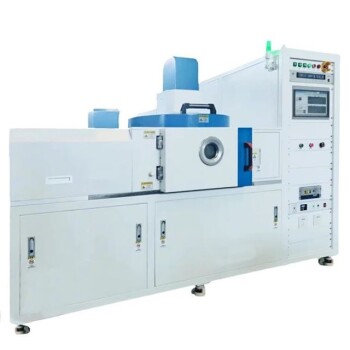
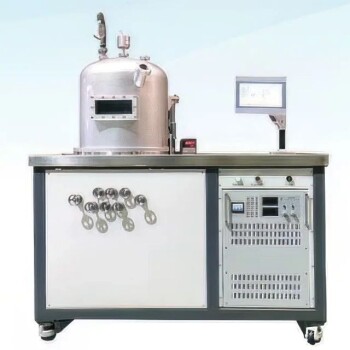
The primary technical advantage of a Chemical Vapor Deposition (CVD) system is its ability to grow a continuous, integrated network of carbon nanotubes directly on the skeleton. Unlike physical methods that merely adhere particles to a surface, CVD utilizes gas-phase precursors reacting on catalyst surfaces to create a dense, uniform structure. This structural continuity is the critical factor in significantly enhancing phonon transmission and overall thermal conductivity.
Core Takeaway While physical mixing often results in disjointed or uneven coatings, CVD facilitates the in-situ growth of a unified filamentous network. This continuous architecture is essential for efficient phonon transport, making CVD superior for applications requiring maximum thermal conductivity in composite phase change materials.
Structural Differences: Growth vs. Adhesion
In-Situ Chemical Growth
The fundamental differentiator of a CVD system is how the carbon nanotubes (CNTs) are introduced to the skeleton.
CVD relies on chemical reactions of gas-phase precursors directly on catalyst surfaces.
This means the nanotubes are grown effectively "from" the skeleton outwards, rather than being applied to it from the outside.
Limitations of Physical Methods
In contrast, traditional methods like physical mixing or simple pyrolysis rely on mechanical adhesion.
These techniques generally involve taking pre-existing nanotubes and attempting to distribute them over the skeleton.
This often leads to poor adhesion, clumping, or gaps in the coating, failing to establish a truly integrated pathway for heat transfer.
The Architecture of Thermal Conductivity
Creating a Dense Filamentous Network
The CVD process results in a dense filamentous network of carbon nanotubes.
Because the growth occurs at the molecular level via catalysts, the nanotubes interlace to form a tight, cohesive structure.
This density is difficult to replicate with physical mixing, which is limited by the particle size and mixing dynamics of the pre-made materials.
Uniformity and Continuity
A CVD system allows for the growth of a more uniform and continuous layer.
Uniformity ensures there are no "cold spots" or interruptions in the material's conductive surface.
Continuity is vital because thermal energy moves most efficiently along unbroken paths; interruptions act as barriers that scatter heat and reduce efficiency.
The Physics of Heat Transfer
Maximizing Phonon Transmission
The technical reason for the improved thermal performance is phonon transmission efficiency.
Phonons are the quasiparticles responsible for carrying heat energy through a lattice.
A continuous, integrated network creates an uninterrupted "highway" for phonons, allowing them to travel with minimal scattering.
Resulting Conductivity Gains
The disjointed nature of physical mixing introduces interfaces that block phonon movement.
By eliminating these interfaces through a continuous network, CVD leads to a substantial increase in the thermal conductivity of the composite phase change materials.
Understanding the Process Trade-offs
Complexity vs. Simplicity
The reference highlights a distinction between CVD and "simple pyrolysis" or "physical mixing."
While CVD offers superior performance, it inherently requires a more controlled environment to manage gas-phase precursors and catalyst surfaces.
Physical mixing, by implication, is a less demanding process but fails to achieve the structural integrity required for high-end thermal performance.
Making the Right Choice for Your Goal
To maximize the efficiency of your composite phase change materials, align your method with your performance requirements:
- If your primary focus is maximum thermal conductivity: Prioritize CVD systems, as the continuous filamentous network ensures the highest efficiency in phonon transmission.
- If your primary focus is process simplicity: Acknowledge that physical mixing eliminates the need for gas-phase reaction control, but at the cost of uniformity and heat transfer efficiency.
Ultimately, the choice of CVD is a choice for structural continuity and superior thermal transport physics.
Summary Table:
| Feature | CVD System (In-Situ Growth) | Physical Mixing/Adhesion |
|---|---|---|
| Mechanism | Chemical reaction of gas precursors | Mechanical distribution of particles |
| Structure | Continuous, integrated filamentous network | Disjointed or clumping particle layer |
| Adhesion | Strong molecular-level integration | Weak mechanical adhesion |
| Heat Transfer | High phonon transmission efficiency | High phonon scattering at interfaces |
| Uniformity | Highly uniform & dense architecture | Potential for gaps and "cold spots" |
| Performance | Maximum thermal conductivity | Moderate to low thermal enhancement |
Elevate Your Materials Research with KINTEK
Maximize your thermal conductivity benchmarks with KINTEK’s high-performance CVD systems. Backed by expert R&D and precision manufacturing, we provide customizable solutions including Muffle, Tube, Rotary, Vacuum, and CVD systems tailored for your unique lab requirements.
Don't settle for disjointed coatings—achieve the structural continuity your research demands. Our technical experts are ready to help you configure the perfect high-temperature furnace for your next breakthrough.
Contact KINTEK Today to Discuss Your Custom Solution
References
- Yuan Jia, Yushi Liu. Recent advances in energy storage and applications of form‐stable phase change materials with recyclable skeleton. DOI: 10.1002/cnl2.117
This article is also based on technical information from Kintek Furnace Knowledge Base .
Related Products
- 915MHz MPCVD Diamond Machine Microwave Plasma Chemical Vapor Deposition System Reactor
- Custom Made Versatile CVD Tube Furnace Chemical Vapor Deposition CVD Equipment Machine
- RF PECVD System Radio Frequency Plasma Enhanced Chemical Vapor Deposition
- MPCVD Machine System Reactor Bell-jar Resonator for Lab and Diamond Growth
- HFCVD Machine System Equipment for Drawing Die Nano Diamond Coating
People Also Ask
- What is the MPCVD method and why is it considered effective for diamond deposition? Superior Purity & High Growth Rates
- What factors influence the quality of diamond deposition in the MPCVD method? Master the Critical Parameters for High-Quality Diamond Growth
- What are some key features and benefits of the microwave plasma chemical vapor deposition system? Achieve Unmatched Material Synthesis
- What is the purpose of a microwave plasma chemical vapor deposition system? Grow High-Purity Diamonds and Advanced Materials
- What is the basic principle of operation for the microwave plasma chemical vapor deposition system? Unlock High-Purity Material Growth