
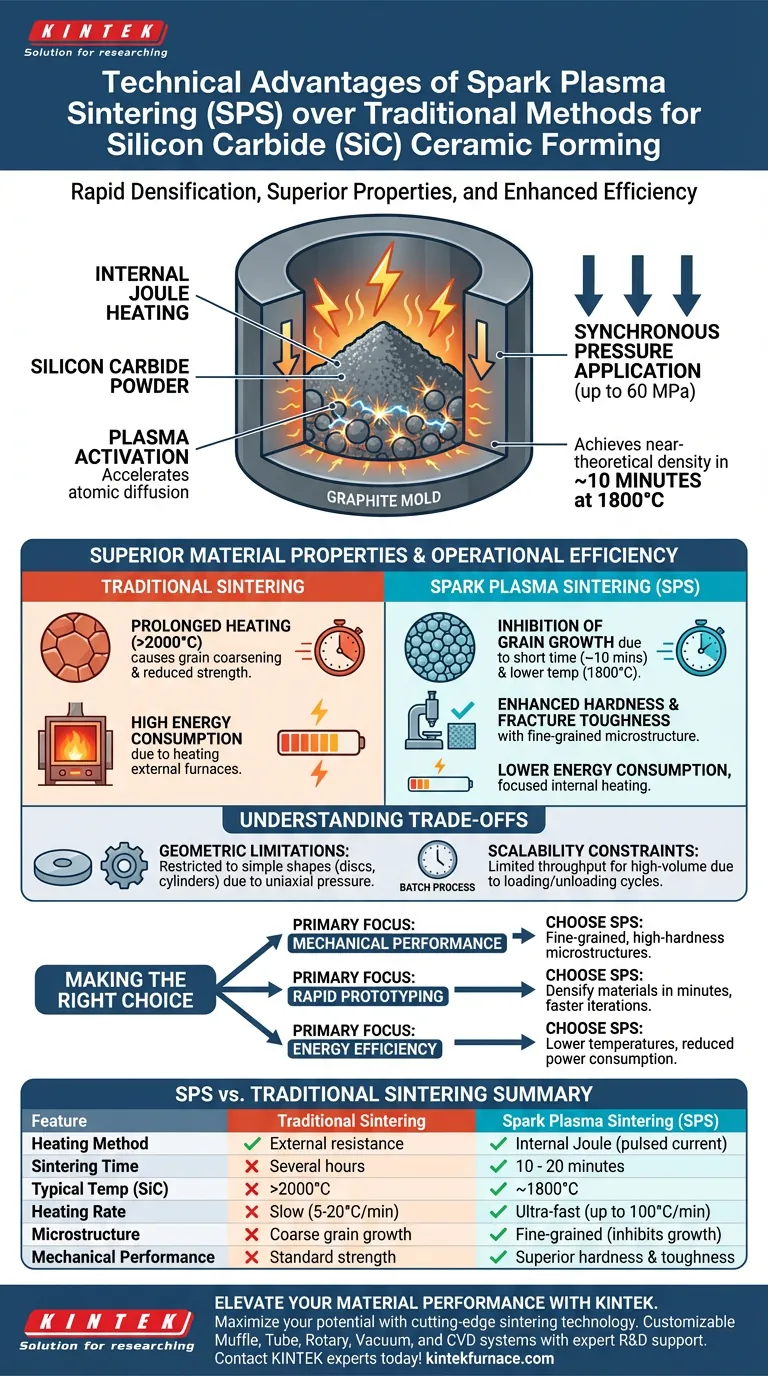
Spark Plasma Sintering (SPS) systems fundamentally outperform traditional silicon carbide forming methods by utilizing pulsed electric current combined with simultaneous axial pressure. This internal heating mechanism allows silicon carbide to reach full densification at 1800°C in as little as 10 minutes, a timeframe unattainable by conventional resistance furnaces.
Core Takeaway Traditional sintering often requires prolonged heating which leads to grain coarsening and reduced mechanical strength. SPS solves this by generating heat directly within the mold and material, achieving near-theoretical density in minutes while preserving a fine-grained, high-strength microstructure.

The Mechanism of Rapid Densification
Internal Joule Heating
Unlike traditional methods that rely on external heating elements, SPS generates heat internally through Joule heating.
Pulsed electric current is passed directly through the graphite mold and the silicon carbide powder. This results in extremely high heating rates, often reaching 100°C per minute.
Plasma Activation
The pulsed current does more than just heat; it creates a plasma activation effect between powder particles.
This accelerates atomic diffusion and promotes grain boundary diffusion, allowing for rapid material consolidation.
Synchronous Pressure Application
SPS systems apply substantial axial pressure, typically up to 60 MPa, simultaneously with the heating cycle.
This mechanical force physically aids in the rearrangement of particles, further reducing the temperature and time required to close pores and achieve full density.
Superior Material Properties
Inhibition of Grain Growth
One of the critical challenges in sintering silicon carbide is controlling grain size; prolonged exposure to high heat typically causes grains to enlarge (coarsen), which weakens the material.
Because SPS completes the sintering process in a very short holding time (often around 10 minutes), it effectively inhibits abnormal grain growth.
Enhanced Hardness and Strength
The result of this rapid, low-temperature process is a bulk ceramic with a fine-grained microstructure.
This structural refinement directly translates to superior physical properties, specifically higher hardness and fracture toughness compared to pressureless sintered silicon carbide.
Operational Efficiency
Lower Processing Temperatures
Traditional silicon carbide sintering often requires temperatures exceeding 2000°C.
SPS achieves full densification at significantly lower temperatures, specifically around 1800°C for silicon carbide.
Energy Consumption
The combination of reduced processing time and lower operating temperatures results in significantly reduced energy consumption.
By eliminating the need to heat a large external furnace chamber, energy is directed solely where it is needed: the mold and the sample.
Understanding the Trade-offs
Geometric Limitations
The SPS process relies on applying uniaxial pressure through graphite molds.
This setup typically restricts the geometry of the final part to simple shapes like discs, cylinders, or plates. Creating complex, net-shape components often requires significant post-processing or is not feasible compared to slip casting or injection molding.
Scalability Constraints
SPS is primarily a batch process.
While the cycle time is short (minutes vs. hours), the need to load and unload graphite dies for every single cycle can limit throughput for high-volume mass production compared to continuous sintering furnaces.
Making the Right Choice for Your Goal
If you are evaluating whether to integrate Spark Plasma Sintering into your production line, consider your specific end-goals:
- If your primary focus is mechanical performance: Choose SPS for its ability to produce fine-grained, high-hardness microstructures that are difficult to achieve with pressureless sintering.
- If your primary focus is rapid prototyping: Choose SPS for its capability to densify materials in minutes rather than hours, allowing for faster iteration cycles.
- If your primary focus is energy efficiency: Choose SPS to utilize lower sintering temperatures (1800°C) and reduce overall power consumption.
SPS converts the sintering process from a thermal endurance test into a precise, rapid electro-mechanical operation.
Summary Table:
| Feature | Traditional Sintering | Spark Plasma Sintering (SPS) |
|---|---|---|
| Heating Method | External resistance heating | Internal Joule heating (pulsed current) |
| Sintering Time | Several hours | 10 - 20 minutes |
| Typical Temp (SiC) | >2000°C | ~1800°C |
| Heating Rate | Slow (5-20°C/min) | Ultra-fast (up to 100°C/min) |
| Microstructure | Coarse grain growth | Fine-grained (inhibits growth) |
| Mechanical Performance | Standard strength/hardness | Superior hardness and toughness |
Elevate Your Material Performance with KINTEK
Maximize your laboratory's potential with cutting-edge sintering technology. Backed by expert R&D and world-class manufacturing, KINTEK offers a comprehensive range of high-performance Muffle, Tube, Rotary, Vacuum, and CVD systems, along with specialized sintering solutions tailored to your unique research and production needs.
Why partner with KINTEK?
- Customizable Systems: Precision-engineered furnaces designed for your specific material requirements.
- Expert Support: Deep technical expertise to help you optimize densification and microstructure.
- Efficiency: Lower your energy footprint while achieving superior mechanical results.
Ready to transform your ceramic forming process? Contact our technical experts today to find the perfect high-temperature solution for your lab!
Visual Guide
References
- Tribological properties of silicon carbide ceramic surfaces modified by polishing, grinding and laser radiation. DOI: 10.1007/s42452-024-06004-y
This article is also based on technical information from Kintek Furnace Knowledge Base .
Related Products
- Spark Plasma Sintering SPS Furnace
- 915MHz MPCVD Diamond Machine Microwave Plasma Chemical Vapor Deposition System Reactor
- RF PECVD System Radio Frequency Plasma Enhanced Chemical Vapor Deposition
- 9MPa Air Pressure Vacuum Heat Treat and Sintering Furnace
- 600T Vacuum Induction Hot Press Vacuum Heat Treat and Sintering Furnace
People Also Ask
- How does the heating mechanism of Spark Plasma Sintering (SPS) function? Enhance TiC/SiC Composite Fabrication
- Why is it necessary to maintain a high vacuum environment during the SPS of SiC? Key to High-Density Ceramics
- What are the technical advantages of using an SPS sintering furnace? Elevate Al2O3-TiC Material Performance
- What are the steps in the discharge plasma sintering process? Master Fast, High-Density Material Consolidation
- What are the advantages of spark plasma sintering (SPS) over traditional forging? Precision Microstructural Control














