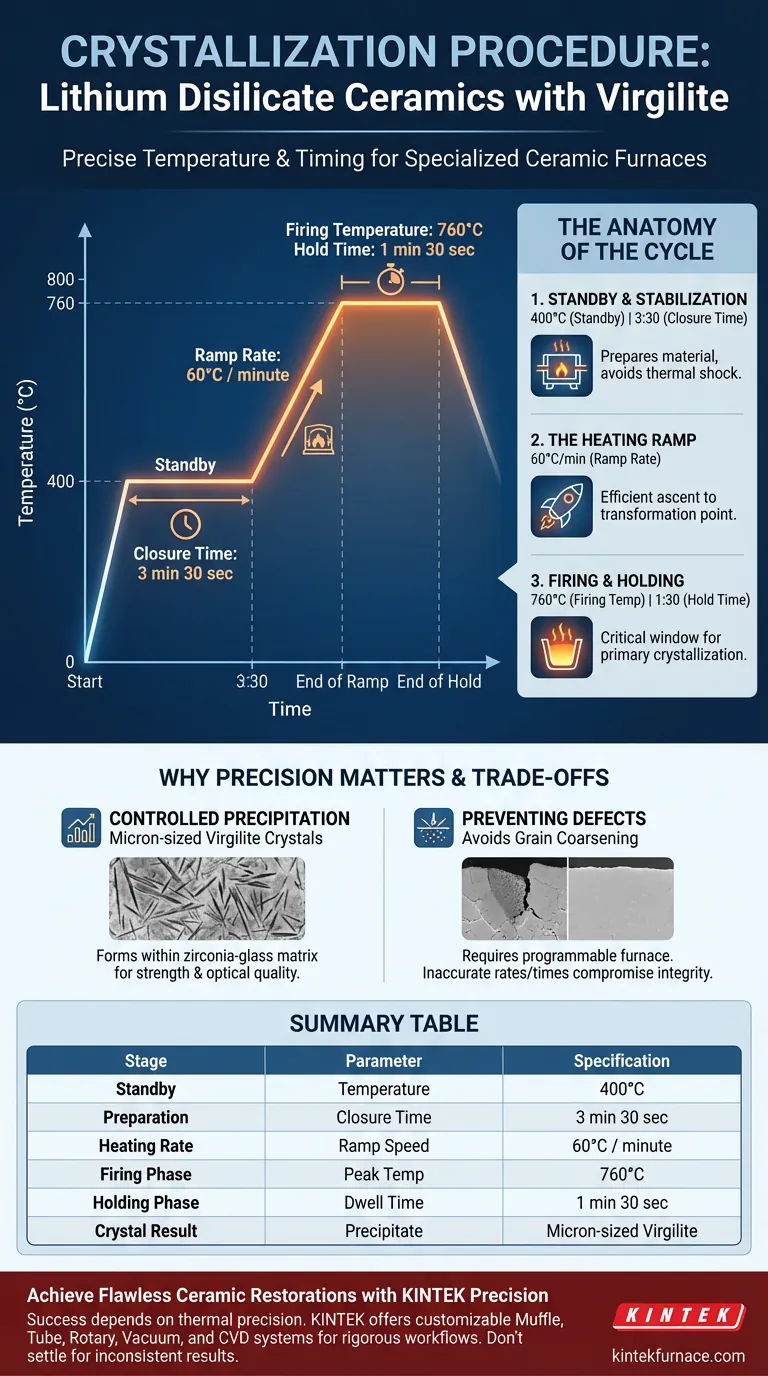
To achieve the correct crystallization of lithium disilicate ceramics containing virgilite, you must adhere to a strict thermal profile in a specialized ceramic furnace. Start with a standby temperature of 400°C and a closure time of 3 minutes and 30 seconds. Ramp the temperature up at a rate of 60°C per minute until reaching a firing temperature of 760°C, holding that peak heat for exactly 1 minute and 30 seconds.
Success relies on a controlled thermal cycle that precipitates micron-sized virgilite crystals within the zirconia-glass matrix. This specific profile significantly reduces total crystallization time while ensuring the uniform microstructure necessary for mechanical strength and optical quality.
The Anatomy of the Thermal Cycle
Standby and Stabilization
The process begins with the furnace set to a standby temperature of 400°C.
Before the active heating phase begins, there is a mandatory closure time of 3 minutes and 30 seconds. This period stabilizes the environment, preparing the material for the rapid temperature increase.
The Heating Ramp
Once stabilization is complete, the temperature must be increased at a precise rate of 60°C per minute.
This controlled ascent is faster than many traditional methods but is essential for this specific material composition. It moves the ceramic efficiently toward its transformation point without causing thermal shock.
Firing and Holding
The target firing temperature for this procedure is 760°C.
Once this temperature is reached, the material must be held there for 1 minute and 30 seconds. This specific hold time is the critical window where the primary crystallization occurs.
Why Precision Matters for Virgilite
Controlled Crystal Precipitation
The thermal profile described above is engineered to precipitate micron-sized needle-like and plate-like virgilite crystals.
These crystals form directly within the zirconia-glass matrix. This internal architecture is what defines the material's final physical properties.
Preventing Microstructural Defects
Using a programmable furnace allows you to manage the thermodynamic environment with high precision.
This regulation prevents grain coarsening, which can occur if the temperature overshoots or if the hold time is extended unnecessarily. A fine-grained microstructure is required to achieve the balance of high mechanical strength and translucent optical properties.
Understanding the Trade-offs
Equipment Limitations
You cannot achieve this specific crystallization profile without a programmable temperature control muffle furnace.
Standard furnaces lacking precise ramp-rate control may fail to hit the 60°C/minute target. Inaccurate heating rates can lead to uneven crystallization, compromising the structural integrity of the ceramic.
Speed vs. Stability
While this procedure offers a reduced total crystallization time compared to traditional methods, the specific hold time of 1:30 is non-negotiable.
Attempting to shorten this hold time further to save production minutes will result in incomplete precipitation. This leads to a weaker matrix and poor optical aesthetics.
Ensuring Process Reliability
To replicate these results consistently, ensure your equipment is calibrated to these exact specifications.
- If your primary focus is Production Efficiency: Adhere strictly to the 60°C/min ramp rate to minimize cycle time without sacrificing the integrity of the crystal formation.
- If your primary focus is Material Durability: Verify the furnace maintains the 760°C temperature without fluctuation during the 1:30 hold time to guarantee full virgilite precipitation.
Precision in these settings is the singular difference between a durable, translucent restoration and a structural failure.
Summary Table:
| Stage | Parameter | Specification |
|---|---|---|
| Standby | Temperature | 400°C |
| Preparation | Closure Time | 3 min 30 sec |
| Heating Rate | Ramp Speed | 60°C / minute |
| Firing Phase | Peak Temperature | 760°C |
| Holding Phase | Dwell Time | 1 min 30 sec |
| Crystal Result | Precipitate Type | Micron-sized Virgilite |
Achieve Flawless Ceramic Restorations with KINTEK Precision
Success in lithium disilicate crystallization depends entirely on thermal precision. At KINTEK, we understand that even a minor temperature fluctuation can compromise the mechanical strength and translucency of your materials.
Backed by expert R&D and manufacturing, KINTEK offers Muffle, Tube, Rotary, Vacuum, and CVD systems, along with specialized lab high-temp furnaces—all fully customizable to meet the rigorous 60°C/min ramp rates and stable hold times your workflow demands.
Don't settle for inconsistent results. Contact our specialists today to find the high-performance furnace solution tailored to your unique laboratory needs.
Visual Guide
References
- Carlos A. Jurado, Damian J. Lee. Influence of occlusal thickness on the fracture resistance of chairside milled lithium disilicate posterior full‐coverage single‐unit prostheses containing virgilite: A comparative in vitro study. DOI: 10.1111/jopr.13870
This article is also based on technical information from Kintek Furnace Knowledge Base .
Related Products
- Molybdenum Disilicide MoSi2 Thermal Heating Elements for Electric Furnace
- Vacuum Dental Porcelain Sintering Furnace for Dental Laboratories
- Dental Porcelain Zirconia Sintering Ceramic Vacuum Press Furnace
- Chairside Dental Porcelain Zirconia Sintering Furnace with Transformer for Ceramic Restorations
- 1400℃ Muffle Oven Furnace for Laboratory
People Also Ask
- What are the typical application temperatures for molybdenum disilicide (MoSi2) heating elements? Master High-Temp Performance
- What is the primary use of molybdenum disilicide? Ideal for High-Temp Heating Elements
- What are the characteristics of molybdenum disilicide heating elements? Unlock High-Temp Performance
- What are the properties of molybdenum disilicide (MoSi2) that make it suitable for high-temperature applications? Discover Its High-Temp Resilience
- What are the applications of molybdenum disilicide heating elements? Achieve Extreme Heat Stability for Industrial Processes