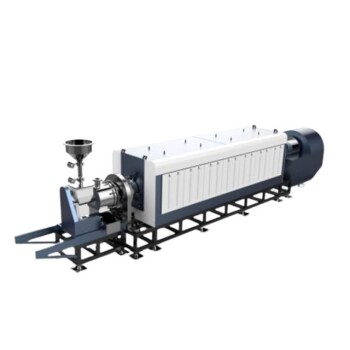
Shaft furnace processes represent the superior choice for high-volume production, currently accounting for over 70% of the global Direct Reduced Iron (DRI) output. While rotary kilns offer specific advantages regarding input materials, shaft furnaces provide a decisive edge in thermal efficiency and single-unit capacity through the utilization of counter-current exchange principles.
Core Takeaway By leveraging the physics of counter-current exchange, shaft furnaces maximize the contact between reducing gases and iron ore. This mechanism allows them to outpace rotary kilns in both energy efficiency and production scale, making them the standard for modern, high-capacity DRI facilities.
The Mechanics of Efficiency
The Counter-Current Advantage
The primary driver of efficiency in shaft furnaces is counter-current exchange.
In this system, reducing gases flow upward while iron ore descends. This facilitates optimal contact between the solid and gaseous phases, ensuring that heat and chemical potential are utilized to their fullest extent before the gas exits the reactor.
Superior Thermal Performance
Because of this direct and prolonged contact, shaft furnaces achieve high thermal efficiency.
The heat transfer is immediate and uniform, reducing the total energy required per ton of iron produced compared to the broader heating mechanisms found in rotary kilns.
Scaling for Mass Production
Large Single-Unit Capacity
Shaft furnaces are engineered for volume.
They offer large single-unit production capacities, allowing producers to scale operations rapidly without the need to manage a complex array of smaller units. This has led to a faster global expansion rate for shaft furnace technology compared to rotary systems.
Consistency at Scale
High volume does not come at the cost of quality.
Shaft furnaces deliver superior uniformity in product quality. The controlled vertical flow ensures that the iron ore is reduced evenly, minimizing variances in the final metallization rate.
Understanding the Trade-offs: The Rotary Kiln Niche
While shaft furnaces dominate the market, it is critical to understand where rotary kilns fit into the industrial landscape.
Fuel Flexibility vs. Efficiency
Rotary kilns are particularly effective at handling low-grade coal.
If your project relies on solid fuels rather than natural gas, rotary kilns provide a necessary alternative. However, this comes with a trade-off: primarily reduced energy efficiency relative to gas-based shaft processes in the context of DRI.
Material Mixing and Homogeneity
Rotary kilns excel at mechanical mixing.
The continuous rotation ensures constant material flow and excellent homogeneity of the final product through physical tumbling. While modern electric rotary designs offer precise temperature control and improved thermal efficiency, they generally cannot match the massive throughput capabilities of large shaft furnaces for standard DRI production.
Making the Right Choice for Your Goal
The decision between these technologies rests on your available fuel sources and production targets.
- If your primary focus is Maximum Scale and Efficiency: Choose shaft furnace technology to leverage high single-unit capacity and superior gas-based thermal efficiency.
- If your primary focus is Feedstock Flexibility: Choose rotary kiln processes if you must utilize low-grade coal or solid fuels that are incompatible with shaft furnaces.
Ultimately, for large-scale industrial DRI production where natural gas is available, the shaft furnace offers the most streamlined path to high output and energy optimization.
Summary Table:
| Feature | Shaft Furnace | Rotary Kiln |
|---|---|---|
| Market Share | >70% Global DRI Output | Niche/Solid-fuel based |
| Efficiency Mechanism | Counter-current exchange | Mechanical mixing/tumbling |
| Primary Fuel | Natural Gas (High Efficiency) | Coal / Solid Fuels (Flexible) |
| Single-Unit Capacity | Very High / Scalable | Moderate |
| Product Uniformity | Superior (Controlled flow) | High (Mechanical homogeneity) |
Optimize Your Thermal Processing with KINTEK
Choosing the right furnace technology is critical to your facility's efficiency and ROI. Backed by expert R&D and manufacturing, KINTEK offers high-performance Muffle, Tube, Rotary, Vacuum, and CVD systems, along with other specialized lab high-temp furnaces. Whether you need the mechanical homogeneity of a rotary kiln or the precise control of a vacuum system, our solutions are fully customizable for your unique research or production needs.
Ready to scale your operations? Contact our experts today to find the perfect thermal solution for your lab or plant!
References
- Tetiana Golub, Molchanov Lavr. ESTABLISHMENT OF THERMODYNAMICAL AND PHYSICO-CHEMICAL PREREQUISITES FOR DIRECT OBTAINING IRON BY THERMOLISIS OF OXIDES. DOI: 10.31319/2519-2884.47.2025.1
This article is also based on technical information from Kintek Furnace Knowledge Base .
Related Products
- Vacuum Sealed Continuous Working Rotary Tube Furnace Rotating Tube Furnace
- Electric Rotary Kiln Small Rotary Furnace Biomass Pyrolysis Plant Rotating Furnace
- Electric Rotary Kiln Continuous Working Small Rotary Furnace Kiln for Pyrolysis Plant Heating
- Electric Rotary Kiln Pyrolysis Furnace Plant Machine Small Rotary Kiln Calciner
- Controlled Inert Nitrogen Hydrogen Atmosphere Furnace
People Also Ask
- What is the purpose of rotary tube furnaces? Achieve Uniform Heat Treatment for Powders and Granules
- What are the key advantages of using a rotary tube furnace? Achieve Dynamic, Uniform Heating for Powders
- What are the advantages of rotary tube furnaces in fuel compatibility? Boost Efficiency and Cut Costs
- How does the amount of material processed vary between batch and continuous rotary tube furnaces? Scale Your Production Efficiently
- What is the temperature range of some rotary tube furnaces? Achieve Uniform Heating Up to 1200°C