
Spark Plasma Sintering (SPS) fundamentally transforms the consolidation process for high-entropy alloys through the application of pulsed direct current.
Unlike traditional hot pressing, which relies on external heating elements and slow thermal conduction, SPS generates heat internally within the sample and mold via Joule heating. This mechanism enables extremely fast heating rates and significantly shorter holding times, allowing materials to reach near-theoretical density without the prolonged thermal exposure that degrades microstructure.
The Core Takeaway The defining advantage of SPS over hot pressing is the ability to decouple densification from grain growth. By achieving full density rapidly through internal heating, SPS preserves the fine, nanocrystalline microstructures essential for the superior mechanical properties of high-entropy alloys, which are typically lost during the long heating cycles of traditional methods.
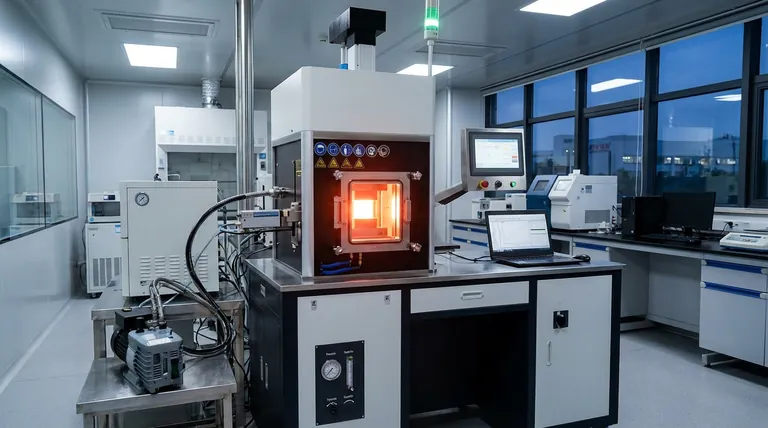
The Mechanism of Rapid Heating
Internal vs. External Heating
Traditional hot pressing furnaces rely on radiant heat from external elements. This heat must slowly penetrate the surface to the core, necessitating slow ramp-up times to ensure uniformity.
Direct Joule Heating
In contrast, SPS passes a pulsed electric current directly through the conductive graphite mold and the alloy powder itself. This creates internal Joule heating, allowing for immediate and rapid temperature increases.
Extreme Heating Rates
While traditional methods are slow, industrial SPS systems can achieve heating rates as high as 100°C/min. This allows the alloy to reach sintering temperatures (typically 800°C–1000°C) in a fraction of the time required by conventional furnaces.
Impact on Microstructure and Performance
Inhibiting Abnormal Grain Growth
The most critical challenge in sintering high-entropy alloys (like CoCrFeMnNi) is preventing the grains from growing too large, which reduces material strength. The extended "soaking" time in traditional hot pressing inevitably leads to grain coarsening.
Preserving Nanocrystalline Features
Because SPS dramatically reduces the holding time at high temperatures, it effectively "freezes" the microstructure in place. This suppresses the growth of nanocrystalline grains, preserving the ultra-fine grain structure achieved during the powder preparation stage.
Achieving Near-Theoretical Density
Despite the short processing time, SPS utilizes synchronized axial pressure (often up to 40 MPa) to assist diffusion. This combination of pressure and rapid heat allows the material to reach near-full density efficiently, eliminating the porosity that weakens finished parts.
Understanding the Trade-offs
Process Sensitivity
While the rapid heating of SPS is advantageous, it requires precise control. The window for error is smaller than in traditional hot pressing; improper calibration of the pulsed current can lead to localized overheating or density gradients if not managed correctly.
Geometrical Constraints
SPS is primarily a pressure-assisted technique using graphite dies. Consequently, it is generally limited to simple shapes (such as discs or cylinders) compared to other sintering methods that might allow for more complex net-shape forming without pressure.
Making the Right Choice for Your Goal
When selecting a consolidation method for high-entropy alloys, consider your specific material targets:
- If your primary focus is Maximum Strength: Choose SPS to maintain an ultra-fine, nanocrystalline grain structure, which directly correlates to superior mechanical properties.
- If your primary focus is Efficiency: Choose SPS to significantly reduce processing cycle times (often completing densification in minutes rather than hours).
- If your primary focus is Chemical Stability: Choose SPS to minimize the time available for undesirable chemical reactions between reinforcement phases and the metal matrix.
Ultimately, SPS is the superior choice when the preservation of a designed microstructure is as critical as achieving full density.
Summary Table:
| Feature | Spark Plasma Sintering (SPS) | Traditional Hot Pressing |
|---|---|---|
| Heating Mechanism | Internal Joule Heating (Pulsed DC) | External Radiant Heating |
| Heating Rate | Very High (Up to 100°C/min) | Slow (Gradual Conduction) |
| Holding Time | Minutes | Hours |
| Grain Structure | Preserves Ultra-fine/Nanocrystalline | Significant Grain Coarsening |
| Density | Near-theoretical (>99%) | High, but time-dependent |
| Thermal Exposure | Minimal (Reduces degradation) | High (Risk of grain growth) |
Revolutionize Your Material Consolidation with KINTEK
Unlock the full potential of high-entropy alloys and advanced ceramics with KINTEK’s cutting-edge sintering solutions. Backed by expert R&D and manufacturing, KINTEK offers customizable Muffle, Tube, Rotary, Vacuum, and CVD systems tailored to your unique laboratory or industrial needs. Whether you require precise grain growth control or rapid densification, our high-temperature furnaces provide the reliability and efficiency your research demands.
Ready to elevate your material performance? Contact us today to consult with our experts and find the perfect furnace for your application.
References
- Anna Kopeć-Surzyn, M. Madej. Influence of Tooling on the Properties of the Surface Layer in HEA Alloy Sinters Produced by the SPS Method. DOI: 10.3390/coatings14020186
This article is also based on technical information from Kintek Furnace Knowledge Base .
Related Products
- Spark Plasma Sintering SPS Furnace
- 9MPa Air Pressure Vacuum Heat Treat and Sintering Furnace
- Vacuum Heat Treat Sintering Furnace with Pressure for Vacuum Sintering
- 600T Vacuum Induction Hot Press Vacuum Heat Treat and Sintering Furnace
- Small Vacuum Heat Treat and Tungsten Wire Sintering Furnace
People Also Ask
- Why is it necessary to maintain a high vacuum environment during the SPS of SiC? Key to High-Density Ceramics
- How does the heating mechanism of Spark Plasma Sintering (SPS) function? Enhance TiC/SiC Composite Fabrication
- What are the technical advantages of using an SPS sintering furnace? Elevate Al2O3-TiC Material Performance
- What are the steps in the discharge plasma sintering process? Master Fast, High-Density Material Consolidation
- What are the advantages of spark plasma sintering (SPS) over traditional forging? Precision Microstructural Control



















